Does Insurance Cover Therapy in Idaho?
Integrity Mental Health Editorial ·

Paying for mental health care shouldn't require a decoder ring. Yet most people booking a first appointment have no idea what their plan actually pays, what they'll owe at the desk, or how Idaho insurance rules affect their benefits. This guide walks through coverage, costs, and the exact questions to ask before your first visit.
Quick Answer
Yes — most health plans in Idaho cover therapy and psychiatric care. Federal mental health parity law and the Affordable Care Act's essential health benefits require most plans to cover behavioral health on terms comparable to medical care. The catch is cost-sharing: coverage existing is not the same as care being free. You'll still owe a deductible, copay, or coinsurance, and your lowest cost almost always comes from seeing an in-network provider.
TL;DR
- Parity law is the foundation. Federal rules say behavioral health benefits can't be more restrictive than medical ones on most plans. See how the cost-sharing math works
- Covered services usually include intake, therapy sessions, medication management, and telehealth. Billing codes on your statement tell you what was charged. Read the service-by-service coverage breakdown
- Idaho plans vary by type. Marketplace, Medicaid, and self-funded employer plans follow different rulebooks. Understand which Idaho insurance rules apply to you
- Network status drives your bill more than anything else. Out-of-network often means paying the full fee upfront. Compare in-network, out-of-network, and self-pay
- One phone call settles most of it. Six specific questions to member services will tell you what you owe. Get the verification script
In This Article
- How Does Mental Health Insurance Actually Work?
- What Does Therapy Coverage Actually Include?
- What Idaho Insurance Rules Mean for Your Coverage
- In-Network vs Out-of-Network: What's the Real Cost Difference?
- How Do You Verify Your Mental Health Benefits Before the First Visit?
- What If Your Plan Doesn't Cover It — or You're Uninsured?
- Finding Covered Therapy and Psychiatry Care in Boise
- Frequently Asked Questions
How Does Mental Health Insurance Actually Work?
Mental health insurance works the same way your medical benefit does. You pay toward a deductible first, then a copay or coinsurance per visit, until you hit your out-of-pocket maximum. After that, the plan typically pays the rest for covered, in-network care that year.
Mental health parity refers to the federal requirement — established by the Mental Health Parity Act of 1996, broadened by the Mental Health Parity and Addiction Equity Act of 2008, and extended to more plans under the Affordable Care Act in 2014 — that behavioral health benefits cannot carry stricter limits than medical and surgical benefits on the same plan.
Four terms explain almost every bill you'll ever get:
- Deductible — the amount you pay yourself before the plan starts sharing costs.
- Copay — a flat per-visit amount, like a set fee for each therapy session.
- Coinsurance — a percentage of the negotiated rate rather than a flat fee.
- Out-of-pocket maximum — the annual ceiling on what you pay for covered in-network care.
Here's an illustrative example, not a quote for any real plan. Imagine a plan with a $2,000 deductible and a $40 behavioral health copay. If your deductible isn't met, early sessions may cost the full negotiated rate. Once it is met, you'd owe $40 per visit until you reach your out-of-pocket maximum.
Different service types bill differently, too. Therapy, psychiatric evaluation, and medication follow-ups are separate billable visits, which is why a clinic offering psychiatry services may quote you two different copays.
Key takeaway: Coverage tells you whether a visit is payable; your deductible, copay, and network status tell you how much you'll actually pay.
What Does Therapy Coverage Actually Include?
Most plans cover individual therapy, group therapy, psychiatric evaluation, medication management, and telehealth visits. Since parity rules took effect, hard annual session caps have become uncommon on compliant plans — though coverage still depends on documented medical necessity.
Your explanation of benefits (EOB) lists procedure codes. Recognizing them makes the statement readable:
| Service | Common billing code | Typically covered? | What affects your cost |
|---|---|---|---|
| Diagnostic intake / psychiatric evaluation | 90791, 90792 | Usually yes | May bill at a higher rate than follow-ups |
| Therapy session (about 45 minutes) | 90834 | Usually yes | Behavioral health copay or coinsurance |
| Therapy session (about 53+ minutes) | 90837 | Usually yes | Some plans review longer sessions more closely |
| Medication management follow-up | 99213 / 99214 | Usually yes | May apply a specialist copay |
| Med management with added therapy time | 99214 + 90833 | Usually yes | Two codes can appear on one claim |
| Telehealth version of the above | Same codes with a telehealth modifier | Often yes | Carrier rules on video vs audio-only differ |
If the two-code combination on a psychiatric visit looks confusing, it helps to know what happens at a medication management appointment and why both a medical and a therapy component can be billed together.
Common exclusions and gray areas to ask about:
- Couples or family counseling without a covered diagnosis — often treated as non-medical and excluded.
- Life coaching, wellness coaching, or non-clinical counseling — generally not a covered medical benefit.
- Neuropsychological or extended psychological testing — frequently requires prior authorization.
- Missed-appointment fees — never billable to insurance; these come straight to you.
Key takeaway: The service type and its billing code — not just the word "therapy" — determine how your plan processes the claim.
What Idaho Insurance Rules Mean for Your Coverage
Idaho follows federal parity and ACA requirements, and individual plans sold through Your Health Idaho, the state's health insurance marketplace, must include mental health and substance use disorder treatment. That makes behavioral health a standard inclusion rather than an add-on for most marketplace shoppers.
Essential health benefits are the categories of care that ACA-compliant individual and small-group plans must cover. Mental health and substance use disorder services, including behavioral health treatment, sit inside that list.
Which rulebook applies to you depends on your plan type:
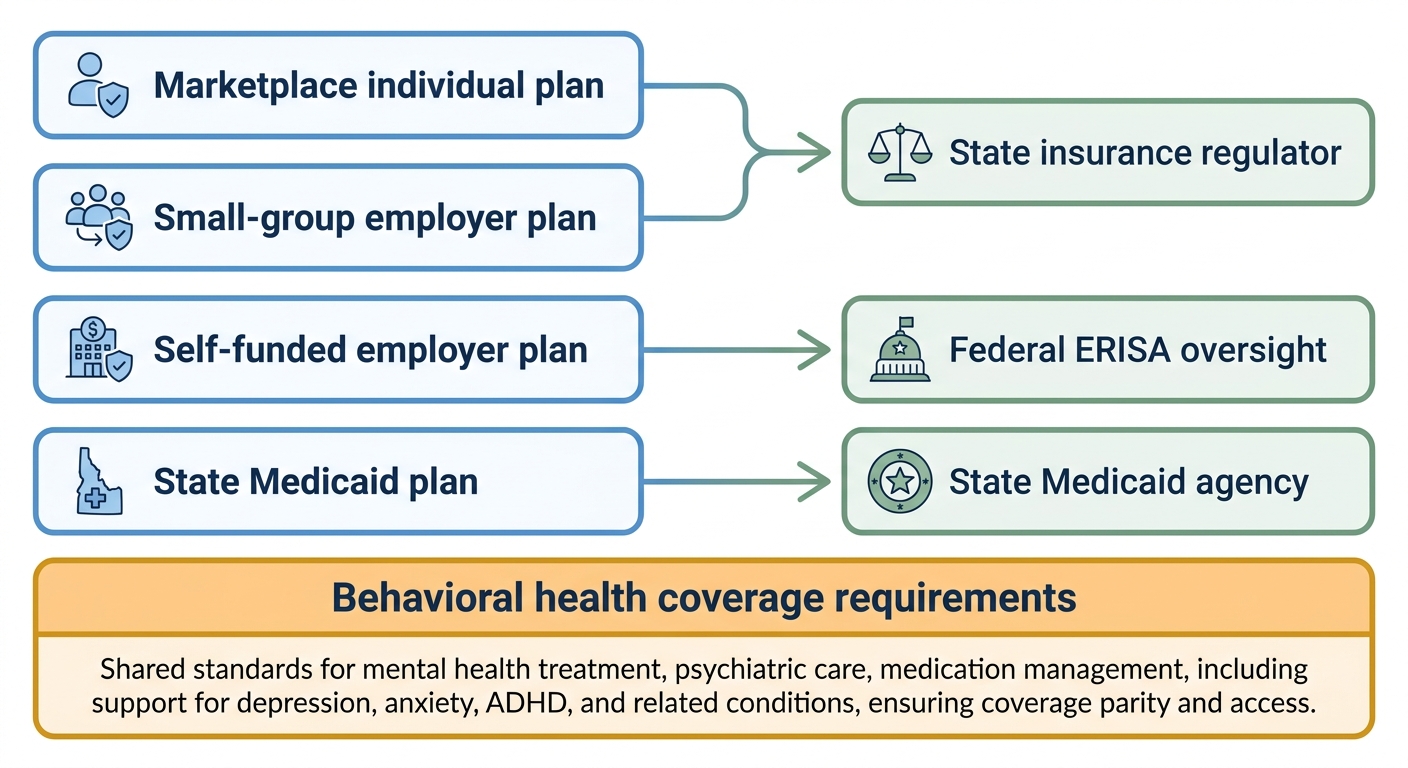
- Marketplace and state-regulated commercial plans — overseen by the Idaho Department of Insurance, with essential health benefit requirements applying.
- Self-funded employer plans — regulated federally under ERISA rather than by the state, so appeal paths and benefit details differ.
- Idaho Medicaid — covers outpatient behavioral health services, administered through the state's behavioral health plan arrangement.
- Short-term and limited-benefit plans — these are not required to match ACA benefit standards, and behavioral health coverage can be narrower or absent.
⚠️ Before buying any short-term or limited-duration policy, read the behavioral health section of the plan documents directly. A plan that covers "mental health" in marketing copy may still exclude ongoing outpatient therapy or medication management.
Idaho insurance plans also differ in how they handle telehealth. Many carriers and Idaho Medicaid reimburse virtual behavioral health visits, which matters in rural counties where in-person options are thin. Confirm whether your plan treats video and audio-only visits the same way.
One more Idaho insurance quirk worth knowing: a clinic can be in-network for one product from a carrier and out-of-network for another product from that same carrier. Always match the clinic against your exact plan name and ID, not just the insurance company logo. You can start by reviewing the insurance plans we accept in Idaho.
Key takeaway: "Covered in Idaho" depends on your plan category — marketplace, employer, Medicaid, or short-term — and each one answers to a different regulator.
In-Network vs Out-of-Network: What's the Real Cost Difference?
In-network care usually costs a fixed copay or coinsurance calculated against a rate your insurer already negotiated. Out-of-network care typically means paying the provider's full fee at the time of service, then seeking partial reimbursement against a separate — and often higher — out-of-network deductible.
| In-network | Out-of-network | Self-pay | |
|---|---|---|---|
| Deductible applied | Standard in-network deductible | Separate, often higher deductible | None |
| What you pay per visit | Copay or coinsurance on negotiated rate | Full fee upfront | Clinic's published rate |
| Reimbursement | Handled between clinic and insurer | You submit a superbill and wait | Not applicable |
| Paperwork burden | Low | High | Low |
| Provider choice | Limited to the network | Wide | Wide |
| Cost predictability | High | Low | High, if quoted in advance |
Three terms worth knowing before you choose:
- Superbill — an itemized receipt with diagnosis and billing codes that you submit to your insurer for possible out-of-network reimbursement.
- Single-case agreement — an arrangement where an insurer agrees to cover an out-of-network provider at in-network terms, sometimes granted when no in-network provider is reasonably available.
- Good-faith estimate — a written cost estimate that the No Surprises Act entitles uninsured and self-pay patients to receive before scheduled care.
If you're paying without insurance, or worried about an unexpected bill, review your rights against surprise medical bills before your appointment. Knowing the estimate rules in advance makes the conversation at the front desk far easier.
Key takeaway: Network status is usually the single biggest factor in what you pay out of pocket for therapy coverage.
How Do You Verify Your Mental Health Benefits Before the First Visit?
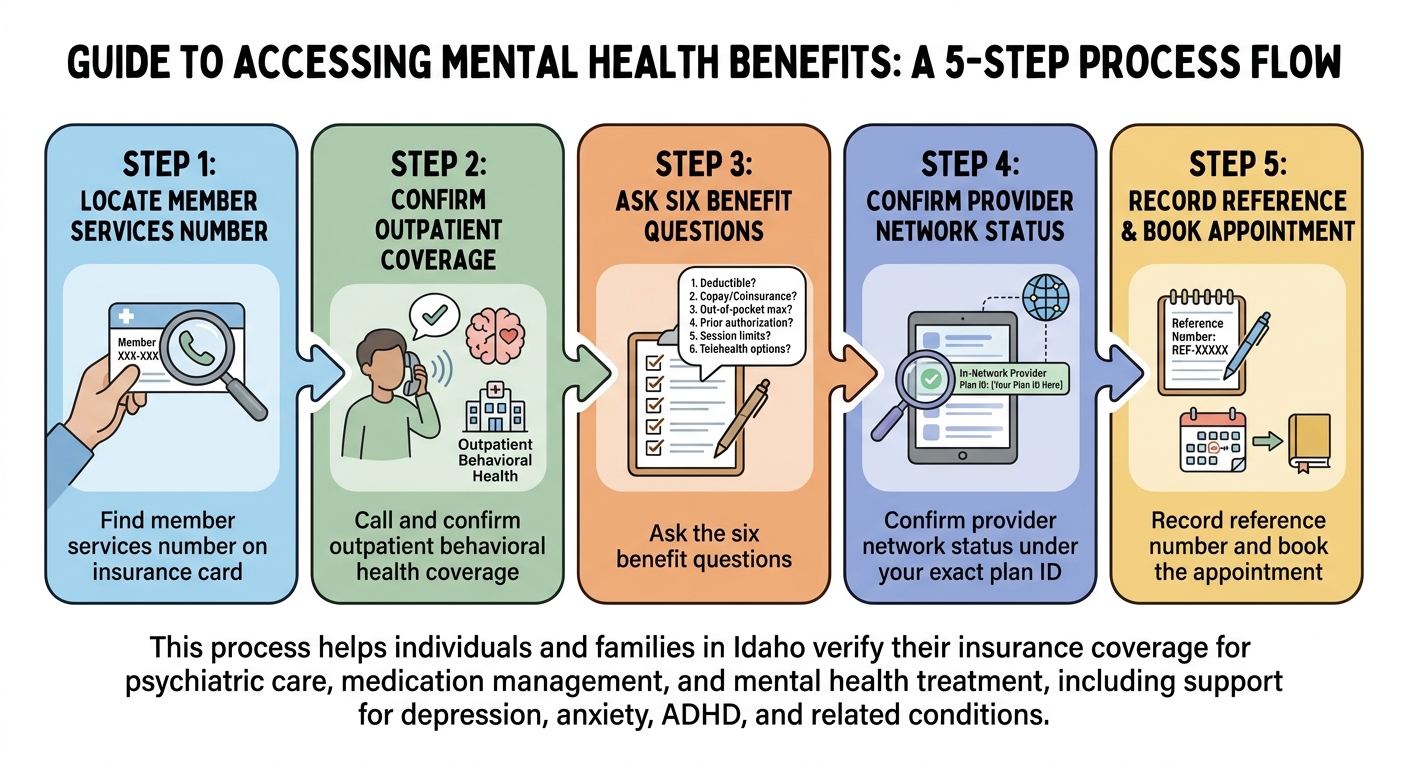
Call the member services number on the back of your insurance card and ask six specific questions. A single ten-minute call removes almost all of the guesswork, and it gives you something to point to if a claim is later processed differently than expected.
Ask exactly this:
- Is outpatient behavioral health covered under my plan?
- Has my deductible been met for this plan year, and how much remains?
- What is my cost for CPT 90834 (therapy) and 99214 (medication management)?
- Is prior authorization required for therapy, psychiatric evaluation, or testing?
- Is telehealth covered at the same rate as an in-person visit?
- Is [clinic or provider name] in-network under my specific plan ID?
Then ask for a reference number for the call and write down the representative's name and the date. Many carriers also show deductible status, copay amounts, and provider network lookups inside their member portal, which is useful for confirming what you were told.
Two cautions worth noting. Quoted benefits are an estimate, not a guarantee of payment — final amounts are set when the claim processes. And a provider directory listing is not the same as confirmation; directories go stale.
Clinics can often run a benefit check for you as part of intake. If you'd rather start there, our questions about insurance and payment page covers accepted plans and self-pay basics, and our team can verify benefits before your first appointment so you know your expected cost in advance.
What If Your Plan Doesn't Cover It — or You're Uninsured?
You still have real options. Self-pay with a written good-faith estimate, sliding-scale arrangements where a clinic offers them, pre-tax HSA or FSA dollars, out-of-network reimbursement through a superbill, Idaho Medicaid if you qualify, and marketplace enrollment through Your Health Idaho are all paths people use.

- HSA and FSA funds — therapy and psychiatric visits are generally treated as qualified medical expenses under IRS rules for medical care; confirm your specific situation with your plan administrator or tax advisor.
- Superbill reimbursement — even without a contracted provider, your plan may reimburse part of the fee once the out-of-network deductible is met.
- Idaho Medicaid — eligibility is based on income and household factors, and enrollment is open year-round rather than limited to a season.
- Your Health Idaho — the state marketplace runs an annual open enrollment period in the fall; a qualifying life event such as job loss, marriage, or a move can open a special enrollment window outside it. Check the marketplace for current dates before relying on them.
If you're between plans and need care now, ask about the clinic's self-pay rate up front and request the estimate in writing. You can also talk to our team about payment options and what a first visit would cost without insurance.
Finding Covered Therapy and Psychiatry Care in Boise
Start with your insurer's online provider directory, then confirm directly with the clinic before booking. Directories are frequently out of date, and as noted earlier, a clinic can be contracted for one product from a carrier while being out-of-network for another.
A short checklist for Treasure Valley residents:
- Search the directory by plan, not just carrier — select your exact plan name from the dropdown.
- Call the clinic and read your plan ID aloud — this is the only reliable confirmation.
- Decide which provider type you need first — benefits for counseling and for prescriber visits can be quoted separately. If you're unsure which to book, compare psychiatrist vs psychologist.
- Ask about wait times, then ask about telehealth — virtual visits sometimes open sooner than in-person slots across Boise, Meridian, Eagle, and Nampa.
- Confirm whether the first visit bills as an evaluation — intake codes can carry a different cost than follow-ups.
Access varies across the valley. If you're looking specifically for mental health care in Boise, checking both network status and current scheduling availability in the same call saves a second round of phone tag. Boise therapy and psychiatry demand can mean a wait, so it's worth asking whether a nearby location or a virtual appointment opens things up.
Frequently Asked Questions
Does insurance cover online therapy and telepsychiatry in Idaho?
In most cases, yes. Many commercial plans and Idaho Medicaid reimburse telehealth behavioral health visits, and some reimburse them at the same rate as in-person care. Rules can differ between video visits and audio-only phone visits, so confirm with your carrier which format is covered and whether the provider must be licensed in Idaho.
How many therapy sessions does insurance cover per year?
Most parity-compliant plans no longer impose a hard annual session cap. Coverage continues as long as visits are medically necessary and documented by your provider. Some plans still apply concurrent review after a certain number of visits, meaning the insurer checks in to confirm ongoing need. Ask whether your plan uses review thresholds.
Will my employer or insurer see what I talk about in therapy?
No. HIPAA protects your clinical records, and employers receive only aggregate claims information — never the content of your sessions. Your insurer does receive the diagnosis and billing codes required to process a claim, which is standard for any medical service. Session notes themselves are not routinely shared for payment purposes.
Is a psychiatric evaluation covered differently than therapy?
Usually yes. Evaluations billed under codes 90791 or 90792 are typically a one-time service charged at a higher rate than routine follow-ups, and some plans apply a specialist copay instead of a behavioral health copay. Knowing what happens during a psychiatric evaluation helps you anticipate both the visit and the bill.
What should I do if a mental health claim is denied?
Request the written denial reason first — it names the specific rule applied. Then file an internal appeal with your insurer before the deadline stated in your plan documents. If the internal appeal fails, state-regulated plans generally allow an external review request through the Idaho Department of Insurance. Self-funded employer plans follow a federal appeals path instead.
⚠️ Appeal deadlines are strict and vary by plan. Note the date on the denial letter and check your plan's filing window immediately rather than waiting.
Summary
Therapy coverage in Idaho is the norm, not the exception — parity law and essential health benefit rules put behavioral health on comparable footing with medical care for most plans. What varies is the cost you carry: your deductible status, your copay or coinsurance, whether prior authorization applies, and above all whether your provider is in-network under your exact plan.
The practical move is simple. Confirm your Idaho insurance benefits by phone with the six questions above, get a reference number, and verify network status with the clinic directly rather than trusting a directory listing. If you're uninsured or out-of-network, ask for a written good-faith estimate before scheduling.
Information about third-party platforms reflects publicly available details at the time of writing and may have changed. Please verify directly with the provider. See our Terms of Use for more.