What Happens During a Psychiatric Evaluation
Integrity Mental Health Editorial ·
If you have searched "psychiatrist near me accepting new patients" and then hesitated before booking, the unknown is usually what stops you. Knowing exactly what happens during a psychiatric evaluation — the questions, the paperwork, the timing, and what you walk away with — removes most of that hesitation. Here is a plain-language walkthrough of the whole visit, start to finish.
Quick Answer
A psychiatric evaluation is a structured clinical conversation in which a psychiatrist or psychiatric nurse practitioner reviews your symptoms, medical and family history, current medications, and daily functioning. A first adult evaluation commonly runs somewhere between 45 and 90 minutes, depending on the practice and the complexity of your history. Many providers also use validated questionnaires such as the PHQ-9 or GAD-7. Most visits end with a working diagnosis, a treatment plan, and a scheduled follow-up.
TL;DR
- A first psychiatry visit is mostly talking — six predictable stages, from check-in paperwork to the treatment plan. See the full step-by-step timeline
- Expect questions grouped into roughly seven areas, including sleep, substance use, family history, and safety. Safety questions are asked of everyone. Review the question categories before you go
- Short questionnaires like the PHQ-9, GAD-7, PCL-5, MDQ, and ASRS help measure severity — they flag patterns, they do not diagnose on their own. Compare the common screening tools
- A first-visit diagnosis is often labeled "provisional" or "rule out," and it can change as your provider learns more. Understand how diagnoses get confirmed
- Bringing five specific items — meds, timeline, records, insurance card, questions — makes the appointment move faster. Get the preparation checklist
In This Article
- What Is a Psychiatric Evaluation?
- What Happens Step by Step During the Appointment?
- What Questions Will the Psychiatrist Ask?
- Which Assessment Tools and Screenings Are Used?
- How Long Does a Psychiatric Evaluation Take?
- Do You Get a Diagnosis at the First Visit?
- What Happens After the Evaluation?
- How Should You Prepare for Your First Appointment?
- What Are the Signs It's Time to Schedule One?
What Is a Psychiatric Evaluation?
A psychiatric evaluation is a medical assessment performed by a psychiatrist or psychiatric nurse practitioner to understand your symptoms, consider medical explanations for them, and build a treatment plan. It is the standard starting point for psychiatry services, and it is different from both therapy and a quick mental health check at your family doctor's office.
The difference matters because it determines what you can walk out with.
A therapy intake focuses on goals, history, and fit with a counselor. A primary care screening is usually a few questions added onto a visit about something else. A psychiatric evaluation is built around diagnosis and medical decision-making — including whether medication is appropriate, and whether lab work is needed first.
| Psychiatric evaluation | Therapy intake | Primary care screening | |
|---|---|---|---|
| Who performs it | Psychiatrist or psychiatric nurse practitioner | Therapist, counselor, or clinical social worker | Family physician, PA, or NP |
| Typical length | Often 45–90 minutes | Often 50–60 minutes | A few minutes within a larger visit |
| Can prescribe | Yes | No | Yes, within scope |
| Main output | Diagnosis plus a medical treatment plan | Therapy goals and treatment approach | Referral or an initial prescription |
Psychiatric providers in the United States generally work from the diagnostic criteria in the DSM-5-TR, published by the American Psychiatric Association, and from the association's practice guidance on evaluating adults. That shared framework is why evaluations across different clinics tend to cover the same ground in a similar order.
Key takeaway: A psychiatric evaluation is a medical visit aimed at diagnosis and treatment planning — broader than a primary care screening and more clinically focused than a therapy intake.
What Happens Step by Step During the Appointment?
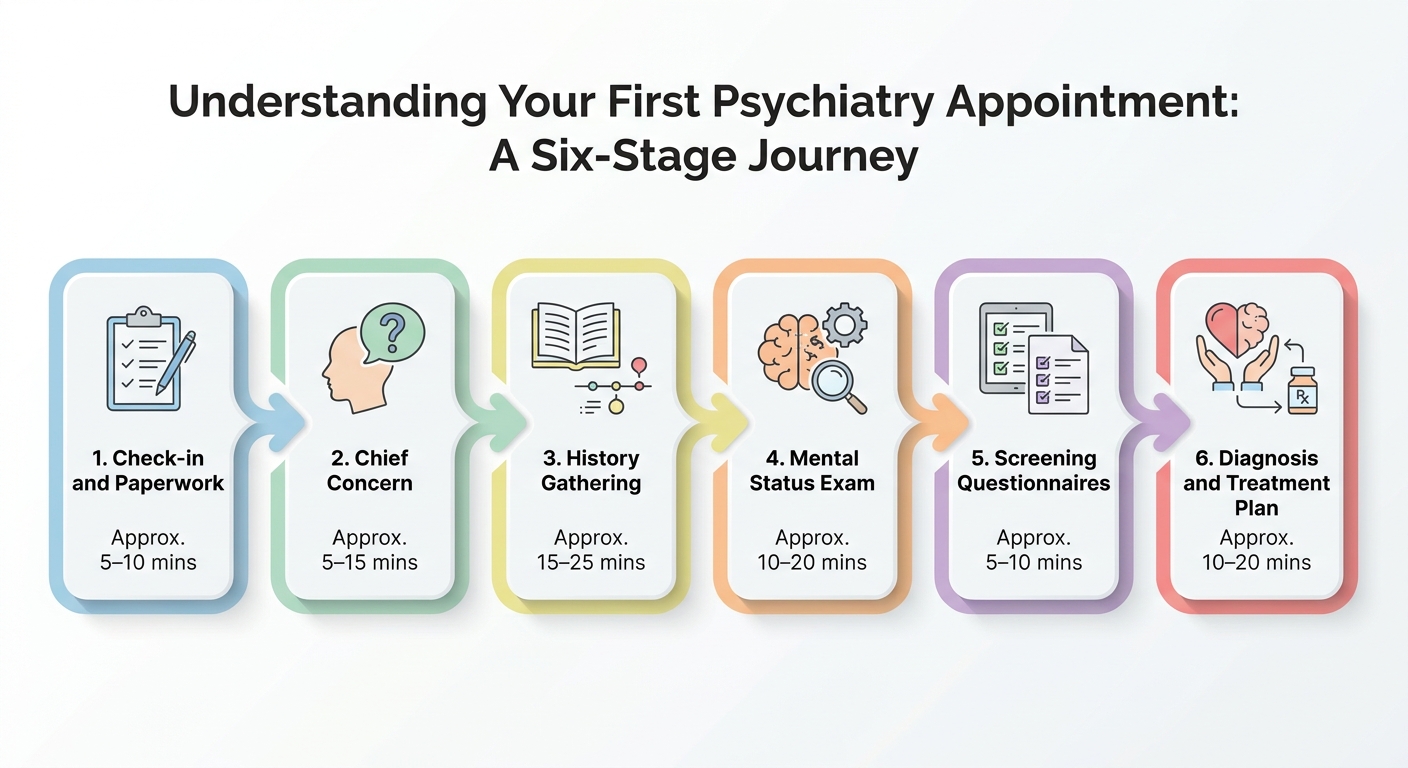
The visit moves through six predictable stages: check-in and paperwork, your chief concern, history gathering, a mental status exam, screening questionnaires, and finally the diagnosis and plan. Nothing is a test. Nothing is a surprise.
Stage 1 — Check-in and paperwork. Expect roughly 10 to 15 minutes if you have not completed forms in advance. This covers consent, privacy notices, insurance, and a health questionnaire. Most practices let you finish intake paperwork online beforehand, which frees that time for the conversation.
Stage 2 — Your chief concern. The provider asks an open question: what brought you in today? Answer in your own words. There is no clinical vocabulary you are supposed to use.
Stage 3 — History gathering. This is the longest stretch, frequently 20 to 30 minutes. It covers symptom history, past treatment, medical conditions, current medications and supplements, family psychiatric history, substance use, and how you are functioning at work, at school, and at home.
Stage 4 — The mental status exam. The mental status exam (MSE) is a structured observation of how you present during the visit, much like a physical exam is for the body. Your provider is noting:
- Appearance and behavior — grooming, eye contact, restlessness or slowing
- Mood — how you describe your emotional state in your own words
- Affect — the emotional expression the provider observes
- Thought process — whether your thinking is organized, tangential, or racing
- Thought content — worries, obsessions, unusual beliefs, intrusive thoughts
- Cognition — attention, memory, and orientation
- Insight and judgment — how you understand what is happening and how you are making decisions
Most of this happens through normal conversation. You may be asked to recall a few words or do simple arithmetic, but there is no pass or fail.
Stage 5 — Screening questionnaires. Short validated forms get scored and added to the picture. Some practices send these before the visit.
Stage 6 — Diagnosis and plan. In the last 10 to 15 minutes, your provider explains what they think is going on, answers your questions, and outlines next steps. Ask them to repeat anything that went by too fast — this is the part worth writing down.
Key takeaway: Your first psychiatry visit follows six stages — paperwork, chief concern, history, mental status exam, screeners, and plan — with history gathering taking the largest share of the time.
What Questions Will the Psychiatrist Ask?
Expect questions that fall into roughly seven buckets. None of them are trick questions, and you are allowed to say "I don't know."

The seven question categories:
- Symptom timeline — "When did you first notice this?" "Has it been constant or does it come and go?" "What makes it better or worse?"
- Sleep, appetite, and energy — how many hours you sleep, whether you wake early, whether your appetite or weight has shifted. These overlap heavily with depression symptoms, which is why they come up early.
- Substance use — alcohol, cannabis, nicotine, caffeine, prescription stimulants, and anything else. Be literal about amounts. This directly affects prescribing safety.
- Family psychiatric history — whether relatives have been treated for depression, bipolar disorder, anxiety, psychosis, or substance use, and whether any medication worked well for them.
- Medical history and current medications — thyroid conditions, head injuries, chronic pain, pregnancy status, plus every prescription, over-the-counter product, and supplement with doses.
- Trauma history — whether you have experienced events that still affect you. You control how much detail you share, and you can say you would rather not go into it today.
- Safety — direct questions about thoughts of self-harm or suicide.
Why ask about suicide if I never said anything about it?
Safety questions are asked of every patient at every psychiatric evaluation, regardless of what brought you in. It is routine screening, not an accusation, and answering honestly does not automatically trigger hospitalization. Your provider is assessing risk level so the plan matches your actual situation.
What if I can't remember dates or details?
Approximate is fine. "Sometime last spring" or "after I changed jobs" gives your provider the sequence they need. If you are unsure about past medications, a pharmacy printout covers it — most pharmacies can produce a full fill history in a few minutes.
⚠️ Underreporting is the biggest avoidable risk. Leaving out alcohol use, cannabis, a supplement, or a past reaction to a medication can change which treatments are safe for you. Providers are not there to judge the answer; they are there to prescribe around it.
Which Assessment Tools and Screenings Are Used?
Most psychiatric evaluations pair the interview with one or more validated questionnaires. A screening tool is a standardized set of questions with a scoring system, designed to measure symptom severity consistently over time. It supports the diagnosis — it does not make it.
| Tool | What it screens for | Items | Score range |
|---|---|---|---|
| PHQ-9 | Depression symptoms | 9 | 0–27 |
| GAD-7 | Generalized anxiety symptoms | 7 | 0–21 |
| PCL-5 | PTSD symptoms | 20 | 0–80 |
| MDQ | Possible bipolar spectrum symptoms | 13 core items plus follow-ups | Yes/no pattern |
| ASRS v1.1 | Adult ADHD symptoms | 18 (6-item Part A screener) | Threshold-based |
The PHQ-9 and GAD-7 are the two you are most likely to see, partly because they are short and partly because they can be repeated at every follow-up to track change. You can complete free PHQ-9 and GAD-7 self-assessments before your appointment and bring the results with you.
Does a high score mean I have that condition?
No. A score indicates how severe your reported symptoms are right now, in one domain, on one day. A high PHQ-9 can reflect depression, but it can also reflect grief, a thyroid problem, chronic pain, poor sleep, or a medication side effect. Your provider interprets the number alongside your history and the mental status exam.
What about lab work?
Some physical conditions produce symptoms that look like psychiatric ones, so providers often order basic labs when the history suggests it. Common examples include:
- TSH — thyroid function, which can affect mood, energy, and anxiety
- CBC — a general blood panel that can reveal anemia and other issues
- Vitamin B12 and vitamin D — deficiencies associated with fatigue and cognitive complaints
- Metabolic panel — baseline values before starting certain medications
Some practices also offer pharmacogenetic testing, which analyzes how your genes may affect the way your body processes certain medications. It is one input a prescriber can consider, not a guarantee of how any individual will respond to a given drug.
Key takeaway: Questionnaires measure severity and labs rule out medical lookalikes — but the diagnosis comes from your provider weighing everything together.
How Long Does a Psychiatric Evaluation Take?
A first adult psychiatric evaluation commonly runs 45 to 90 minutes, with the exact length depending on how complex your history is and how the practice schedules. Follow-up medication management visits are typically much shorter — often in the 15 to 30 minute range.
Child and adolescent evaluations frequently run longer. That is because the provider usually gathers collateral information: parent interviews, school reports, teacher rating scales, and sometimes records from a pediatrician. Expect more than one appointment for a thorough picture.
Telehealth evaluations generally take about the same amount of time as in-person ones. The interview and the screening tools are identical; the main differences are logistical, such as arranging lab work locally or handling anything that requires in-person vitals.
If you are tight on time, say so at the start. Your provider can prioritize the most urgent concern and schedule a second visit rather than rushing the history.
Do You Get a Diagnosis at the First Visit?
Often, yes — but it is usually a working diagnosis, meaning the provider's best current explanation based on the information available today. It can be revised as more becomes known.
Two phrases commonly appear in charts, and both are normal:
- Provisional — the criteria appear to be met, but the provider wants more information or more time before committing.
- Rule out — a condition is being actively considered and still needs to be excluded or confirmed.
Psychiatric diagnoses in the U.S. are made using the criteria in the DSM-5-TR, published by the American Psychiatric Association. Those criteria often require a specific duration of symptoms, which is one reason a single visit cannot always settle the question.
Why do some diagnoses take more than one visit?
Certain conditions depend on patterns that only show up over time or across sources of information:
- Bipolar disorder requires identifying past manic or hypomanic episodes, which people often do not recognize as symptoms in the moment. A thorough bipolar disorder evaluation may involve family input and a detailed mood timeline.
- ADHD requires evidence of symptoms beginning in childhood and showing up in more than one setting, which can mean school records or input from a partner or parent.
- PTSD requires linking symptoms to a specific traumatic event, and some people need a few visits before discussing it.
- Substance-related presentations can require a period of observation to separate the substance's effects from an underlying condition.
⚠️ Do not treat a first-visit label as permanent. Diagnoses are revised regularly as new information emerges, and a change in your diagnosis is a sign the process is working — not a sign anyone got it wrong. Ask your provider what would cause them to reconsider.
What Happens After the Evaluation?
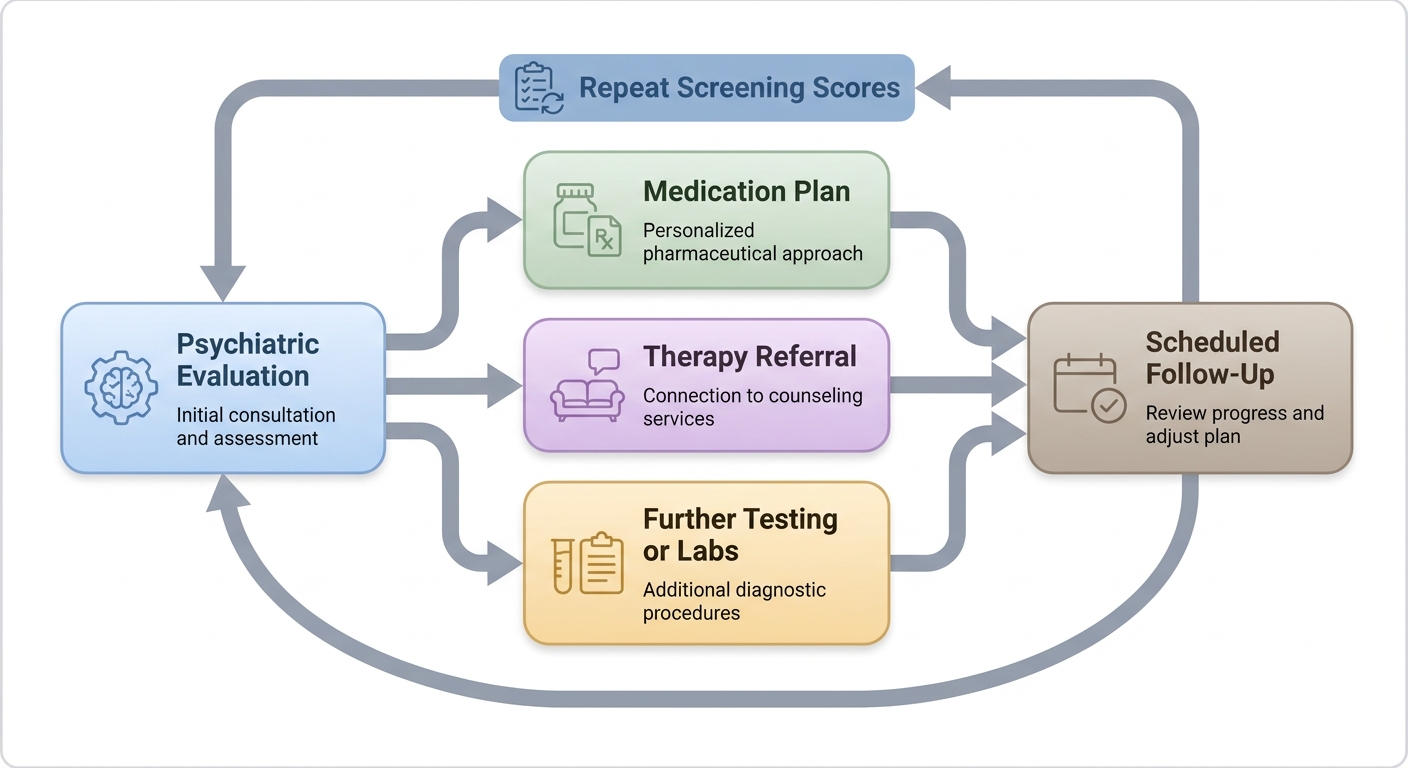
You leave with a treatment plan. In most cases, that plan is a combination of several elements rather than one single intervention.
Typical components include:
- Medication — if prescribed, with a discussion of what it is for, how it is taken, and what side effects to watch for
- Therapy referral — many plans pair medical treatment with counseling
- Lab work — orders to complete before or shortly after starting treatment
- Lifestyle targets — sleep schedule, alcohol reduction, movement, structure to the day
- A scheduled follow-up — commonly within 2 to 4 weeks when a new medication is started, so response and side effects can be reviewed
What is measurement-based care?
Measurement-based care is the practice of repeating the same screening tools at follow-up visits so changes can be tracked with numbers instead of memory. If your PHQ-9 was a certain score at intake, repeating it at week four gives you and your provider a concrete comparison point.
It makes adjustments more deliberate. Instead of "I think I feel a little better," you have a trend line, which helps when deciding whether to continue, adjust, or change course. Individual responses vary, and only your provider can interpret what a change in score means for you.
Coordinating all of this — prescriptions, lab orders, therapy referrals, and the follow-up calendar — is exactly the burden most patients do not want to carry alone. That coordination is what an integrative patient care model is designed to handle, so you are not the one chasing results between appointments.
Key takeaway: The evaluation ends with a plan, not a prescription pad — and the follow-up schedule is as important as whatever is prescribed.
How Should You Prepare for Your First Appointment?
Bring five things. Everything else is optional.

Your preparation checklist:
- A current medication and supplement list with doses — include over-the-counter products, vitamins, and anything herbal. A phone photo of each bottle works.
- A short symptom timeline — three to five lines covering when symptoms started, what has changed, and what you have already tried.
- Past provider and hospitalization records — names, dates, and which medications you have taken before, including any that did not agree with you.
- Your insurance card and photo ID — check your plan against the practice's accepted insurance plans before the visit so billing questions do not eat into your appointment time.
- Your own list of questions — write them down. People reliably forget them once the conversation starts.
Two optional steps that can save real time: complete your intake forms online in advance, and finish a self-assessment beforehand. Together these can free up 10 to 15 minutes that would otherwise go to clipboard work.
What if I'm nervous about talking to a stranger?
Say that first. "I'm nervous and I'm not sure where to start" is a perfectly good opening line, and providers hear it constantly. You can also bring a partner, parent, or friend into part of the visit if having someone there helps — just mention it when scheduling so the practice knows to expect two people.
Key takeaway: Arriving with your medications, a timeline, and written questions shifts the visit from reconstructing basics to actually planning treatment.
What Are the Signs It's Time to Schedule One?
Consider a psychiatric evaluation when symptoms have lasted more than two weeks, when they are interfering with work, school, sleep, or relationships, or when therapy alone has not moved things as much as you hoped.
Concrete signals that commonly prompt an evaluation:
- Persistent low mood or loss of interest in things you used to enjoy
- Panic episodes or constant worry you cannot turn off — see the full picture of anxiety symptoms if that is the pattern
- Sleep disruption that has become the norm rather than the exception
- Concentration problems affecting your performance at work or school
- Intrusive or racing thoughts that feel outside your control
- Increasing alcohol or substance use as a way to manage mood or sleep
- Mood swings that family members notice before you do
- A medication that is not working the way it used to
You do not need a crisis to justify an appointment. Evaluations exist to answer questions, and "I'm not sure this is a big enough problem" is itself a reason to get an informed opinion.
How do you find a psychiatrist near me accepting new patients?
Start by confirming three things before you book:
- Availability — ask directly whether the practice is taking new patients and what the wait is for a first evaluation.
- Insurance and cost — verify network status and your behavioral health copay, or ask for a self-pay estimate.
- Scope — check that the practice sees your age group and treats your concern, and whether telehealth is an option.
A practice listing clear locations, provider bios, and current availability is generally easier to get into than one you have to chase by phone.
⚠️ If you are in immediate danger or thinking about ending your life, do not wait for an appointment. Call or text 988 to reach the Suicide & Crisis Lifeline in the U.S., or call 911. An evaluation is for planning; a crisis line is for right now.
Summary
A psychiatric evaluation is a structured, mostly conversational visit that moves from paperwork through history, a mental status exam, and screening questionnaires to a working diagnosis and a treatment plan. It typically takes 45 to 90 minutes for a first adult appointment. Nothing in it is a test you can fail, and the single most useful thing you can do is answer honestly — especially about sleep, alcohol, and medications. If you have been putting off searching for a psychiatrist near me accepting new patients because you did not know what the visit involved, you now know the full sequence.
Frequently Asked Questions
Is a psychiatric evaluation covered by insurance?
Most commercial plans, Medicaid, and Medicare include psychiatric evaluation under behavioral health benefits, commonly billed with codes such as 90791 or 90792. Coverage and copays vary by plan, so verify before your appointment. If you are paying out of pocket, you are entitled to a written estimate in advance under the good faith estimate protections of the No Surprises Act.
Can a psychiatric evaluation be done online?
Yes. Telehealth psychiatric evaluations use the same interview structure and the same screening tools as in-person visits, and many Idaho practices offer them as a standard option. Exceptions come up when vitals or an in-person exam are needed, when lab work has to be arranged locally, or when specific rules apply to prescribing controlled substances. Ask the practice how they handle those situations.
What should you not say to a psychiatrist?
There is nothing you should not say. The real risk runs the other direction: minimizing symptoms, or leaving out alcohol, cannabis, or supplement use, changes what your provider believes is safe to prescribe. Your information is protected under HIPAA, with narrow legal exceptions such as imminent danger to yourself or someone else. If you are unsure about confidentiality, ask about the limits at the start of the visit.
Do psychiatrists always prescribe medication?
No. Plenty of evaluations end with a therapy referral, lab work, sleep interventions, or a decision to monitor symptoms before starting anything. Medication is one tool among several, and whether it fits depends on your diagnosis, your history, and your preferences. You can tell your provider directly that you would like to explore non-medication options first.
How is a psychiatric evaluation different from a psychological evaluation?
A psychiatric evaluation is a medical assessment that can lead to prescriptions and lab orders, performed by a psychiatrist or psychiatric nurse practitioner. A psychological evaluation is testing-heavy and performed by a psychologist, using standardized instruments such as the MMPI-3 for personality assessment or the WAIS-IV for cognitive ability. The two are often complementary rather than competing.
Information about third-party platforms reflects publicly available details at the time of writing and may have changed. Please verify directly with the provider. See our Terms of Use for more.