What Happens at a Medication Management Appointment
Integrity Mental Health Editorial ·

Managing psychiatric medication well takes more than a prescription — it takes regular check-ins. A med management appointment is where that happens: a short, focused visit to review how your medication is working, catch side effects early, and adjust the plan. Here's exactly what to expect, what to bring, how often these visits happen, and what they typically cost.
Quick Answer
A medication management appointment is a focused follow-up visit — often 15 to 30 minutes — where a psychiatric provider reviews how your current medications are working, screens for side effects, orders or reviews labs, adjusts doses, and sends refills. Medication management is the ongoing process of prescribing, monitoring, and adjusting psychiatric medication over time. Many providers use brief rating scales like the PHQ-9 (depression) and GAD-7 (anxiety) to track changes between visits.
TL;DR
- These visits are short and structured, not open-ended therapy sessions — most follow the same five-part sequence. See the visit timeline
- A first evaluation runs much longer than a follow-up, because it covers diagnosis and history from scratch. Compare intake vs. follow-up
- Preparation makes the visit far more useful — bring a current med list, your pharmacy, and dated notes on side effects. Use the pre-visit checklist
- Visit frequency tightens after any change and spaces out once you're stable. Review typical monitoring intervals
- Most follow-ups work well over video, with some exceptions for lab-dependent or controlled medications. Check the telehealth rules
In This Article
- What Is a Med Management Appointment?
- What Happens Step by Step During the Visit?
- How Is It Different From a Psychiatric Intake?
- What Should You Bring and Prepare?
- How Often Do You Need a Medication Review?
- What Does Medication Management Cost?
- Can Medication Management Be Done Online?
- Which Medication Tracking Apps Actually Help Between Visits?
- What Are the Most Common Mistakes People Make?
What Is a Med Management Appointment?
A medication appointment is a scheduled check-in dedicated entirely to your prescriptions — how they're working, what they're doing to your body, and whether anything should change.
Med management is the shorthand clinics, schedulers, and billing staff use for this type of visit. A medication review is the part of the visit where your provider goes line by line through everything you take, including supplements and over-the-counter products, and checks for interactions or duplications.
Who provides it? In Idaho and Utah, prescribing is typically handled by psychiatrists (medical doctors), psychiatric mental health nurse practitioners (PMHNPs), and physician assistants working in psychiatry. You can see the full range of psychiatry services these providers offer, from diagnosis through ongoing prescribing.
On the billing side, established-patient follow-ups in outpatient psychiatry are commonly billed under evaluation and management codes such as 99213 or 99214. The code depends on the complexity of the visit and the time spent, so you may see one of these on your statement.
⚠️ Med management is not therapy. A medication visit focuses on symptoms, dosing, and side effects. Talk therapy explores patterns, coping skills, and history over longer sessions. Many people work with both a prescriber and a therapist, and the two roles are designed to complement each other rather than replace one another.
What Happens Step by Step During the Visit?
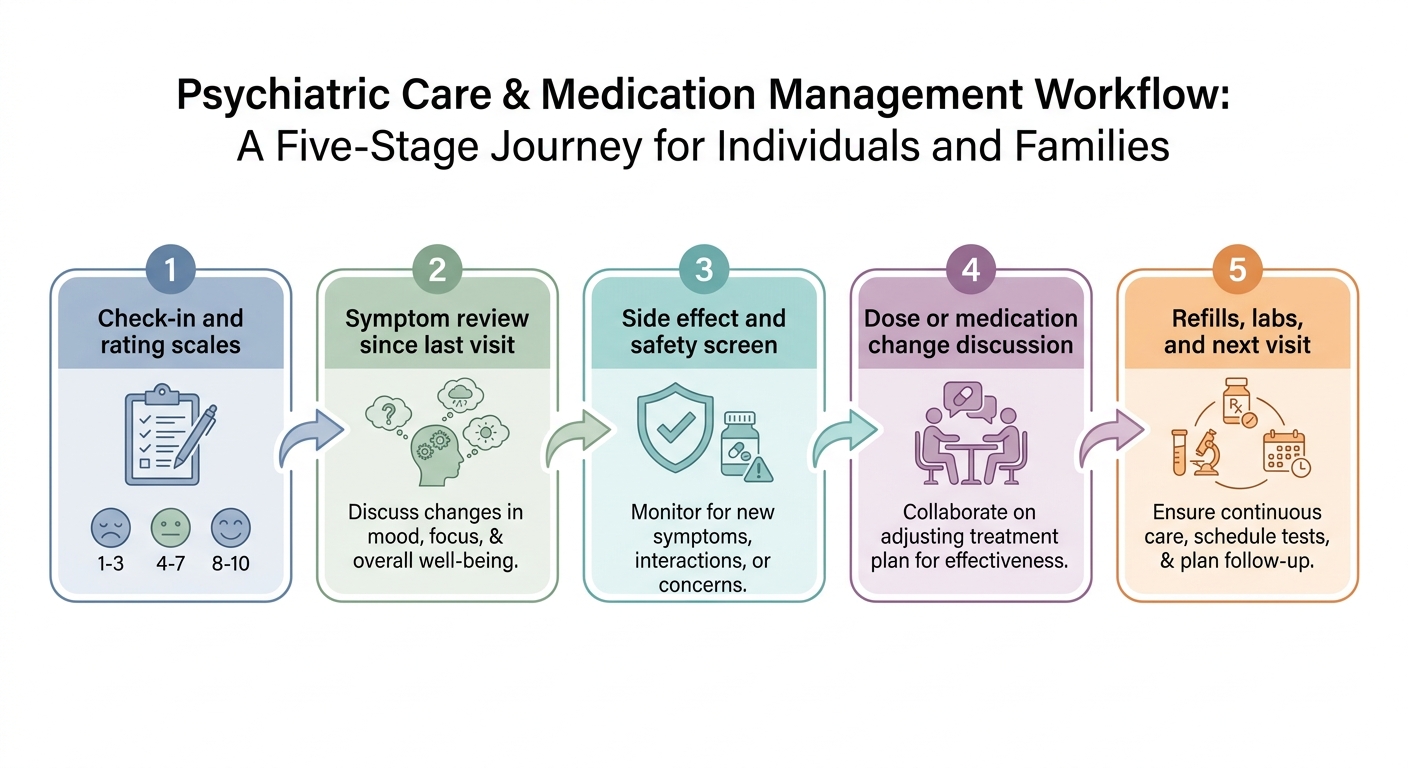
Most medication management appointments follow the same five-part sequence. Knowing the order helps you prepare and makes sure nothing you care about gets left out.
1. Check-in and rating scales. Before you're seen, you'll often complete a short questionnaire — commonly the PHQ-9 for depressive symptoms or the GAD-7 for anxiety. These are scored numbers that make change visible over time. You can preview the same instruments through our free online self-assessments so the questions aren't a surprise.
2. Symptom review since the last visit. Your provider asks what's better, what's worse, and what hasn't moved. Specific answers matter more than general ones. "I fell asleep by 11 most nights instead of 2 a.m." is far more useful than "a little better."
3. Side effect and safety screen. Expect questions about sleep, appetite and weight, energy, sexual side effects, nausea, headaches, irritability, and mood swings. Your provider will also ask about thoughts of self-harm — this is a routine safety question asked of everyone, not a judgment about you.
4. The adjustment discussion. Based on what you've reported, the conversation turns to options: hold the current dose, increase or decrease it, switch to a different medication, add something, or begin a taper. Your provider should explain the reasoning and the trade-offs of each path.
5. Refills, labs, and scheduling. The visit closes with practical items — prescriptions sent to your pharmacy, any lab orders placed, and your next appointment booked at an interval that matches what just changed.
Key takeaway: Nothing is decided without your input. Dose changes, switches, and tapers are discussed with you, not handed to you — and you can ask for the reasoning behind any recommendation.
How Is It Different From a Psychiatric Intake?
An intake is the long diagnostic first visit. A medication management follow-up is the shorter recurring check-in that comes after it. Both matter, but they do very different jobs.
| Intake evaluation | Medication management follow-up | |
|---|---|---|
| Typical duration | Often 60–90 minutes | Often 15–30 minutes |
| Main goal | Reach a working diagnosis and build a treatment plan | Monitor response, adjust dosing, maintain the plan |
| What's discussed | Full history, symptoms, family history, past medications, substance use, medical background | Changes since last visit, side effects, labs, refills |
| Paperwork | Extensive intake forms and consents | Brief rating scales and updates |
| Typical frequency | Once, at the start of care | Recurring, from monthly to every few months |
| Who attends | Patient, sometimes a family member or guardian | Usually the patient alone; a parent for minors |
The intake builds the map. The follow-up checks whether you're still on the right road. If you haven't had your first visit yet, our detailed walkthrough of what happens during a psychiatric evaluation covers that longer appointment in depth, so this guide stays focused on the follow-ups that come afterward.
One practical difference: at an intake, your provider is gathering information. At a follow-up, they're comparing. That's why dated notes about how you've felt are worth more than memory alone.
What Should You Bring and Prepare?
Bring a current medication list, your pharmacy name and location, your insurance card, and notes on how you've actually felt since the last visit. Ten minutes of prep can change what a 20-minute appointment accomplishes.
Pre-visit checklist:
- Every medication you take — name, dose, and how often, including prescriptions from other providers
- Supplements and over-the-counter products — including herbal products, since some interact with psychiatric medications (St. John's Wort and SSRIs is a well-known example to raise with your provider)
- Your pharmacy — full name and location, so refills go to the right place
- Side effect notes with dates — when it started, how long it lasted, how bad it was
- Sleep and appetite patterns — rough averages are fine
- Alcohol, cannabis, and nicotine use — honest numbers, not estimates you'd be comfortable repeating
- Recent labs or records from other clinicians
- Written questions — the three you'd be frustrated to leave without asking
- Insurance card and ID
- Pill count or refill status if you're running low

Paperwork shouldn't eat into your appointment time. Our patient forms can be completed online before you arrive, and the self-assessments can be done at home — so the visit itself goes to the conversation rather than the clipboard.
How Often Do You Need a Medication Review?
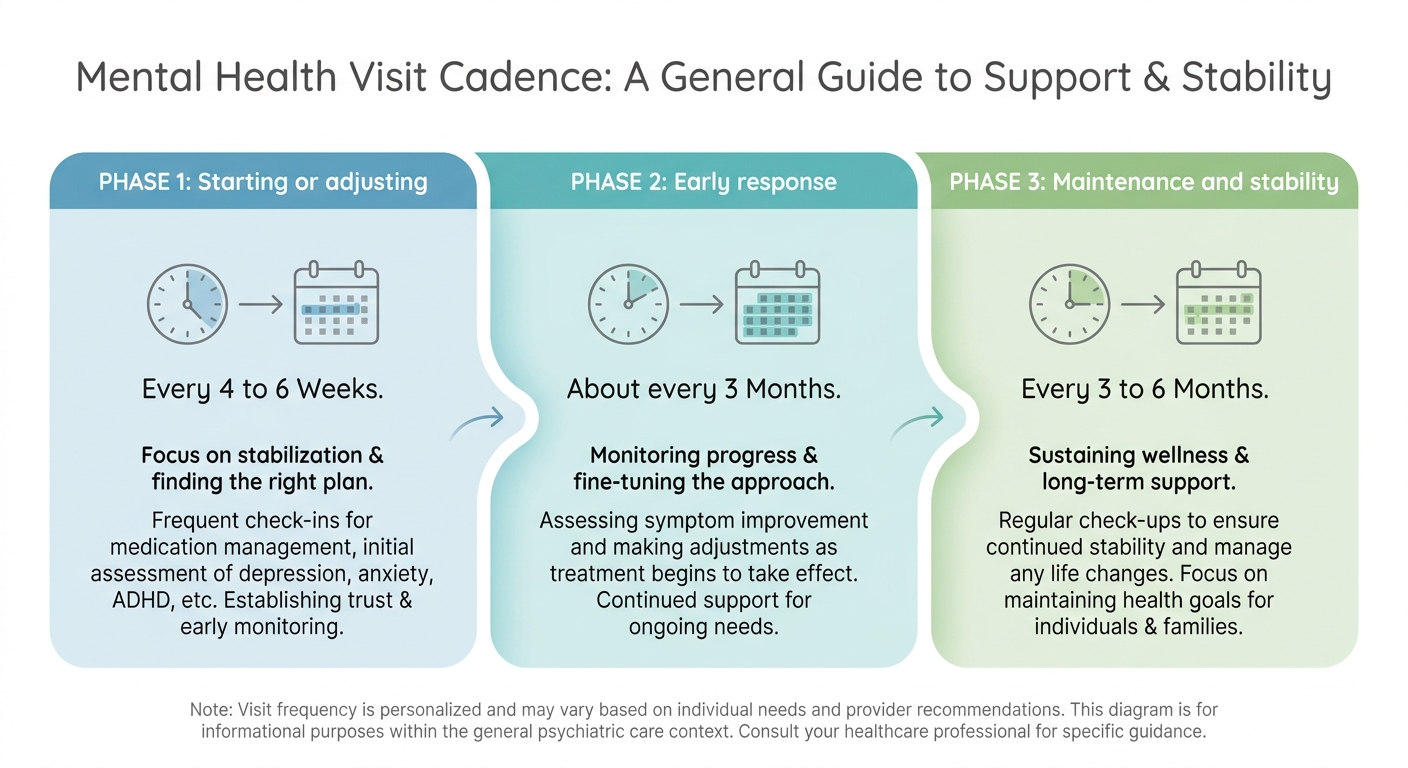
Visit frequency tracks how recently something changed. A common pattern in outpatient psychiatry looks like this:
- Starting or changing a medication: every 4–6 weeks
- Settling in, responding well: roughly every 3 months
- Stable on a long-term regimen: often every 3–6 months
There's a clinical reason for the tighter early schedule. Antidepressant labeling generally describes several weeks before full effect can be judged, so a check-in at the four-to-six week mark lands when there's actually something to evaluate. Too soon, and you're measuring noise.
Some medications call for closer monitoring. Controlled substances — including stimulants prescribed for ADHD — are governed by DEA and state prescribing rules that can limit refill quantities and require more frequent contact. Medications that need bloodwork follow the lab schedule rather than the calendar. Your provider will tell you which category you're in and why. You can review the conditions covered under our psychiatry services, including ADHD, depression, anxiety, and bipolar disorder.
If something changes between visits — a new side effect, a new medication from another doctor, a pregnancy, a hospitalization — call rather than wait. Intervals are a default, not a rule.
Key takeaway: The schedule follows the medication, not the clock. Any change resets you to the shorter interval until things settle again.
What Does Medication Management Cost?
With insurance, a med management follow-up is usually processed like any other specialist office visit, which means a standard specialist copay or coinsurance under your plan. The exact amount depends on your plan's design and whether you've met your deductible — your member services line can confirm it before you book.
| With insurance | Self-pay | |
|---|---|---|
| Initial evaluation | Specialist copay or coinsurance; deductible may apply | Higher than a follow-up, reflecting the longer visit |
| Follow-up visit | Typically processed as a specialist office visit | Generally lower than the initial evaluation |
| What affects the price | Plan tier, deductible status, in-network status | Visit length and complexity |
| What to confirm first | Network status and copay amount | Written estimate before scheduling |
Check whether your plan is among the insurance partners we work with before your first visit — in-network status is the single biggest factor in what you'll owe.
If you're paying out of pocket, you have a federal right to a written good-faith estimate of expected charges before scheduled care. Our page on No Surprises Act protections explains how that estimate works and what to do if a bill arrives substantially higher than quoted.
Ask about cost up front. Billing questions are routine, and front-desk staff answer them every day.
Can Medication Management Be Done Online?
Yes — most follow-ups are well suited to telehealth video visits. The core of the appointment is conversation, rating scales, and prescribing, all of which translate well to a secure video platform.
Some situations still need in-person steps:
- Lab-dependent medications — such as lithium or clozapine, which require ongoing bloodwork
- Vital signs or physical monitoring — including blood pressure or weight checks
- Certain controlled substances — prescribing rules differ from standard medications
Controlled-substance telemedicine rules have changed repeatedly in recent years through DEA rulemaking, and the current requirements are worth confirming directly with your provider before assuming a stimulant or benzodiazepine can be handled entirely by video. Your clinic's scheduling team will know what applies to your specific prescription.
Practical telehealth tips: join from a private, quiet space, have your medication bottles within reach, test your camera and microphone a few minutes early, and know your current address — providers are required to confirm your physical location at the time of the visit.
⚠️ Confirm the format before you book. If a lab draw or in-person check is required and you've scheduled a video visit, you may need a second appointment. One question at scheduling prevents the whole problem.
Which Medication Tracking Apps Actually Help Between Visits?
A reminder app plus a simple mood log covers most of what a prescriber needs between visits. Fancy features matter far less than whether you'll actually open it daily.
| App | Best for | Reminders | Mood tracking | Cost |
|---|---|---|---|---|
| Medisafe | Multi-medication schedules | Yes | Limited | Varies — verify current pricing |
| MyTherapy | Meds plus symptom notes | Yes | Yes | Varies — verify current pricing |
| Round Health | Simple, low-friction reminders | Yes | No | Varies — verify current pricing |
| Apple Health (Medications) | iPhone users wanting built-in tracking | Yes | Via Health app logging | Included with iOS |
| Daylio | Fast daily mood logging | Optional | Yes | Varies — verify current pricing |
Choose based on your actual problem. If you forget doses, pick a reminder-first app. If you can't remember how last month felt, pick a mood logger. If both, pick one app that does both rather than two you'll abandon.
What makes any of these useful at a visit is the export. A printed or emailed log of doses taken and daily mood ratings turns a vague "I think it's been okay" into a pattern your provider can act on. Bring two weeks of data if you have it.
Low-tech works too. A pill organizer and a note on your phone's calendar accomplish the same goal. The best tracking system is the one you still use in month three.
What Are the Most Common Mistakes People Make?
The biggest one is stopping a medication without telling the provider. Here are the five pitfalls that most often derail an otherwise good treatment plan.
- Stopping abruptly. Several psychiatric medications, including many antidepressants, are associated with discontinuation symptoms when stopped suddenly. If you want off a medication, that's a legitimate goal — tell your provider so it can be tapered on a plan rather than guessed at.
- Under-reporting alcohol use. Alcohol interacts with many psychiatric medications and can affect sleep, mood, and how a medication appears to be working. Providers ask so they can prescribe safely, not to judge. Our page on alcohol use and psychiatric medication explains why this matters clinically.
- Waiting until the appointment to request refills. Pharmacies and prior authorizations take time. Request refills several days before you run out, not the morning of.
- Skipping ordered labs. If bloodwork was ordered, the next visit's decisions depend on it. Showing up without labs often means the appointment can't accomplish what it was scheduled for.
- Expecting results too fast. Full effect from an antidepressant is commonly described as taking several weeks. Judging a medication after one week often leads to abandoning something that hadn't been given a fair trial.
Key takeaway: Honesty and timing fix most of these. Report what's actually happening, request refills early, and give changes the time they need to show up.
Frequently Asked Questions
What is a med management appointment?
A med management appointment is a short, recurring visit with a prescribing psychiatric provider focused entirely on your medications. The provider reviews your symptoms since the last visit, screens for side effects, adjusts doses if needed, orders labs, and sends refills. It's typically much shorter than an initial evaluation.
Can a psychiatrist prescribe medication?
Yes. Psychiatrists are medical doctors (MD or DO) with prescribing authority. Psychiatric mental health nurse practitioners and physician assistants working in psychiatry also prescribe in Idaho and Utah. Psychologists hold doctoral degrees in psychology and generally do not have prescribing authority in these states, which is why many people see both a therapist and a prescriber.
How long does a psych intake take?
An initial psychiatric evaluation commonly runs 60 to 90 minutes, compared with roughly 15 to 30 minutes for a follow-up. The extra time covers your full history, symptom timeline, past medication trials, and diagnostic discussion. Our guide to what happens during a psychiatric evaluation breaks that visit down step by step.
How does a psychiatrist appointment go?
Follow-up appointments usually move through five stages: brief rating scales at check-in, a review of symptoms since the last visit, a side effect and safety screen, a discussion of whether to change anything, and finally refills, labs, and scheduling. You'll be asked specific questions and invited to raise your own.
Do I need therapy too, or just medication?
Many clinicians recommend combining medication with therapy for moderate to severe depression and anxiety, and treatment guidelines frequently describe combined treatment as an option worth discussing. What's right for you depends on your diagnosis, symptom severity, and preferences — it's a conversation to have with your provider rather than a fixed rule.
What if my medication isn't working?
Say so at the visit, clearly and early. Options your provider may discuss include adjusting the dose, switching to a different medication, adding a second agent, or exploring pharmacogenetic testing and our patient care model to inform the next choice. Responses vary between individuals, and finding the right fit sometimes takes more than one trial.
Booking Your Next Medication Review
A good med management visit is a two-way conversation. You bring accurate information about how you've actually felt; your provider brings clinical judgment about what to do with it. Neither half works well alone — which is why preparation matters so much for an appointment this short.
To recap: expect a focused 15-to-30-minute visit built around rating scales, symptom review, a side effect screen, an adjustment discussion, and refills. Visits are more frequent right after a change and space out as things stabilize. Bring your medication list, your pharmacy, and dated notes.
We see patients in Boise, Meridian, Eagle, Nampa, and Emmett, with telehealth available across Idaho and Utah. Schedule a consultation with our psychiatric team and we'll review your current prescriptions together.
Information about third-party platforms reflects publicly available details at the time of writing and may have changed. Please verify directly with the provider. See our Terms of Use for more.