Psychiatrist vs Psychologist: Who to Book and Why
Integrity Mental Health Editorial ·

If you've typed "psychiatrist near me" into a search bar and landed on a wall of directory listings, the hard part isn't finding names — it's knowing which kind of provider you actually need. Psychiatrists and psychologists do overlapping work, but only one of them can write a prescription. This guide breaks down the real differences, what a visit involves, what it may cost, and how to book without burning three weeks on phone tag.
Quick Answer
A psychiatrist is a medical doctor (MD or DO) — or, in many clinics, a psychiatric mental health nurse practitioner — who can diagnose mental health conditions and prescribe medication. A psychologist is a doctoral-level clinician (PhD or PsyD) who provides talk therapy and formal psychological testing, but who generally cannot prescribe in most states. Book psychiatry when medication is likely part of the plan. Book psychology when therapy or testing is the goal. Many people end up seeing both.
TL;DR
- Prescribing authority is the dividing line. Everything else — assessment, diagnosis, treatment planning — overlaps heavily. Compare the two credentials side by side
- Go to psychiatry first when medication is already in the picture — a drug that stopped working, an unclear diagnosis, or symptoms that are disrupting sleep, work, or safety. See the scenarios that point to psychiatry
- Your first visit is the long one. Medication-management follow-ups are much shorter and spaced out once you're stable. Review typical visit lengths and frequency
- Cost depends on insurance status, not just the clinic. Self-pay patients have a federal right to a written cost estimate before care. Understand insured vs. self-pay pricing
- Telehealth doesn't erase geography. Your provider must be licensed in the state you're physically in during the visit. Read why location still matters
In This Article
- What's the Real Difference Between a Psychiatrist and a Psychologist?
- When Should You See a Psychiatrist Instead of a Psychologist?
- Can You See Both at the Same Time?
- How Do You Find a Good Psychiatrist?
- How Long Is a Psychiatry Appointment?
- How Much Does a Psychiatry Appointment Cost?
- How Do You Book a Psychiatry Appointment Without the Runaround?
- Does "Psychiatrist Near Me" Still Matter if Telehealth Is an Option?
- What Mistakes Do People Make When Choosing a Provider?
- Frequently Asked Questions
What's the Real Difference Between a Psychiatrist and a Psychologist?
Two things actually separate them: the training path and prescribing authority. Both can assess symptoms, both can diagnose, and both build treatment plans — but only the medical side of the house manages medication.
Prescribing authority is the legal scope that allows a licensed clinician to order, adjust, and refill prescription medication. In most states it belongs to physicians, psychiatric nurse practitioners, and other medical prescribers — not to psychologists.
There's also a third category most comparison articles skip entirely: the psychiatric mental health nurse practitioner (PMHNP). PMHNPs are advanced-practice nurses with graduate training in psychiatry who evaluate, diagnose, and manage medication. In a lot of outpatient clinics, they handle the bulk of ongoing medication care.
| Psychiatrist (MD/DO) | Psychiatric NP (PMHNP) | Psychologist (PhD/PsyD) | |
|---|---|---|---|
| Degree | Medical doctorate | Graduate nursing degree | Doctorate in psychology |
| Training path | 4 years of medical school plus a psychiatry residency | Nursing practice plus psychiatric specialty training | Doctoral program plus supervised clinical internship |
| Prescribes medication | Yes | Yes, within state scope | Generally no |
| Typical session format | Longer intake, shorter medication follow-ups | Longer intake, shorter medication follow-ups | Recurring therapy hours or testing sessions |
| Best first stop for | Complex diagnoses, medication changes | Ongoing medication management | Talk therapy, psychological and cognitive testing |
What credentials should you actually verify?
Credentials are checkable in minutes, and they tell you more than a profile photo does.
- Board certification — psychiatrists may be certified by the American Board of Psychiatry and Neurology (ABPN).
- An active state license — confirm it through the relevant state licensing board, not just the clinic website.
- Scope of practice — ask directly whether the provider prescribes, and whether that includes controlled medications.
- Clinic model — our psychiatry services cover more than prescriptions, including counseling and coordinated care, so ask what a clinic actually offers under one roof.
Key takeaway: If you need a prescription evaluated, adjusted, or started, you need a medical prescriber — a psychiatrist or psychiatric NP. If you need weekly talk therapy or formal testing, a psychologist or licensed therapist is the better first call.
When Should You See a Psychiatrist Instead of a Psychologist?
Start with psychiatry when medication is already part of the story, when symptoms are interfering with daily function, or when the diagnosis itself is unclear and medically complicated.
Concrete situations that usually point toward a psychiatry appointment first:
- A medication that stopped helping — you've tried an antidepressant or two and symptoms haven't shifted.
- Depression that may actually be something else — mood swings, periods of unusually high energy, or a family history that raises questions about bipolar disorder.
- ADHD care that involves stimulant medication — these require a prescriber and ongoing monitoring.
- Postpartum depression with sleep disruption or safety concerns — timing matters, and a medical evaluation is appropriate.
- Physical symptoms tangled with mental ones — thyroid issues, sleep disorders, and medication side effects can all mimic psychiatric conditions.
Therapy-first makes more sense when you want tools for managing stress, relationships, grief, or patterns of thinking, and when symptoms are uncomfortable but not derailing daily life.
Here's the same decision path mapped out:
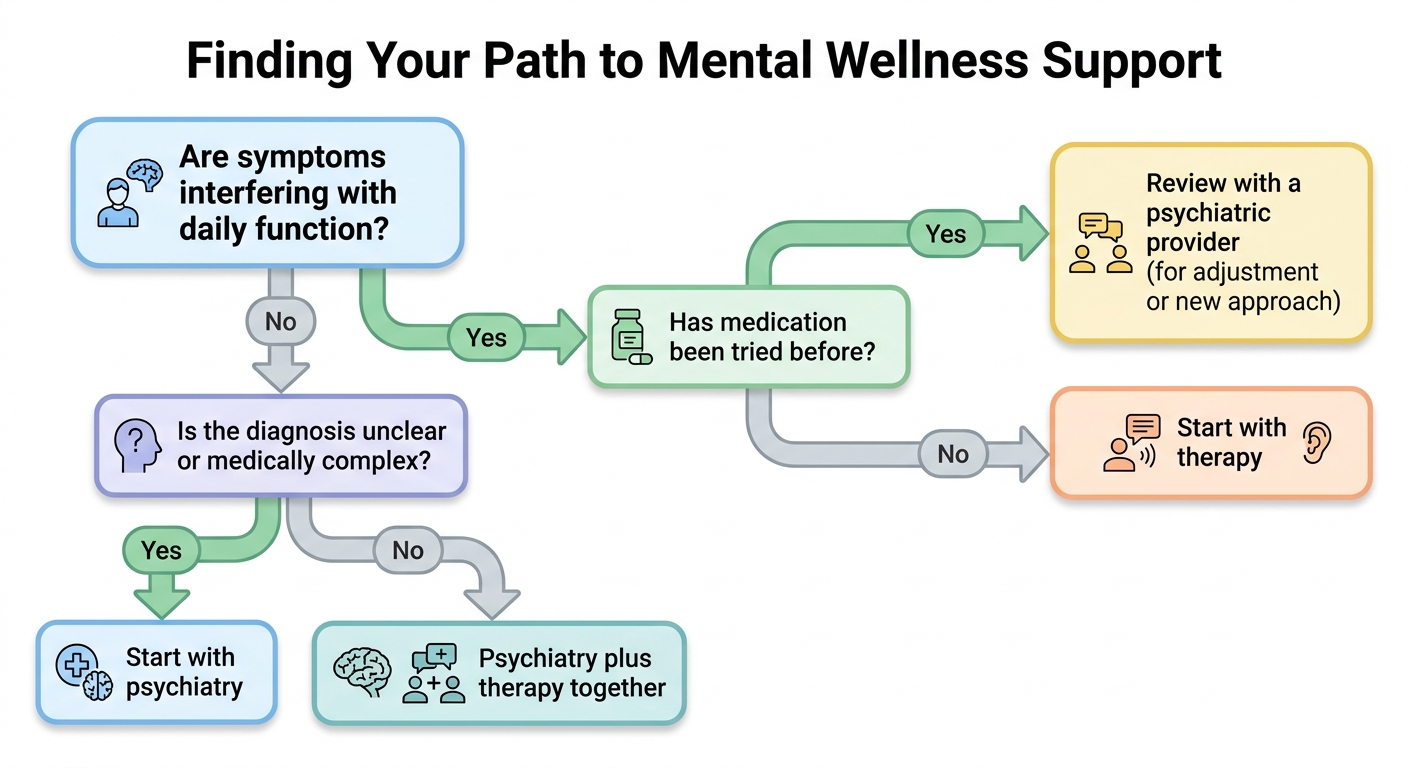
If you're unsure which box you fall into, that uncertainty is itself a reason to book a psychiatric evaluation. Sorting out the diagnosis is part of the visit, not a prerequisite for it.
Key takeaway: Severity, medication history, and diagnostic uncertainty are the three signals that point toward psychiatry as the first appointment.
Can You See Both at the Same Time?
Yes — and it's one of the most common arrangements in outpatient mental health care. It's often called split care: a prescriber handles medication, while a therapist handles the weekly sessions.
Split care is a treatment model in which medication management and psychotherapy are delivered by two different clinicians who coordinate on the same plan. Many clinicians favor it for moderate to severe symptoms because medication and therapy address different parts of the problem — one targets the biological side, the other builds skills and insight. Results vary between individuals, and whether combined care fits you is a clinical decision made in consultation.
How coordination usually works in practice:
- You sign a release of information so the two providers can share notes.
- Your prescriber documents medication changes; your therapist flags symptom shifts they're seeing weekly.
- Appointment rhythms differ — therapy tends to be frequent and regular, medication visits less so.
Some clinics shorten this loop by housing both services internally. That's the idea behind an integrative patient care model, where medication management, counseling, and additional tools like pharmacogenetic testing sit under one practice rather than across three.
How Do You Find a Good Psychiatrist?
Verify board certification, match the provider's focus to your condition, confirm they take your insurance, and check real appointment availability — in that order. Most directory listings give you names and photos; almost none give you criteria.
What should you check before you book?
Work through this list before you commit to a first appointment:
- Board certification and active licensure — verify through the state licensing board.
- Condition focus — does the provider routinely treat your condition, whether that's ADHD, OCD, trauma, or mood disorders?
- Prescribing scope — including whether they manage controlled medications.
- Telehealth availability — and whether they can see you where you physically live.
- Realistic wait time — not "accepting new patients," but the actual next open slot.
- Insurance participation — confirmed with both the clinic and your insurer.
- Refill and between-visit policy — who handles refills, and how fast they respond.
Which directories are worth using?
Two national tools come up repeatedly in searches. The American Psychiatric Association operates a Psychiatrist Locator, which as of November 2026 presents itself as a search tool for finding psychiatrists. Psychology Today's psychiatrist directory similarly lists provider profiles filterable by in-person availability, according to that page as of the same date.
Both are starting points, not endpoints. A directory entry doesn't tell you a clinic's refill policy, wait time, or whether your plan is in network. That's why it's worth reading a practice's own provider pages — you can meet our providers and see credentials and locations before you pick up the phone.
⚠️ A listing that says "accepting new patients" may be months stale. Always confirm current availability directly with the clinic.
How Long Is a Psychiatry Appointment?
Your first visit is the longest one. Initial psychiatric evaluations are scheduled as extended appointments, while routine medication follow-ups are considerably shorter and spaced further apart once things are stable.
Medication management is ongoing psychiatric care focused on selecting a medication, monitoring response and side effects, and adjusting dose or regimen over time. It's a maintenance relationship, not a one-off consult.
| Visit type | Relative length | Typical rhythm | What it covers |
|---|---|---|---|
| Initial evaluation | Longest appointment | One time, at intake | Full history, symptom review, diagnosis, treatment plan |
| Early follow-up | Short | More frequent while starting or changing medication | Response check, side effects, dose adjustment |
| Maintenance follow-up | Short | Spaced out once symptoms are stable | Refills, monitoring, plan review |
| Therapy session | Standard therapy hour | Usually weekly or biweekly | Skills, processing, behavioral work |
Clinics bill these differently, which is why the lengths differ. An initial psychiatric diagnostic evaluation is coded separately from a routine follow-up office visit, and the follow-up code reflects a shorter, more focused encounter. If exact minutes matter for your schedule, ask the front desk what the appointment is booked for — that's the only reliable answer.
Want the inside view rather than the logistics? Our dedicated guide to what happens during a psychiatric evaluation walks through the intake conversation step by step.
How Much Does a Psychiatry Appointment Cost?
It depends on whether you're using insurance, and the first visit almost always costs more than follow-ups. With coverage, most people pay a specialist copay or coinsurance after their deductible. Without coverage, you pay the clinic's published self-pay rate.
| Payment path | What you typically pay | What to confirm first |
|---|---|---|
| In-network insurance | Specialist copay or coinsurance after deductible | That the specific provider — not just the clinic — is in network |
| Out-of-network | Clinic rate, possibly with partial reimbursement | Whether your plan reimburses out-of-network behavioral health |
| Self-pay | The clinic's listed intake and follow-up rates | That you receive a written estimate before the visit |
| Telehealth | Often billed the same as in-person | Your plan's telehealth behavioral health benefit |
Two things change the math more than the sticker price. First, which plan you carry — start by checking the insurance partners we work with and confirming with your insurer directly. Second, your federal protections if you're paying out of pocket.
A good faith estimate is a written estimate of expected charges that uninsured and self-pay patients are entitled to receive before scheduled care under the federal No Surprises Act. You can review your No Surprises Act protections and request an estimate before your first appointment rather than after.
Ask these questions when you call:
- Is this provider in network with my specific plan, not just my insurer?
- What is the self-pay rate for an initial evaluation versus a follow-up?
- Is there a separate charge for forms, letters, or between-visit messages?
- What's the no-show or late-cancellation fee?
Key takeaway: The cost question has two parts — the clinic's rate and your coverage. Verify both in the same phone call, and ask for a written good faith estimate if you're self-pay.
How Do You Book a Psychiatry Appointment Without the Runaround?
Gather three things before you contact anyone: your insurance information, your medication history, and a rough timeline of symptoms. Prepared patients get scheduled faster because the clinic can route them correctly on the first pass.
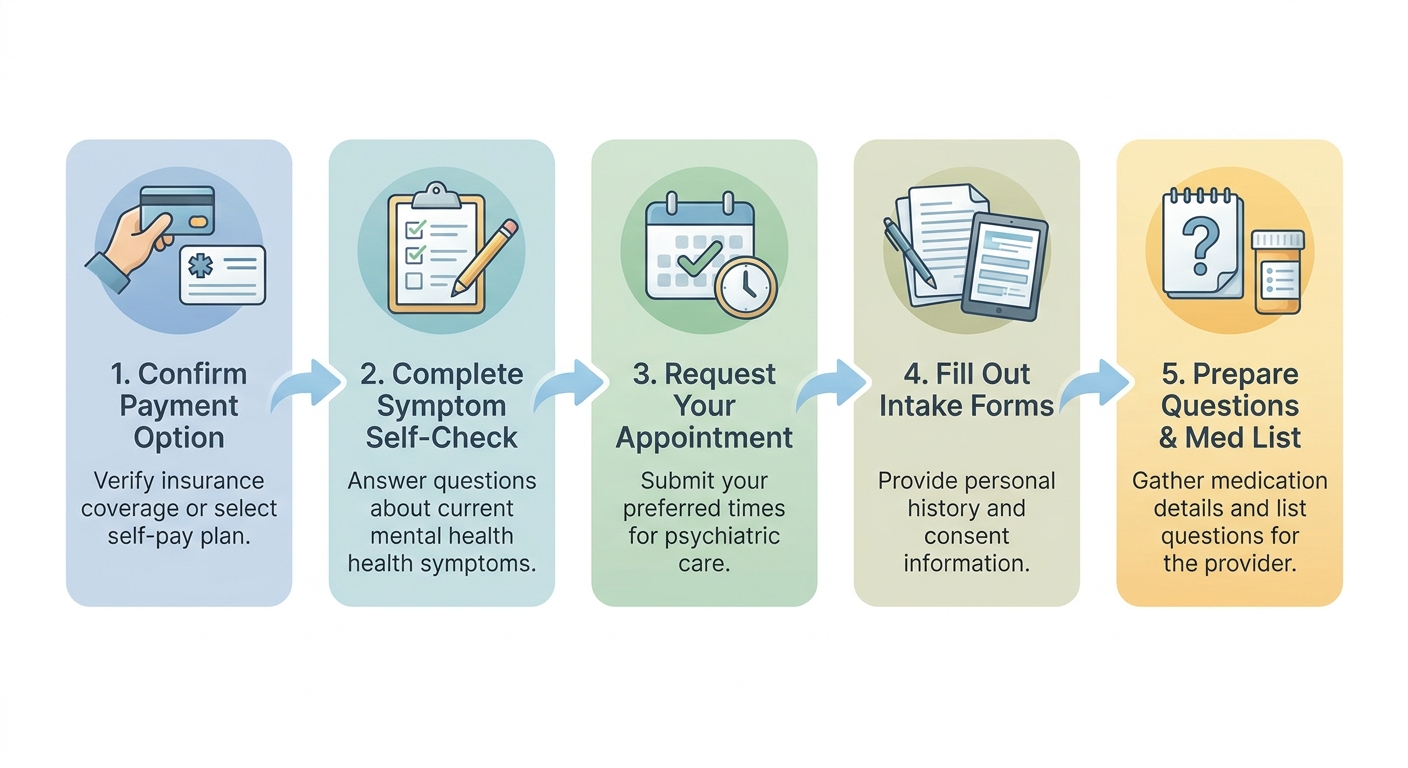
Step 1 — Settle the money question. Confirm coverage or ask for the self-pay rate before you book, not at check-in.
Step 2 — Describe your symptoms clearly. Standardized questionnaires help you put words to what's happening. Our free self-assessments (PHQ-9, GAD-7, PCL-5) take a few minutes and give your provider a useful starting point.
Step 3 — Submit the request. Online appointment requests often move as fast as calling, and they create a written record of what you asked for.
Step 4 — Complete intake paperwork early. Finishing patient forms in advance protects your appointment time for the actual conversation.
Step 5 — Bring the raw material. A written list of current medications and doses, past psychiatric treatments and how they went, and two or three questions you want answered.
Wait times vary by clinic and by provider. Some outpatient practices can see new patients within a few weeks; telehealth slots sometimes open sooner than in-person ones. Ask about cancellation lists — they move faster than most people expect.
⚠️ If you're in crisis, don't wait for a scheduled appointment. Call or text 988 for the Suicide and Crisis Lifeline, or go to the nearest emergency room.
Does "Psychiatrist Near Me" Still Matter if Telehealth Is an Option?
Yes. Your provider must hold a license in the state where you are physically sitting during the visit — not where the clinic's office is. That single rule is why a local search still matters even when the appointment happens over video.

Geography shows up in a few other practical ways:
- Controlled medications. Federal rules on prescribing controlled substances — including stimulants used for ADHD — by telehealth have shifted several times in recent years. Ask the clinic how they currently handle it rather than assuming video will cover it.
- Rural distance. Across the Treasure Valley and eastern Idaho, driving time to the nearest in-person option can be the deciding factor in whether care actually continues.
- Hybrid care. Many practices do an in-person intake and then move follow-ups to video, which keeps the drive to a minimum.
If you want an in-person option within reach, check which Idaho communities a practice actually serves. Integrity Mental Health has locations serving Boise, Meridian, Coeur d'Alene, and Rexburg, with virtual visits available for patients located in Idaho.
Key takeaway: Online psychiatry expands your options within a state, not across state lines. Confirm licensure for your location before your first video visit.
What Mistakes Do People Make When Choosing a Provider?
The most common mistake is booking purely on availability and discovering later that the provider doesn't treat your condition or can't prescribe what you need. Five more worth avoiding:
- Assuming a psychologist can prescribe. In most states they can't, and prescribing rules differ by state and change over time — confirm scope directly with the provider or the relevant licensing board.
- Skipping insurance verification. "We take your insurance" and "this provider is in network with your plan" are different sentences.
- Not asking about refills and after-hours contact. You'll care about this a lot more in week six than in week one.
- Withholding part of your history. Supplements, alcohol, cannabis, and over-the-counter sleep aids all interact with psychiatric medication. Your prescriber needs the full list.
- Quitting after one visit. Psychiatric medications often take weeks, not days, before a provider can judge whether they're helping. Leaving early can mean restarting the clock later.
That last point matters most for people starting treatment for mood or anxiety treatment concerns, where early side effects can arrive before any benefit does. Talk to your prescriber about what you're feeling instead of stopping on your own.
Key takeaway: Verify scope, verify coverage, disclose everything, and give the plan enough time to be evaluated properly.
Frequently Asked Questions
These are the questions people ask most often when they're deciding between a psychiatrist and a psychologist, or getting ready to book a first mental health appointment.
Can a psychologist prescribe medication?
In most states, no. Prescribing is handled by psychiatrists, psychiatric nurse practitioners, and other medical prescribers. A small number of states have passed laws granting specially trained psychologists limited prescribing authority, and those rules differ and change over time. Confirm a specific provider's prescribing scope with them or with the relevant state licensing board before you book.
Do I need a referral to see a psychiatrist?
Often no, but it depends on your plan. PPO plans typically allow you to self-refer to a specialist, while HMO and some managed Medicaid plans may require a referral from your primary care provider. Check your plan's behavioral health benefits page, then confirm with the clinic. You can also review the insurance partners we work with before calling.
How soon can I get a psychiatry appointment?
Availability varies by clinic, provider, and time of year. Many outpatient practices schedule new patients within a few weeks, and telehealth slots often open sooner than in-person ones. Asking to be added to a cancellation list can move you up. If you're in crisis, contact 988 or go to an emergency room instead of waiting.
Is a psychiatrist worth it if I'm already in therapy?
It's worth a conversation if symptoms haven't improved after a consistent stretch of therapy, if sleep or appetite is badly disrupted, or if your therapist has suggested a medication evaluation. A psychiatric consult doesn't replace therapy — in split care, the two run alongside each other. Whether medication fits your situation is decided during the evaluation.
What should I bring to my first psychiatry appointment?
Bring these five things:
- Photo ID and your insurance card
- A written list of current medications and supplements, with doses
- A summary of past psychiatric treatment and how it went
- A rough timeline of your symptoms
- Two or three questions you want answered
Completing your patient forms beforehand leaves more of the visit for the conversation itself.
Is a psychiatric nurse practitioner as good as a psychiatrist?
Both can evaluate, diagnose, and manage medication, so for most routine medication care either one is an appropriate choice. Psychiatrists complete medical school and a psychiatry residency, which can matter for unusually complex or treatment-resistant cases. Psychiatric nurse practitioners often have more open scheduling, which means faster access. Ask the clinic who would be managing your care and how the team consults with each other.
Can I switch providers if the first one isn't a fit?
Yes. Fit matters in mental health care, and asking to change providers is a normal request rather than a complaint. Call the clinic, say what isn't working — communication style, scheduling, treatment approach — and ask about other providers on the team. Request that your records transfer so your new provider has your medication history and doesn't restart from zero.
Does online psychiatry work as well as an in-person visit?
For many people, yes — video visits cover the same ground as an office visit: history, symptom review, diagnosis, and medication planning. In-person may still be preferable when a physical exam, lab coordination, or certain controlled-medication rules come into play. Ask the clinic which parts of your care they handle virtually and which they prefer to do face to face.
Summary
The psychiatrist vs psychologist question comes down to one practical fork: do you need a prescriber or a therapist? Psychiatrists and psychiatric nurse practitioners diagnose and manage medication. Psychologists provide therapy and formal testing. Plenty of people work with both at once, and that coordination is a normal part of mental health care rather than a sign something went wrong.
When you're comparing options, judge them on verifiable things — licensure, condition focus, prescribing scope, insurance participation, wait time, and refill policy — rather than on directory ranking. Ask what the appointment is scheduled for, ask what it costs, and ask for a good faith estimate if you're paying out of pocket.
And if your search for a psychiatrist near me has stalled at the comparison stage, the fastest way forward is usually a single conversation with a clinic that can route you correctly. Request an appointment with our Idaho team and start with the evaluation rather than the guesswork.
Information about third-party platforms reflects publicly available details at the time of writing and may have changed. Please verify directly with the provider. See our Terms of Use for more.