Anxiety Treatment Options, Ranked by Evidence
Integrity Mental Health Editorial ·

Anxiety is one of the most common reasons people in Idaho look for mental health help — and one of the most treatable. The hard part isn't finding options; it's sorting which ones have real research behind them and which are mostly noise. This guide walks through every major anxiety treatment category, groups them by how strong the clinical evidence is, and explains how providers decide what to recommend.
Quick Answer
The anxiety treatments with the strongest research support are cognitive behavioral therapy (CBT), exposure-based therapy, and antidepressant medications in the SSRI and SNRI families — used alone or together. Clinical practice guidelines across professional psychiatric and psychological bodies consistently place these in the first-line tier. Lifestyle habits, breathing skills, and mindfulness help many people, but they are usually layered on top of treatment rather than used instead of it. The right fit depends on symptom severity, anxiety subtype, medical history, and your own preference.
TL;DR
- CBT is the most-studied psychotherapy for anxiety, and exposure work is its most active ingredient. See how the therapy types compare
- SSRIs and SNRIs are the usual first-line medications, with buspirone and hydroxyzine as non-habit-forming alternatives and benzodiazepines generally limited to short-term use. Review the medication class table
- Combination care is common for moderate-to-severe anxiety, while milder presentations often start with skills and therapy alone. Walk through the decision path
- Sleep, movement, caffeine limits, and grounding skills reduce symptom load but rarely resolve a diagnosed disorder on their own. Get the non-medication checklist
- A screener score gives you and your provider a shared baseline to measure progress against over the first few months. See what a 12-week plan looks like
In This Article
Here's the path this guide takes, from definitions to booking an appointment:
- What Counts as Anxiety Treatment?
- How Are Anxiety Treatments Ranked by Evidence?
- Which Types of Anxiety Therapy Actually Work?
- What Medications Are Used for Anxiety?
- How Do You Manage Anxiety Without Medication?
- Therapy, Medication, or Both: How Clinicians Decide
- What Does a Treatment Plan Look Like Over 12 Weeks?
- What Are Emerging and Adjunctive Options?
- How Do You Access Anxiety Care in Idaho?
What Counts as Anxiety Treatment?
Anxiety treatment is any structured intervention — psychotherapy, medication, or skills-based self-management — intended to reduce how often anxiety shows up, how intense it gets, or how much it interferes with daily life. The key word is structured. Deep breathing when you remember to do it is a coping habit; a planned course of therapy with between-session practice is treatment.
Everyday worry and a diagnosed anxiety disorder are different things. Diagnostic criteria used in the U.S. describe distinct conditions — generalized anxiety disorder, panic disorder, social anxiety disorder, and specific phobias among them — defined by symptom pattern, duration, and the degree of impairment they cause. You can read more about the anxiety disorders we treat and about what actually causes anxiety disorders if you want the background before weighing treatment options.
Three terms worth knowing up front:
- Screener — A brief standardized questionnaire, such as the GAD-7, that turns self-reported symptoms into a score your provider can track over time.
- First-line treatment — The option that published clinical guidelines recommend trying first for most people with a given condition.
- Adjunctive treatment — Something added alongside a primary treatment to support it, not replace it.
⚠️ Caution: Symptom checklists can't rule out medical conditions that imitate anxiety. Thyroid problems, certain medications, caffeine load, sleep apnea, and heart rhythm issues can all produce anxiety-like symptoms. A clinical evaluation is what separates these possibilities — self-diagnosing from a list does not.
Key takeaway: Treatment is a structured plan with a measurable target, not a collection of coping tips.
How Are Anxiety Treatments Ranked by Evidence?
Treatments are grouped into tiers based on how much high-quality research supports them and how consistently clinical practice guidelines recommend them. First-line options have the deepest and most replicated evidence base. Second-line options are well-supported but typically tried after a first-line approach hasn't worked or isn't a good fit. Adjunctive options are supported as helpful additions rather than standalone solutions.
| Treatment | Evidence tier | How it's usually delivered | Often considered for |
|---|---|---|---|
| Cognitive behavioral therapy (CBT) | First-line | Weekly structured sessions with homework between visits | Most anxiety subtypes, all severity levels |
| Exposure / ERP | First-line | Graded, repeated practice facing feared situations or sensations | Phobias, panic disorder, social anxiety, OCD |
| SSRIs / SNRIs | First-line | Daily medication, dose adjusted over follow-up visits | Moderate-to-severe or persistent anxiety |
| Acceptance and Commitment Therapy (ACT) | Second-line | Weekly sessions focused on values and willingness | People who struggle with symptom-elimination goals |
| Mindfulness-based programs | Second-line | Structured multi-week group or self-guided course | Stress reactivity, rumination, relapse prevention |
| Buspirone | Second-line | Daily medication, non-habit-forming | Generalized anxiety, often as an alternative or add-on |
| Benzodiazepines | Limited / short-term | Occasional or time-limited use under close supervision | Acute, severe episodes while other treatment takes hold |
| Exercise, sleep repair, breathing retraining | Adjunctive | Daily and weekly routine | Everyone, alongside primary treatment |
Three things this table does not say are worth naming directly. It doesn't say first-line means best for you — it means best supported on average. It doesn't predict how any individual will respond, because responses vary widely between people. And it doesn't rank the tiers by how pleasant they feel; exposure therapy is uncomfortable by design and still sits in the top tier.
Anxiety is widely recognized as a common mental health concern among U.S. adults, which is part of why the research base is so large. That volume of study is also why the first-line list has stayed fairly stable: the same handful of approaches keep performing well across different populations and settings.
Key takeaway: Evidence tiers describe average results across large groups, not a guarantee for any one person.
Which Types of Anxiety Therapy Actually Work?
CBT and its exposure-based variants have the longest and strongest track record in anxiety therapy. ACT and mindfulness-based programs are credible alternatives, particularly for people who find a symptom-elimination framing frustrating. What these approaches share matters more than their labels.

Key takeaway: The therapy label matters less than whether the work includes structured exposure and real practice between sessions.
Cognitive Behavioral Therapy (CBT)
CBT is a structured, time-limited therapy that targets the thought-and-behavior loops keeping anxiety in place. Sessions are usually weekly, follow an agenda, and come with assignments to complete before the next visit. Most courses run a few months rather than years.
The concrete tools are easy to recognize:
- Thought records — Writing down an anxious prediction, the evidence for and against it, and what actually happened.
- Behavioral experiments — Testing a feared prediction in real life instead of debating it internally.
- Worry postponement — Setting aside a short, scheduled window for worry rather than letting it run all day.
- Activity and avoidance tracking — Mapping which situations you've quietly stopped doing.
The homework is not optional padding. Between-session practice is where most of the change work happens, which is why clinicians often say the people who get the most out of CBT are the ones who do the exercises on the days they least want to.
Exposure and Response Prevention
Graded exposure is the core active ingredient for phobias, panic disorder, and social anxiety. You and your therapist build a fear hierarchy — a ladder of situations ranked from mildly uncomfortable to very difficult — and work up it deliberately, staying in each situation long enough for the alarm response to settle.
For panic disorder, therapists often add interoceptive exposure: deliberately bringing on harmless physical sensations like a racing heart or lightheadedness so the body learns those sensations aren't dangerous.
Exposure and response prevention (ERP) is the exposure variant used for obsessive-compulsive disorder, where the "response prevention" part means resisting the compulsion that normally follows an obsession. It's widely described in clinical guidelines as the leading psychotherapy for OCD.
Exposure work is collaborative and paced. Nobody is thrown into a worst-case scenario on day one.
ACT, Mindfulness, and Newer Approaches
Acceptance and Commitment Therapy (ACT) teaches willingness — learning to carry anxious thoughts and sensations while still doing what matters to you — rather than aiming to eliminate symptoms first. For people exhausted by fighting their own anxiety, that reframe often lands better.
Mindfulness-based stress reduction is a structured multi-week program combining meditation, body awareness, and gentle movement. It's typically taught in a group format with daily home practice.
Digital and app-delivered CBT programs have become a practical option where in-person access is limited, which matters in rural Idaho counties. Quality varies a lot between products, so it's worth asking a provider which ones they consider clinically credible.
What Medications Are Used for Anxiety?
Anxiety medication falls into a few clear groups. SSRIs and SNRIs are the usual first-line choices for ongoing anxiety treatment. Buspirone and hydroxyzine are non-habit-forming alternatives. Benzodiazepines are generally reserved for short-term or occasional use, and beta-blockers are sometimes used situationally for performance anxiety.
| Medication class | Examples | How it's typically used | Dependence risk |
|---|---|---|---|
| SSRIs | Sertraline, escitalopram | Daily; dose adjusted gradually over follow-up visits | Not considered habit-forming |
| SNRIs | Venlafaxine, duloxetine | Daily; sometimes chosen after an SSRI trial | Not considered habit-forming |
| Buspirone | Buspirone | Daily, often for generalized anxiety or as an add-on | Not considered habit-forming |
| Antihistamine (hydroxyzine) | Hydroxyzine | As-needed for acute symptoms | Not considered habit-forming |
| Benzodiazepines | Various | Short-term or rescue use under close supervision | Recognized risk of tolerance and dependence |
| Beta-blockers | Propranolol | Situational, for physical symptoms like tremor or racing heart | Not considered habit-forming |
A few process facts help set expectations. Daily antidepressants are not instant — prescribers normally schedule a follow-up several weeks out before judging whether a medication is helping, because that's how long a steady dose needs to be evaluated fairly. Starting low and adjusting upward is standard practice, not a sign something went wrong. Side effects are reviewed before you start, and your prescriber will ask about them at each visit.
Some clinics use pharmacogenetic testing — a cheek swab or blood test that looks at genes affecting how your body processes certain medications — as one input into prescribing decisions. It's a tool to inform the conversation, not a substitute for clinical judgment. You can read how that fits into integrative psychiatry and pharmacogenetic testing in a broader care model.
⚠️ Caution: Never start, stop, or change the dose of a psychiatric medication without your prescriber. Stopping certain antidepressants abruptly can cause discontinuation symptoms, and benzodiazepines in particular require a supervised taper.
If you're weighing pills against sessions, our deeper piece on how clinicians choose between medication and therapy covers that decision in detail. The short version: the anxiety medication vs therapy question usually isn't either/or.
Key takeaway: First-line medication choices are well established, but the right one for you is decided through a prescriber conversation and adjusted over follow-up visits.
How Do You Manage Anxiety Without Medication?
Non-medication management works best as a layered daily routine rather than a single technique. Therapy skills do the heaviest lifting; sleep, movement, and stimulant limits create the conditions that make those skills workable. Learning how to manage anxiety without medication is realistic for mild symptoms and valuable at every severity level — but it rarely resolves a moderate-to-severe disorder on its own.

A weekly checklist you can screenshot:
- Keep a consistent wake time, including weekends — anchoring the morning tends to stabilize the rest of the sleep cycle.
- Get regular moderate aerobic movement across most days of the week; walking counts.
- Cap caffeine early in the day and notice whether your afternoon cup tracks with your evening symptoms.
- Be honest about alcohol, which many people use to take the edge off and which often worsens next-day anxiety.
- Practice paced breathing daily, not only during spikes — box breathing or a longer-exhale pattern works.
- Schedule a short worry window instead of letting worry run on demand.
- Name one avoided situation each week and approach a smaller version of it.
How Do You Deal With Anxiety When You're Alone?
Grounding techniques are designed for exactly this moment. The most widely taught is 5-4-3-2-1: name five things you can see, four you can touch, three you can hear, two you can smell, and one you can taste. It pulls attention out of the thought spiral and back into the room.
Pair it with these:
- Paced breathing — Make the exhale longer than the inhale and repeat for a few minutes.
- A written coping card — Keep two or three lines on your phone that your calmer self wrote for your anxious self.
- A scheduled check-in — Agree in advance on a time to call or text someone, so reaching out isn't a decision you have to make mid-spike.
- Temperature and movement — Cold water on the face or a short walk can interrupt escalation.
⚠️ If you're having thoughts of harming yourself, call or text 988 (the Suicide & Crisis Lifeline) or go to your nearest emergency department. Self-management tools are not for crisis moments.
Therapy, Medication, or Both: How Clinicians Decide
Five factors usually drive the recommendation: symptom severity, anxiety subtype, how you've responded to past treatment, medical and pregnancy considerations, and your own preference. Preference matters more than people expect — a plan you won't follow isn't a good plan.
A common decision path looks like this:
- Mild symptoms — Skills, lifestyle structure, and therapy are typically offered first, with medication held in reserve.
- Moderate symptoms — Therapy is usually recommended, with medication discussed as an option depending on function and history.
- Severe symptoms, or anxiety that's blocking daily functioning — Combination care is frequently recommended from the start, since medication can create enough stability to make therapy work possible.
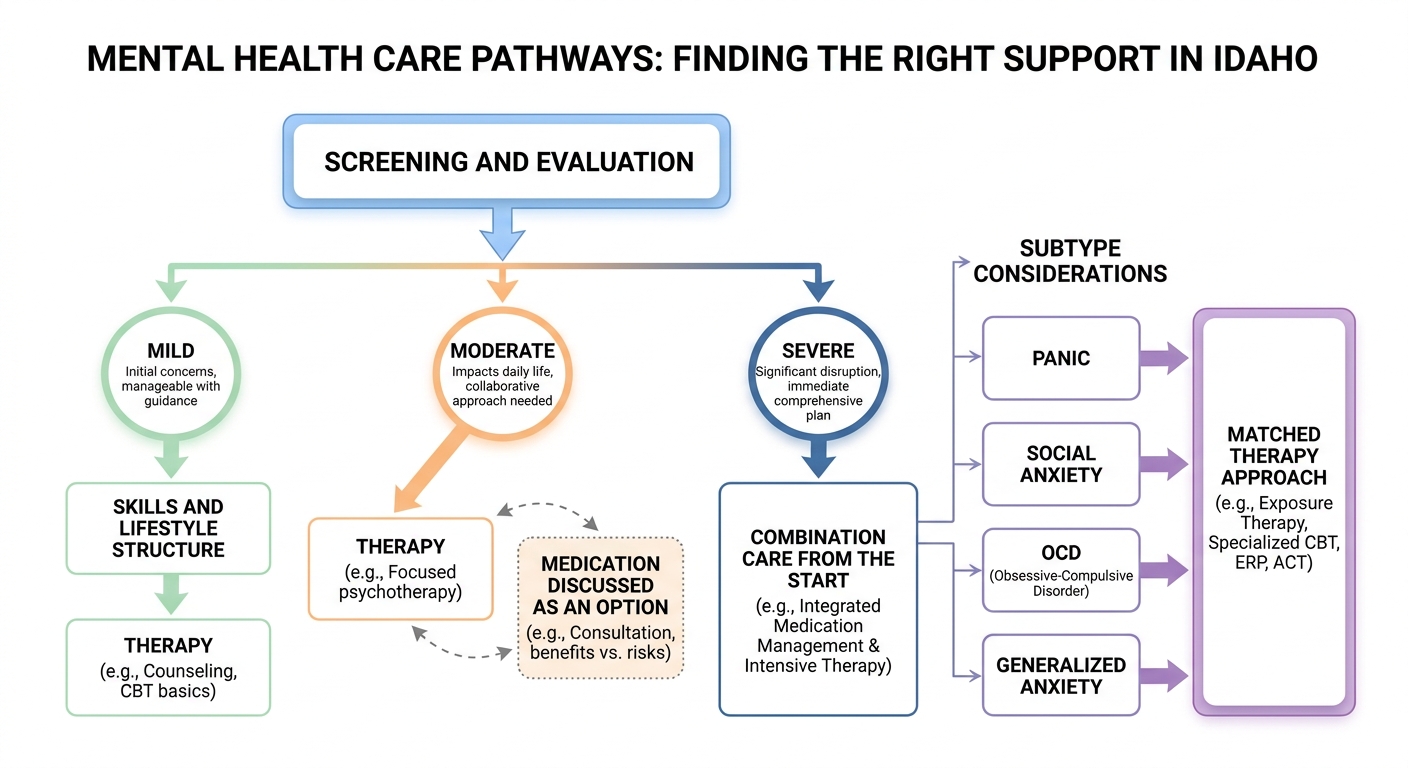
Subtype shifts the plan too. Panic disorder points toward interoceptive exposure. Social anxiety points toward graded real-world exposure. OCD points toward ERP specifically, not general talk therapy. Generalized anxiety often responds to CBT's worry-focused tools.
A screener score gives this conversation a shared starting point. If you want a baseline before your first visit, you can take the GAD-7 anxiety self-assessment — it takes a couple of minutes, and bringing the result to an intake saves time.
Key takeaway: Severity sets the intensity of the plan, subtype sets the technique, and your preference decides whether the plan is realistic to follow.
What Does a Treatment Plan Look Like Over 12 Weeks?
A typical plan moves through six stages: intake and evaluation, a baseline screener, treatment start, an early check-in, a response review, and then either maintenance or adjustment. The structure exists so that progress is measured rather than guessed at.
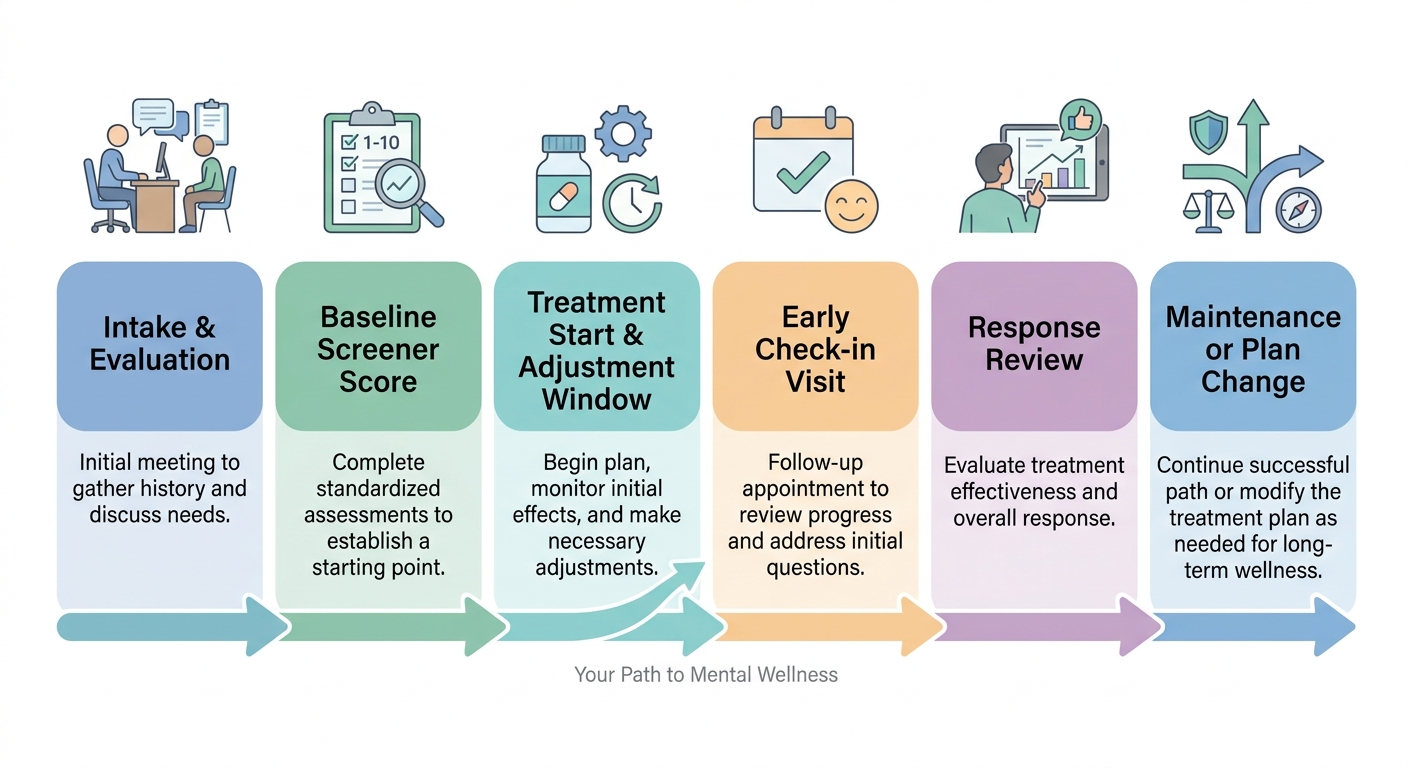
Stage by stage:
- Intake and evaluation — History, current symptoms, medical review, and goals. Our guide to what happens during a psychiatric evaluation walks through this visit in detail.
- Baseline screener — A score recorded before treatment begins, so later changes are comparable.
- Treatment start — Therapy sessions begin, medication is started at a low dose, or both.
- Early check-in — A short follow-up focused on tolerability, side effects, and whether you're able to do the between-session work.
- Response review — You and your provider compare your current screener score to baseline and discuss what's shifted in daily life.
- Maintenance or adjustment — Either continue what's working with less frequent visits, or change the plan.
Re-scoring the same screener at each review point is what measurement-based care means in practice. Memory is unreliable about mood; a number from eight weeks ago isn't.
Key takeaway: If nothing has shifted by the mid-point review, that's information — not failure. It usually means the plan needs adjusting, not that treatment doesn't work for you.
Adjustment can mean several things: a dose change, switching medication classes, adding or intensifying exposure work, addressing sleep or substance use, or re-examining the diagnosis itself. Anxiety frequently travels with depression, ADHD, or trauma histories, and an incomplete picture is a common reason a reasonable plan underperforms.
What Are Emerging and Adjunctive Options?
The credible additions to standard anxiety care right now are digital and app-delivered CBT, measurement-based care, pharmacogenetic-informed prescribing, and integrative approaches that treat sleep, nutrition, and co-occurring conditions as part of the plan rather than afterthoughts.
Here's how to think about evidence maturity across them:
- Prescription digital therapeutics — Some software-based treatments have gone through formal FDA review pathways. Availability, indication, and insurance coverage vary, so confirm specifics with a provider.
- Measurement-based care — Using repeated standardized scores to guide decisions is a process improvement with solid support in the psychiatric literature, and it's inexpensive to implement.
- Pharmacogenetic-informed prescribing — Useful as one input among several. It does not select a medication for you, and clinicians weigh it alongside history and response.
- Supplements and nutraceuticals — This is where caution belongs. Marketing claims routinely outrun the evidence, and supplements can interact with prescribed medications.
⚠️ Tell your prescriber about every supplement you take, including melatonin, herbal products, and high-dose vitamins. "Natural" does not mean free of interactions.
Integrative psychiatry treats the body-level contributors — sleep disruption, thyroid issues, substance use, chronic pain — as part of the anxiety picture rather than separate problems. You can see how that philosophy shapes care in our description of integrative psychiatry and pharmacogenetic testing.
Key takeaway: New tools are worth considering, but they sit alongside first-line treatment rather than replacing it.
How Do You Access Anxiety Care in Idaho?
Start with a screener, then book an intake with a psychiatric provider or therapist. In Idaho, in-person clinics cluster around the Treasure Valley — Boise, Meridian, Eagle, Nampa, and Emmett — while telehealth covers much of the gap for people in rural counties who would otherwise drive hours each way.

An intake appointment covers your symptom history, medical background, current medications, family history, and goals. It ends with a working plan rather than a vague suggestion to "see how things go." You can review the range of psychiatry services for anxiety to see what's offered before you call.
What to bring to a first appointment:
- A current list of all medications and supplements, with doses
- Your insurance card and photo ID
- A rough timeline of when symptoms started and what's changed since
- Any screener results you've completed
- Names of past providers and treatments you've tried
What to ask before you book:
- Is this visit in person or telehealth, and which do you recommend for me?
- Do you accept my plan? Checking the insurance plans we accept ahead of time avoids surprises.
- How soon is the first follow-up usually scheduled?
- Do you provide therapy, medication management, or both?
- Who do I contact between visits if something changes?
For families in Nampa, Idaho and surrounding Canyon County communities, telehealth often shortens the wait for an opening compared with holding out for a specific in-person slot. Ask about both when you call.
Frequently Asked Questions
What are the treatment options for anxiety disorders?
The main options are cognitive behavioral therapy, exposure-based therapy including ERP for OCD, SSRI and SNRI medications, buspirone, hydroxyzine, short-term benzodiazepines in limited situations, and structured lifestyle change. Milder presentations often start with therapy and skills alone. Moderate-to-severe presentations more often combine therapy with medication. A clinical evaluation matches the option to your subtype and severity.
What does it mean to feel anxious about being anxious?
That's anticipatory anxiety, sometimes called "fear of fear," and it's a core maintaining loop in panic disorder. You start scanning for early physical signs of anxiety, which raises arousal, which produces the signs you were watching for. Interoceptive exposure — deliberately and safely bringing on those harmless sensations — is the therapy technique aimed directly at this loop.
How do you deal with anxiety when you're alone?
Use grounding and paced breathing first: the 5-4-3-2-1 sensory exercise pulls attention outward, and lengthening your exhale helps settle physical arousal. Keep a written coping card on your phone and a pre-agreed check-in time with someone you trust, so reaching out isn't a decision you have to make mid-spike. If you're in crisis or having thoughts of self-harm, call or text 988.
Are there good self-help resources about anxiety for adults?
Yes. National mental health institutes, established patient advocacy organizations such as the Anxiety & Depression Association of America, and university-affiliated CBT libraries publish free, adult-oriented explainers. Prefer clinician-reviewed sources over social media advice, and treat any resource promising a fast cure with skepticism. Self-help material works best alongside care, not instead of it.
How long does anxiety treatment take to work?
Timelines vary between individuals, and no outcome can be promised. In practice, therapy courses are usually planned as a set of weekly sessions over a few months, and prescribers schedule a medication follow-up several weeks after starting so the dose has a fair evaluation period. Your provider will re-score your screener at planned review points to judge progress objectively.
Summary
Anxiety treatment has a clear evidence hierarchy, and knowing it makes you a better participant in your own care. CBT and exposure-based therapy lead the psychotherapy tier. SSRIs and SNRIs lead the medication tier, with buspirone and hydroxyzine as alternatives and benzodiazepines limited to short-term roles. Sleep, movement, caffeine limits, and grounding skills belong in nearly every plan — as support, not substitutes.
What the tiers can't tell you is which path fits your symptoms, history, and life. That's what an evaluation is for. Start with a screener for a baseline, bring it to an intake, and ask for a plan with review points built in so progress is measured rather than hoped for.