What Causes Anxiety Disorders — and What Actually Helps
Integrity Mental Health Editorial ·
If you've ever wondered what causes anxiety disorders, the honest answer is that there is rarely a single cause. Anxiety develops where inherited biology meets lived experience, and both halves of that equation shape what treatment looks like. This guide covers the causes, the risk factors, the symptoms adults miss most often, and the care options available across Idaho.
Quick Answer
What causes anxiety disorders is a combination of factors, not one trigger. Inherited vulnerability, differences in how the brain's fear and regulation circuits communicate, chronic or traumatic stress, certain medical conditions, and some substances all contribute. Most people who develop an anxiety disorder have several of these stacked together. That's also why effective anxiety care usually addresses more than one layer at a time.
TL;DR
- Anxiety is multi-causal. Genetics load the odds, but environment, stress and health conditions usually decide the outcome. See the full causes breakdown
- Adults often feel anxiety in the body first. Headaches, stomach trouble, chest tightness and broken sleep show up before people name the feeling. Review the adult symptom checklist
- Some physical conditions imitate anxiety. Thyroid problems, heart rhythm issues and withdrawal states can look identical to a panic attack. Compare the common look-alike causes
- Lifestyle changes help, but they are not a substitute for treatment in moderate-to-severe cases. Weigh the evidence behind natural remedies
- Medication and therapy work through different mechanisms and are often used together. See how the two approaches compare
In This Article
- What Causes Anxiety Disorders?
- What Are the Biggest Risk Factors and Triggers?
- What Does Anxiety Look Like in Adults?
- Do Natural Remedies for Anxiety Actually Work?
- Anxiety Medication vs. Therapy: Which Should You Choose?
- How Do You Find Anxiety Treatment Near You in Idaho?
- Summary
- Frequently Asked Questions
What Causes Anxiety Disorders?
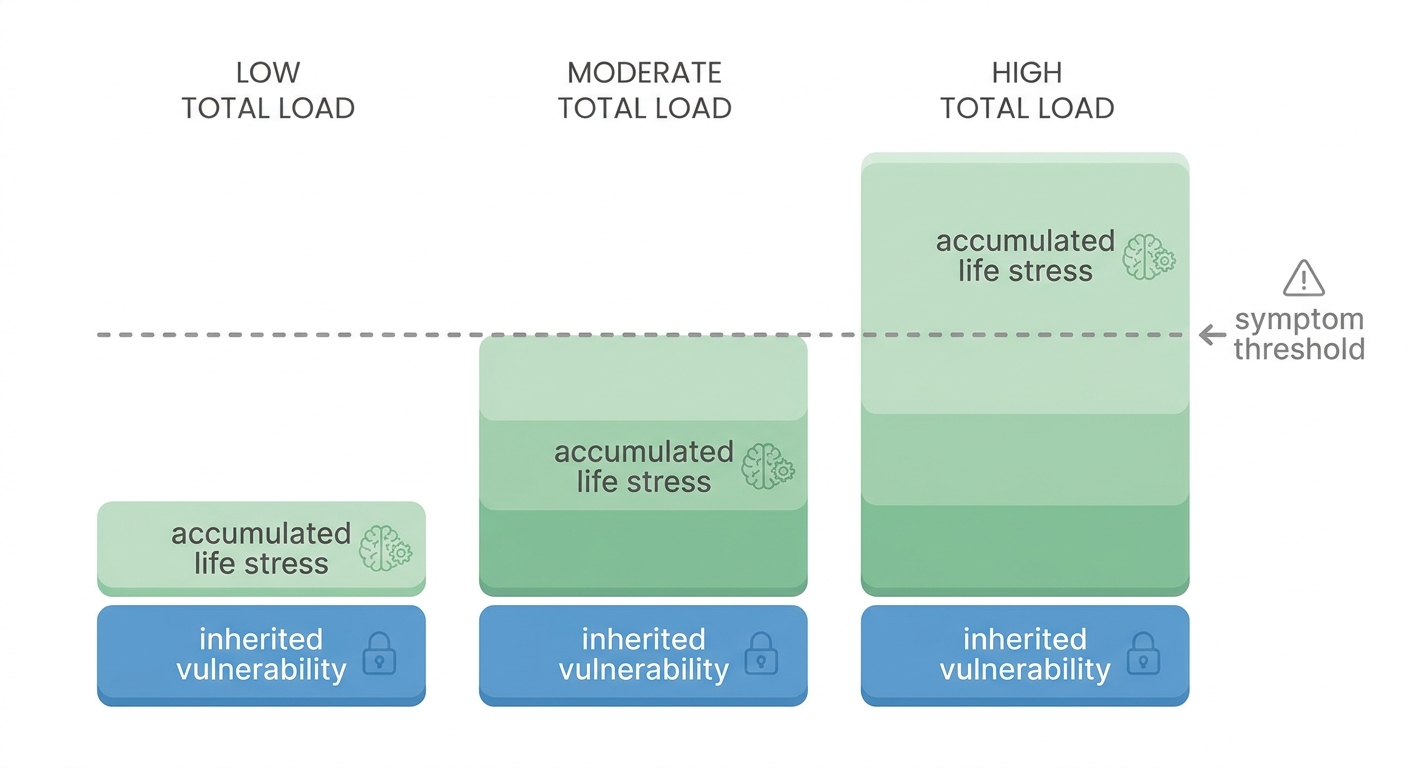
Anxiety disorders arise from an interaction between inherited vulnerability and environmental load. Think of it as a scale: biology sets where the needle starts, and life experience pushes it up or down. When the combined weight passes a personal threshold, worry stops being useful and starts interfering with daily life.
An anxiety disorder is a diagnosable condition in which fear or worry is persistent, out of proportion to the situation, and disruptive to daily functioning. That last part is the dividing line. Ordinary stress fades when the stressor does; a disorder keeps running after the threat is gone.
Clinicians generally describe four contributing layers:
- Genetic vulnerability — a family history of anxiety or mood conditions raises the odds, without making anxiety inevitable.
- Brain circuitry and chemistry — the amygdala (the brain's threat alarm) and the prefrontal cortex (the region that weighs context and calms the alarm) communicate differently in people with anxiety disorders. Signaling systems involving serotonin, norepinephrine and GABA are also involved.
- Stress and life experience — chronic strain, loss, trauma, caregiving load and financial pressure all add weight.
- Medical and substance factors — a number of physical conditions and substances produce anxiety-like symptoms directly.
Anxiety disorders are not one condition but a family of them. Generalized anxiety disorder centers on broad, hard-to-control worry. Panic disorder involves sudden surges of intense fear with strong physical symptoms. Social anxiety disorder focuses on scrutiny and judgment. Specific phobias attach to a single object or situation. The underlying causes overlap heavily, which is why a careful evaluation matters more than self-diagnosis from a symptom list.
Where you land in that family shapes care. Panic disorder and social anxiety, for example, often respond to different therapy techniques even when the medication choices look similar. Our overview of anxiety disorder symptoms and treatment breaks down how each type presents and what treatment typically involves.
Key takeaway: No single gene, event or chemical "causes" anxiety — it emerges when inherited sensitivity and accumulated stress meet, which is why treatment works best when it addresses both.
How Much of Anxiety Is Genetic vs. Environmental?
Anxiety is partly inherited, but genetics alone don't determine who develops a disorder. Anxiety is understood to run in families, while environment, experience and timing also contribute substantially to risk. Having an anxious parent raises your odds; it does not seal your outcome.
What appears to be inherited is sensitivity rather than the disorder itself. People with a family history often describe a nervous system that reacts faster and settles slower. Add a demanding season of life, and that trait can tip into a clinical condition. Remove the stress load, improve sleep, and the same person may function well for years.
Several biological threads contribute:
- Neurotransmitter signaling — serotonin, norepinephrine and GABA systems influence how quickly the threat response fires and how efficiently it shuts off.
- Stress hormone regulation — repeated activation of the body's stress axis can leave the alarm system easier to trigger.
- Epigenetics — early-life stress may change how genes are expressed, without changing the genes themselves.
Genetics also matter in a practical, non-abstract way: they affect how your body processes medication. Pharmacogenetic testing is a lab test that examines genetic variation in drug-metabolizing enzymes such as CYP2D6 and CYP2C19. Results can give a prescriber additional information when selecting or dosing a medication, which some providers use as one additional data point when selecting or dosing medication. It is one input among many, not a prescription in itself — you can read how it fits into our pharmacogenetic testing and integrative care approach.
Which Medical Conditions and Substances Mimic Anxiety?
Several physical conditions produce symptoms nearly indistinguishable from an anxiety disorder. That's why a thorough history and appropriate medical workup belong at the start of anxiety treatment, not after months of unsuccessful attempts.
| Look-alike cause | Distinguishing clue |
|---|---|
| Overactive thyroid (hyperthyroidism) | Weight loss, heat intolerance, tremor, racing pulse at rest |
| Heart rhythm irregularities | Palpitations that start and stop abruptly, sometimes with lightheadedness |
| Anemia | Fatigue and breathlessness on exertion, pale skin, low stamina |
| Sleep apnea | Loud snoring, morning headaches, waking unrefreshed, daytime sleepiness |
| Perimenopause and hormonal shifts | Symptoms clustering with cycle changes, hot flashes, sleep disruption |
| Vitamin B12 deficiency | Tingling in hands or feet, memory fog, fatigue |
| High caffeine intake | Symptoms tied to intake timing; jitteriness that fades on reduction |
| Alcohol withdrawal | Morning tremor and dread, easing after drinking, worsening on days off |
| Stimulant or decongestant medications | Onset coinciding with a new prescription or dose change |
The alcohol pattern deserves special attention because it's so easy to misread. Alcohol quiets anxiety in the short term and amplifies it during withdrawal, which creates a loop that looks like worsening anxiety. If drinking has become a tool for managing nerves, alcohol use disorder may be part of the picture and should be assessed alongside the anxiety itself.
⚠️ Don't assume anxiety before ruling out physical causes. New-onset panic symptoms in adulthood — especially with chest pain, fainting, or an irregular pulse — warrant medical evaluation first. Thyroid and cardiac causes are treatable, and missing them delays relief.
What Are the Biggest Risk Factors and Triggers?
The strongest risk factors are childhood adversity, sustained stress load, a first-degree relative with an anxiety or mood condition, and co-occurring mental health conditions. Sex also plays a role — Anxiety disorders are often reported to affect women and men differently, though individual risk depends on many overlapping factors.. Risk factors raise the baseline; triggers push an already-loaded system past its limit.
A useful way to picture this is the stress-vulnerability model. Inherited sensitivity gives you a starting level. Life stress adds on top. Symptoms appear when the total crosses your personal threshold — which is why two people in the same stressful job can have completely different outcomes.
Which risk factors apply to you?
- Family history — a parent or sibling with anxiety, depression, or panic attacks
- Early adversity — childhood trauma, neglect, instability or chronic family conflict
- Chronic stress load — caregiving, job insecurity, financial strain, medical illness
- Co-occurring conditions — OCD, PTSD, depression, or ADHD frequently travel alongside anxiety
- Hormonal transitions — pregnancy, the postpartum depression period, and perimenopause are all higher-risk windows
- Substance use — alcohol, cannabis, nicotine and stimulants all influence anxiety levels
- Temperament — lifelong shyness, perfectionism or a strong need for certainty
Everyday triggers are different from root causes, but they're often what finally brings someone in. Short or broken sleep is the most common and the most underestimated. One poor night raises next-day reactivity; a month of them can look like a new disorder.
Other frequent triggers include caffeine stacked on top of poor sleep, doom-scrolling before bed, financial pressure, relationship conflict, and schedule overload. Seasonal darkness is worth naming for Idaho residents specifically. Long winters in the Treasure Valley and the panhandle mean less daylight, less outdoor activity, and disrupted sleep timing — a combination that can amplify both anxiety and low mood between November and March.
Key takeaway: Risk factors explain who is vulnerable; triggers explain when symptoms surface. Sleep, substances and stress load are the three levers most people can actually move.
What Does Anxiety Look Like in Adults?
In adults, anxiety usually shows up in the body first. Tension headaches, stomach trouble, chest tightness, jaw clenching and insomnia often send people to a primary care office long before anyone uses the word anxiety. Recognizing anxiety symptoms in adults means looking past worry and checking the physical signals.

Physical signs
- Muscle tension, especially neck, shoulders and jaw
- Headaches and chest tightness
- Stomach upset, nausea, or IBS-type symptoms
- Racing heart, shortness of breath, sweating
- Trouble falling asleep or waking at 3 a.m. with a racing mind
- Persistent fatigue that sleep doesn't fix
Cognitive signs
- Looping worry that's hard to switch off
- Difficulty concentrating or losing your place mid-task
- Catastrophic forecasting — jumping to the worst outcome
- Memory lapses that feel like brain fog
Emotional signs
- A background sense of dread without a clear reason
- Irritability or a short fuse, often misread by others as anger
- Feeling on edge, restless, or unable to relax
Behavioral signs
- Avoiding calls, meetings, driving, or social events
- Procrastinating on anything with an uncertain outcome
- Over-preparing and seeking repeated reassurance
- Using alcohol, cannabis or nicotine to take the edge off
Irritability deserves a second mention because it's so often misidentified. Many adults — men in particular — experience anxiety as tension and short temper rather than as fear. Partners and coworkers read it as personality. It's frequently a nervous system running at full alert.
The GAD-7 is a brief seven-question screening questionnaire used in primary care and psychiatry to gauge anxiety severity over the past two weeks. Scores range from 0 to 21, and higher scores point to more severe symptoms. It is a screening tool, not a diagnosis — a provider interprets the score alongside your history. You can complete our free GAD-7 anxiety self-assessment in about two minutes and bring the result to your first visit.
Key takeaway: The most commonly missed signal in adults isn't worry — it's the physical load: tension, gut symptoms, and sleep that never restores.
Do Natural Remedies for Anxiety Actually Work?
Some do, within limits. Exercise, sleep regularization and structured mindfulness training have the strongest support among non-drug approaches, and many people find them genuinely helpful. Supplements are a weaker and messier category, with mixed evidence and real interaction risks. Natural remedies for anxiety work best as a foundation, not as a replacement for treatment when symptoms are moderate to severe.
| Approach | Evidence strength | Typical time to notice change | Cautions |
|---|---|---|---|
| Aerobic exercise | Strong and consistent | Weeks of regular activity | Start gradually if deconditioned |
| Sleep regularization | Strong | 2–4 weeks of consistent timing | Hard to sustain with shift work |
| Mindfulness-based stress reduction (MBSR) | Moderate to strong | Over a structured multi-week course | Requires regular daily practice |
| Breathing techniques (box, 4-7-8) | Moderate, useful in the moment | Immediate, short-acting | Not a standalone treatment |
| Reducing caffeine | Moderate | Days to weeks | Taper to avoid withdrawal headaches |
| Limiting alcohol | Moderate | Weeks | Withdrawal can temporarily worsen anxiety |
| Magnesium | Mixed and limited | Variable | Can cause GI upset; interacts with some drugs |
| L-theanine | Limited, mostly short-term studies | Variable | Generally well tolerated; evidence is thin |
| Ashwagandha | Mixed; study quality varies | Variable | Thyroid and liver concerns reported; avoid in pregnancy |
| Kava | Not recommended | — | Associated with reports of serious liver injury |
| St. John's wort | Not for anxiety first-line | — | Interacts with many medications, including SSRIs |
A few practical notes on the strongest options. With movement, consistency matters more than intensity — a brisk daily walk that you actually do beats an ambitious plan you abandon. With sleep, the highest-value change is usually a fixed wake time, including weekends.
Breathing exercises are the one tool that works in the moment. Slow exhales that last longer than your inhales help settle the physical surge during a spike. They won't resolve an underlying disorder, but they give you something to do while other treatment takes effect.
⚠️ Tell your prescriber about every supplement you take. Several herbal products — St. John's wort among them — interact with SSRIs and other prescriptions. Combining serotonergic supplements with antidepressants can be dangerous. "Natural" does not mean inert, and individual responses vary.
If lifestyle changes have been genuinely tried for a couple of months and daily functioning still suffers, that's useful information rather than failure. It usually means the load has outgrown what self-management can carry alone.
Anxiety Medication vs. Therapy: Which Should You Choose?
For mild-to-moderate anxiety, structured therapy alone is a reasonable first-line choice and is often all that's needed. For moderate-to-severe symptoms, or when therapy alone hasn't produced enough change, clinicians commonly combine medication with therapy. The anxiety medication vs. therapy question is less either/or than most people expect — the right answer depends on severity, history, preference, and what you've already tried.
Understanding what causes anxiety disorders helps explain why both work. Therapy retrains the learned patterns that maintain the fear loop. Medication adjusts the signaling that keeps the alarm system over-reactive. Different levers, same system.
| Approach | How it works | Time to benefit | Common considerations | Often a good fit when |
|---|---|---|---|---|
| CBT (cognitive behavioral therapy) | Identifies and restructures anxious thought patterns and avoidance behaviors | Over a course of weekly sessions | Requires between-session practice | Symptoms are mild to moderate; you prefer skills over medication |
| Exposure therapy | Gradual, planned contact with feared situations to break the avoidance cycle | Progressive across sessions | Temporarily uncomfortable by design | Phobias, panic, social anxiety |
| ACT (acceptance and commitment therapy) | Builds willingness to experience discomfort while acting on values | Over a course of sessions | Less focused on symptom elimination | Chronic worry; previous CBT felt like fighting thoughts |
| SSRIs (e.g., sertraline, escitalopram) | Adjust serotonin signaling | Several weeks before judging effect | Early nausea, sleep changes, sexual side effects possible | Moderate-to-severe or persistent anxiety |
| SNRIs (e.g., venlafaxine, duloxetine) | Adjust serotonin and norepinephrine signaling | Several weeks | Blood pressure monitoring may be needed | SSRI response was inadequate; co-occurring pain |
| Buspirone | Non-sedating anti-anxiety medication | Typically weeks | Dizziness, headache possible | Generalized anxiety; sedation is undesirable |
| Hydroxyzine | Antihistamine used for acute anxiety | Short-acting | Drowsiness | Occasional, situational use |
| Benzodiazepines | Rapid calming via GABA activity | Short-acting | Dependence, tolerance, and sedation risks; generally short-term use only | Narrow, time-limited situations under close supervision |
A few things worth knowing before a first appointment. Choosing a medication is not a coin flip — prescribers weigh your symptom pattern, medical history, other prescriptions, past responses, and side effect tolerance. Dosing usually starts low and increases gradually. Our psychiatry and medication management services page explains how ongoing monitoring and adjustment work.
Benzodiazepines deserve a clear-eyed note. They act quickly, which makes them appealing, and that same property is why most guidelines treat them as a short-term or situational option rather than a long-term plan. Responses and risks vary by individual, and this is a conversation to have directly with a prescriber.
Anxiety therapy and medication are also not permanent commitments. Many people use medication during a difficult stretch, build skills in therapy, and later taper with their provider's guidance. Any change should be planned clinically, never stopped abruptly on your own.
Key takeaway: Therapy teaches your brain new responses; medication lowers the volume of the alarm. For moderate-to-severe anxiety, clinicians commonly use both.
How Long Until Treatment Starts Working?
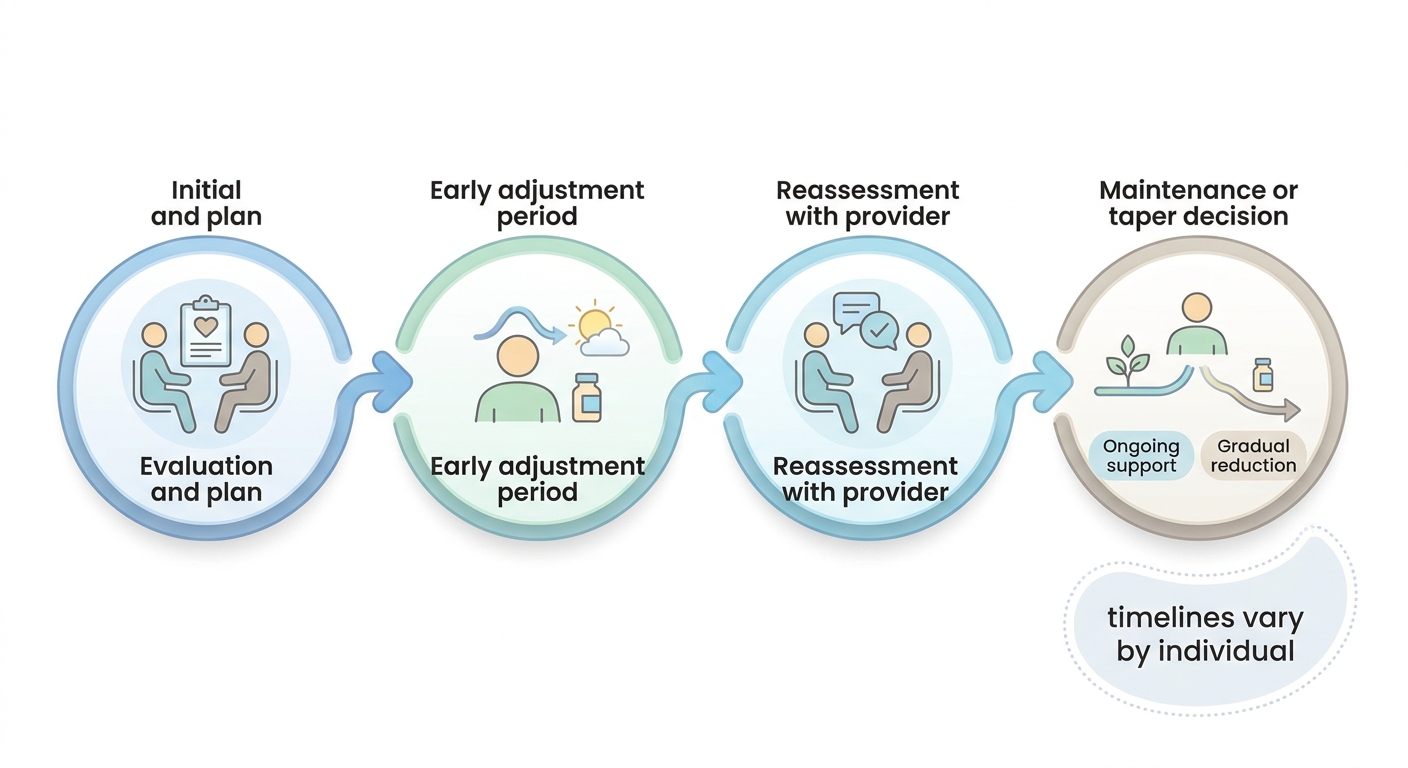
Expect weeks, not days. Prescribers generally ask patients to give an antidepressant several weeks at a therapeutic dose before judging whether it's helping, with some people noticing early shifts in sleep or physical tension sooner. Therapy follows a similar arc — A structured CBT course typically involves a series of weekly sessions over time, with duration varying by individual., with skills building progressively.
The first week or two can feel bumpy. Some people experience increased jitteriness, nausea, or sleep disruption early on that eases as the body adjusts. Knowing this in advance is useful, because it's the most common point at which people stop a medication prematurely. Report side effects to your prescriber rather than quitting unilaterally — dose and timing adjustments are routine.
Pharmacogenetic testing is sometimes used to inform these decisions, giving a prescriber extra information about how you metabolize certain medications. It doesn't remove the need for careful follow-up, and results vary in how much they change a plan.
⚠️ Never stop an anxiety medication abruptly. Several common medications require a planned taper, and sudden discontinuation can cause discontinuation symptoms. Always coordinate changes with your prescriber.
How Do You Find Anxiety Treatment Near You in Idaho?
Start with a psychiatric evaluation, confirm your insurance is accepted, and ask whether telehealth is available. Many Idaho patients can book directly without a physician referral, though specific requirements depend on your plan. Searching "anxiety treatment near me" turns up a long list — these questions narrow it fast.

Questions to ask before you book
- Do you take my insurance? Verify your specific plan, not just the carrier name. Our insurance partners page lists accepted plans.
- What is the self-pay rate if I'm uninsured? Ask for the cost of the initial evaluation and follow-ups separately.
- Do you offer telehealth? Video visits matter if you're rural, working, or managing childcare.
- Do I need a referral? Confirm with both the clinic and your plan.
- Do you prescribe, provide therapy, or both? Some practices handle medication management only; others coordinate both.
- What ages do you see? Important for families seeking care for teens or older adults.
- How soon is the first available appointment? Wait times vary by location and provider.
Geography shapes access in Idaho. The Treasure Valley has the densest concentration of providers, while smaller communities often depend on telehealth. We see patients for Boise anxiety and psychiatry appointments and serve Meridian, Eagle, Nampa and Emmett as well, with virtual visits available for patients who can't travel.
A few practical preparation steps make the first visit more productive:
- Bring a current medication list, including supplements and doses.
- Note your symptom timeline — when it started, what makes it better or worse.
- Write down family history of anxiety, depression or substance use.
- Bring recent lab results if you have them, especially thyroid panels.
- Complete a GAD-7 beforehand so you and your provider start with a shared baseline.
Key takeaway: The fastest route to relief is usually one scheduled evaluation, not another week of research. A provider can rule out medical mimics and build a plan in a single visit.
What Happens at Your First Anxiety Appointment?
A first psychiatric visit typically runs longer than a standard medical appointment — often around an hour — because it covers a lot of ground. Expect questions about your current symptoms, how long they've lasted, your medical and psychiatric history, family history, sleep, substance use, and what you've already tried.
The goal is a working diagnosis and a treatment plan you agree with. That plan might include therapy, medication, lab work to rule out physical causes, lifestyle targets, or some combination. You should leave knowing what happens next and when you'll follow up.
If you want a full walkthrough before you go, our detailed guide to what happens during a psychiatric evaluation covers the process step by step, including what to bring and what providers are listening for.
Summary
What causes anxiety disorders is rarely one thing. Inherited sensitivity, brain circuitry, stress load, medical conditions and substances all contribute, and most people carry several of these at once. That's encouraging rather than discouraging, because multiple contributing factors mean multiple points where change is possible.
Three things are worth carrying away. Adults usually feel anxiety in the body before they name it. Physical causes should be ruled out early. And anxiety therapy, medication, and lifestyle work are complementary tools rather than competing ones — a provider helps you decide which combination fits your situation.
This article is educational and not a substitute for individual medical advice. Treatment responses vary from person to person, and the right plan is determined in a clinical consultation.
Frequently Asked Questions
Can anxiety disorders be cured completely?
Many people reach a point where symptoms no longer interfere with daily life, though anxiety is more often described as well-managed than permanently cured. Evidence-based therapies and medication help a substantial number of people improve meaningfully, but outcomes vary by individual, severity and history. Some people experience a return of symptoms during high-stress periods and respond well to a short course of renewed treatment.
Is anxiety hereditary?
Partly, yes. Having a parent or sibling with an anxiety disorder raises your risk, but inheritance is probabilistic rather than deterministic. What appears to be passed down is a more reactive stress response, not the disorder itself. Plenty of people with strong family histories never develop an anxiety disorder, and plenty without one do.
What's the difference between anxiety and an anxiety disorder?
Anxiety is a normal, useful response to a perceived threat that fades once the threat passes. An anxiety disorder is persistent, out of proportion to the circumstances, and impairing — for generalized anxiety disorder, symptoms are generally present most days over a period of about six months. The practical test is interference: if worry is shaping what you avoid, you're past ordinary stress.
Can you treat anxiety without medication?
Yes. CBT, exposure therapy and ACT are established first-line options, and many people with mild-to-moderate anxiety improve without ever taking medication. Exercise, consistent sleep and reduced caffeine or alcohol support those gains. If symptoms are severe, or therapy alone hasn't produced enough change after a fair trial, it's reasonable to discuss medication with a prescriber.
Does insurance cover anxiety treatment in Idaho?
Most major commercial plans and Medicaid cover psychiatric evaluation and medication management, and Federal mental health parity rules are intended to make mental health benefits more comparable to medical benefits, though specifics vary by plan., though specifics vary by plan.. Coverage specifics — copays, deductibles, visit limits, telehealth — vary by plan, so verify yours directly. Federal billing protections under the No Surprises Act also give uninsured and self-pay patients the right to a good faith estimate.