Anxiety Medication vs Therapy: How Treatment Is Chosen
Integrity Mental Health Editorial ·

Choosing between anxiety medication and therapy is one of the most common questions people bring to a first psychiatric visit — and the honest answer is that the two do different jobs. This guide walks through how each form of anxiety treatment works, what the trade-offs look like, and how clinicians in Idaho and Utah decide where to start with you rather than for you.
Quick Answer
There is no single best anxiety treatment for everyone. Clinicians generally consider starting with therapy — most often cognitive behavioral therapy (CBT) — when symptoms are mild and recent. When anxiety is more severe, comes with panic attacks, or occurs alongside depression, providers often discuss adding medication such as an SSRI. For many adults with moderate-to-severe symptoms, combining both is the approach clinicians most commonly recommend. The right plan depends on your severity, history, and preferences.
TL;DR
- Mild, recent anxiety often starts with therapy. Skills-based treatment gives you tools you keep using later. Compare the main evidence-based therapy types
- Medication targets the physical side of anxiety — the racing heart, the constant edge, the sleep disruption. See how anxiety medication works in the brain
- The two approaches differ in speed, durability, cost, and effort, not just effectiveness. Review the side-by-side trade-offs
- Combined care is commonly recommended for moderate-to-severe anxiety, because lowering arousal can make therapy work feel more manageable. Read why clinicians combine the two
- Plans get adjusted. A first choice is a starting point, not a life sentence. See how a first appointment builds your plan
In This Article
- How Does Anxiety Medication Actually Work?
- What Types of Therapy Treat Anxiety?
- Anxiety Medication vs Therapy: Side-by-Side
- Which Should You Start With?
- Is Combining Medication and Therapy Better Than Either Alone?
- How Long Until Each Option Works?
- What About Side Effects, Dependence, and Tapering?
- What Does Anxiety Treatment Cost in Idaho?
- How to Start Treatment in Idaho or Utah
- Frequently Asked Questions
How Does Anxiety Medication Actually Work?
Anxiety medication works by adjusting the chemical signaling that sets your baseline level of alertness. Most first-line options act on serotonin, a neurotransmitter involved in mood and threat response. The goal is not sedation. It is turning down a nervous system that is running too hot.
An SSRI (selective serotonin reuptake inhibitor) is a class of medication that increases the amount of serotonin available between nerve cells. Sertraline and escitalopram are two commonly prescribed examples.
An SNRI (serotonin-norepinephrine reuptake inhibitor) acts on serotonin and norepinephrine together. Venlafaxine and duloxetine fall in this group.
Other medications are used in more specific situations:
- Buspirone — a non-sedating anti-anxiety medication sometimes used on its own or alongside an antidepressant.
- Hydroxyzine — an antihistamine that may be prescribed for short-term relief of anxiety symptoms.
- Propranolol — a beta-blocker sometimes used for the physical symptoms of performance anxiety, such as a pounding heart or shaking hands.
- Benzodiazepines (for example, lorazepam or alprazolam) — fast-acting but carry a recognized risk of tolerance and dependence, which is why they are generally not considered a long-term solution for chronic anxiety.
Who prescribes and monitors anxiety medication?
Psychiatric providers — psychiatrists, psychiatric nurse practitioners, and physician assistants with psychiatric training — prescribe and monitor these medications. Primary care physicians also prescribe them, and often do so well for straightforward cases.
What specialty care adds is closer follow-up. Psychiatric medication management involves starting at a low dose, checking how you respond, adjusting, and switching if the first choice is not a good fit. Dosing decisions, interactions with other medications, and any history of bipolar disorder or substance use all factor into the choice.
⚠️ Never start, stop, or change the dose of a psychiatric medication on your own. Abrupt changes can cause uncomfortable symptoms, and some decisions depend on medical history only a clinician can review with you.
Key takeaway: Anxiety medication lowers the body's baseline arousal through neurotransmitter signaling, and the specific drug chosen depends on your symptom pattern and health history — not on a one-size-fits-all default.
What Types of Therapy Treat Anxiety?
The therapy approaches with the strongest research support for anxiety disorders are cognitive behavioral therapy, exposure-based therapy, and acceptance and commitment therapy. All three are structured and goal-directed. None of them require you to spend years talking about childhood.
Matching the method to the diagnosis matters, because generalized worry, panic, social anxiety, and obsessive-compulsive patterns respond to different techniques. You can read more about anxiety as a condition we treat for how these presentations differ.
What is cognitive behavioral therapy?
Cognitive behavioral therapy (CBT) is a structured, time-limited therapy that targets the thought-and-behavior loops that keep anxiety running. You identify the thoughts that spike anxiety, test them against evidence, and change the behaviors — usually avoidance — that keep the fear alive. Sessions typically include homework between visits.
How does exposure therapy work?
Exposure therapy works by gradually and deliberately approaching what you have been avoiding, in a planned order, until your nervous system learns the feared outcome does not arrive. For obsessive-compulsive disorder, the specific form is exposure and response prevention (ERP), where you face the trigger and skip the compulsion.
Exposure is collaborative. You and your therapist build the list together, starting with items you can manage.
What is acceptance and commitment therapy?
Acceptance and commitment therapy (ACT) is an approach that teaches you to make room for anxious feelings instead of fighting them, while taking action toward what you value. Rather than arguing with anxious thoughts, you practice noticing them and continuing anyway.
| Therapy approach | Often used for | Typical structure |
|---|---|---|
| Cognitive behavioral therapy (CBT) | Generalized anxiety, panic, social anxiety | Weekly sessions for a defined course, with between-session practice |
| Exposure / ERP | Phobias, panic, OCD, social avoidance | Weekly sessions built around a graded exposure plan |
| Acceptance and commitment therapy (ACT) | Chronic worry, anxiety plus low mood | Weekly or biweekly, values- and skills-focused |
| Mindfulness-based stress reduction | Stress reactivity, physical tension | Group format, set number of weeks, daily practice |
Anxiety therapy also works through telehealth for many people, which matters in a state where a specialist may be an hour's drive away.
Key takeaway: The best-supported anxiety therapies are structured, time-limited, and chosen to match your specific symptom pattern rather than applied generically.
Anxiety Medication vs Therapy: Side-by-Side
Medication and therapy work on different parts of the same problem. Medication changes the body's alarm sensitivity. Therapy changes how you respond to the alarm. Comparing them on effectiveness alone misses the trade-offs that actually drive the decision.
| Factor | Medication | Therapy |
|---|---|---|
| Main mechanism | Adjusts neurotransmitter signaling to lower baseline arousal | Retrains thought patterns and avoidance behaviors |
| Time commitment | Brief follow-up visits, less frequent once stable | Regular sessions plus between-session practice |
| Effort required | Low day-to-day effort | Active participation is part of the treatment |
| Common downsides | Side effects, trial-and-error to find the right fit | Takes scheduling, energy, and willingness to face triggers |
| After you stop | Symptoms may return; tapering is planned with a clinician | Skills learned generally stay available to you |
| Cost pattern | Ongoing prescription plus periodic visits | Per-session cost over a defined course |
| Availability | In person or via telehealth with a prescriber | In person or via telehealth with a therapist |
Neither column is the "winner." A person with crushing physical symptoms who cannot concentrate long enough to do therapy homework may need medication to make therapy usable. Someone with situational anxiety tied to a specific fear may do well with exposure work alone.
Preference counts too. If you strongly do not want to take a daily medication, that is a legitimate clinical input, not an obstacle. If you cannot commit to weekly sessions right now, that matters as well.
Key takeaway: Medication tends to reduce the body's alarm response with less daily effort, while therapy builds skills you keep — which is why the comparison is about fit and trade-offs, not about which one is better.
Which Should You Start With?
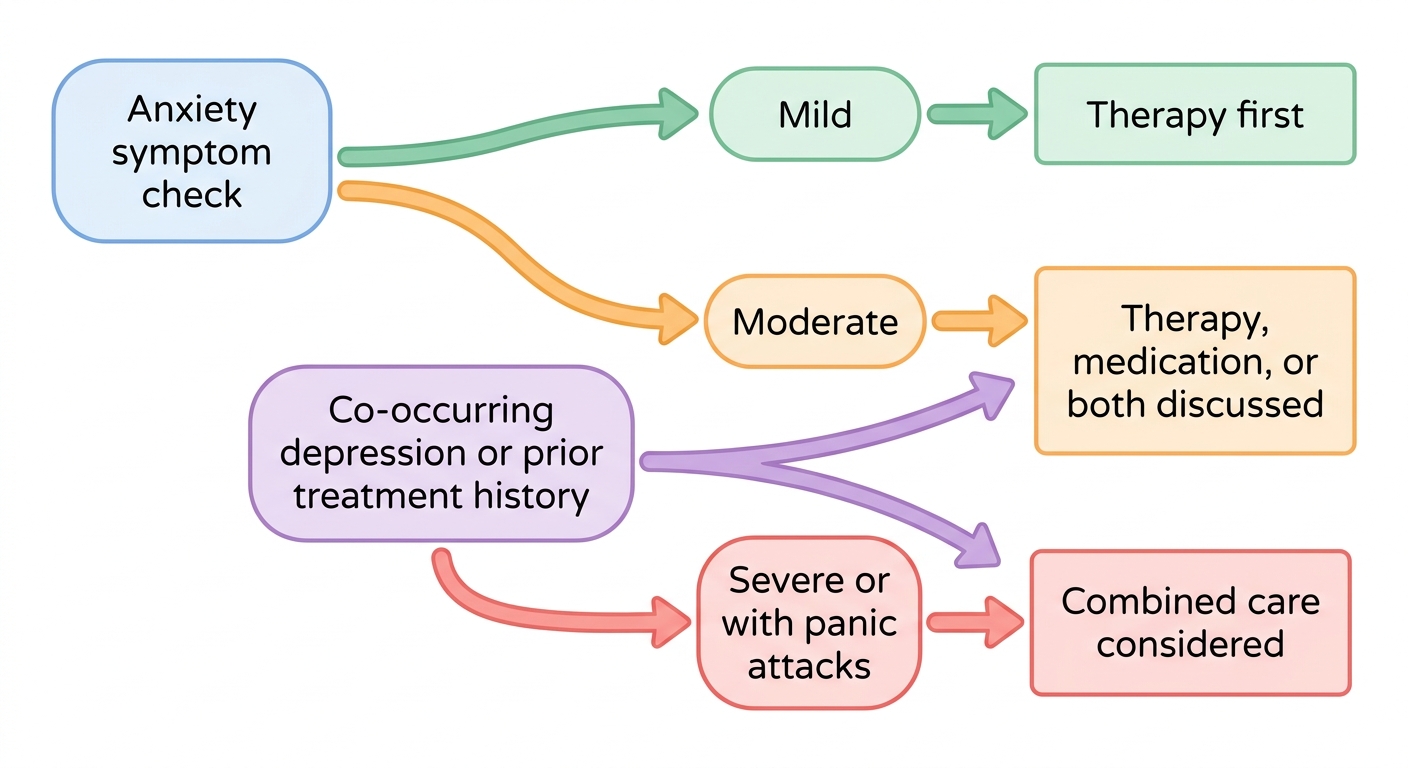
Three things usually decide the starting point: how severe your symptoms are, what kind of anxiety you have, and what you have tried before. Clinicians weigh those together in the first visit.
A common pattern looks like this:
- Mild symptoms, no prior episodes — therapy first is a frequent recommendation, with medication reconsidered if progress stalls.
- Moderate symptoms interfering with work, school, or sleep — providers often discuss both options and may suggest starting them together.
- Panic disorder with frequent attacks — medication plus CBT is a combination clinicians commonly consider, because panic attacks can make exposure work very hard to tolerate alone.
- Anxiety with co-occurring depression — medication tends to enter the conversation earlier, since both conditions may respond to the same class of medication.
- A previous medication that worked well — history is one of the strongest guides to what to try again.
How do you measure anxiety severity?
Clinicians use brief, standardized questionnaires to put a number on something that otherwise feels unmeasurable. The most common one for anxiety is the GAD-7, a short set of questions about how often specific symptoms bothered you over the past two weeks.
Your total score lands in a mild, moderate, or severe range. That band does not diagnose you, but it gives you and your provider a shared starting point — and a way to tell whether things are moving later. You can take the free GAD-7 anxiety self-assessment before your first visit and bring the result with you.
Severity is not the only input. Pregnancy, other medical conditions, current medications, substance use, and your own preference all shape the recommendation. Two people with identical scores can reasonably end up with different plans.
⚠️ A self-assessment score is a conversation starter, not a diagnosis. If you are having thoughts of harming yourself, call or text 988 — the Suicide & Crisis Lifeline — or go to your nearest emergency department.
Is Combining Medication and Therapy Better Than Either Alone?
For moderate-to-severe anxiety, combined care is the approach clinicians most commonly recommend. Many clinicians present medication and CBT together as an option worth discussing when symptoms are significant, and some providers report that the two approaches can complement each other. Results still vary from person to person.
The reasoning is mechanical, not magical. Exposure work asks you to sit with discomfort on purpose. When baseline arousal is extremely high, that discomfort can feel unmanageable, and people drop out. Lowering the physical intensity of anxiety can make the therapy work feel possible.

Combination care also addresses two different risks at once:
- Medication without therapy leaves the avoidance habits untouched, which some clinicians point to as a reason symptoms can resurface after stopping.
- Therapy without medication can be hard to engage with when sleep, concentration, and physical symptoms are severe.
Combining does not mean forever. A frequent pattern is to use both during the hardest stretch, then revisit whether medication is still needed once therapy skills are solid. That decision is made with your prescriber, never on your own.
Key takeaway: Combined anxiety care is commonly recommended for more severe symptoms because medication can lower arousal enough to make active therapy work tolerable — but duration and need are reassessed over time.
How Long Until Each Option Works?
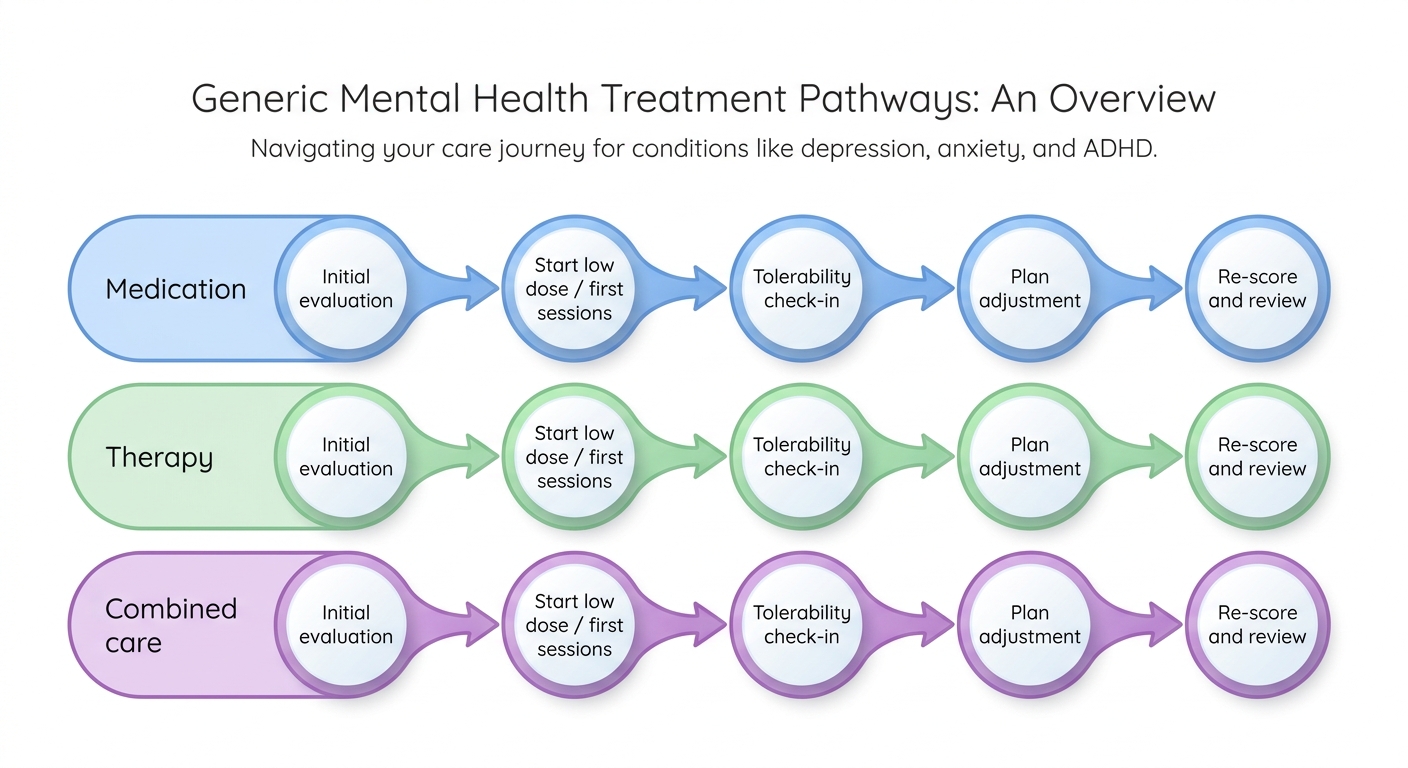
Neither option is instant, and expectations are where most people get tripped up. Antidepressant-class medications used for anxiety are not designed for same-day relief, and therapy builds skills over a course of sessions. What you can count on is a schedule of check-ins designed to catch problems early.
Here is how the monitoring usually unfolds:
- Starting medication — your prescriber begins at a low dose and schedules a follow-up to review how you are tolerating it before adjusting.
- Early weeks — side effects, if they appear, often show up before any benefit does. This is the most common point at which people stop too soon, which is exactly why the follow-up visit exists.
- Starting therapy — the first sessions are usually assessment and skill-building; active exposure or behavioral work comes after the plan is set.
- Re-measuring — many providers re-administer the GAD-7 periodically so change is tracked with data, not just memory.
What should you track between appointments?
Keep a short, simple log. It makes follow-up visits far more productive than trying to recall six weeks from memory.
- Sleep — hours, and how long it takes to fall asleep
- Avoidance — what you skipped this week because of anxiety
- Physical symptoms — racing heart, stomach trouble, muscle tension
- Side effects — what, when, and how bad
- Your GAD-7 score — re-taken on a consistent schedule
⚠️ If a new medication causes severe side effects, worsening mood, or any thoughts of self-harm, contact your prescriber right away rather than waiting for your next scheduled visit.
What About Side Effects, Dependence, and Tapering?
Most people tolerate first-line anxiety medications, but side effects are real and worth discussing before you start. Commonly reported ones with SSRIs and SNRIs include nausea, headache, changes in sleep, and sexual side effects. Many are dose-related, and some ease as the body adjusts — though not for everyone, and persistent side effects are a valid reason to change course.
Discontinuation syndrome is the cluster of flu-like, dizzy, or "electric shock" sensory symptoms that can appear when an antidepressant is stopped abruptly. It is not addiction. It is a withdrawal-type reaction that a gradual, planned taper is designed to minimize.
Dependence is a different issue and applies mainly to benzodiazepines. These medications carry a recognized risk of tolerance and physical dependence with ongoing use, which is why they are generally reserved for short-term or situational use rather than chronic anxiety management.
⚠️ Do not stop an antidepressant or anti-anxiety medication cold turkey, even if you feel better. Ask your prescriber for a taper plan.
What if the first medication does not work?
Not responding to the first medication is common and does not mean treatment has failed. The standard next steps are adjusting the dose, switching within or across classes, or adding a second agent.
When several trials have not worked or side effects keep derailing things, pharmacogenetic testing and advanced psychopharmacology can add information to the decision. Pharmacogenetic testing looks at how your genes affect the way your body processes certain medications. It does not pick a drug for you, and it is not a guarantee of a better outcome — it is one more input that may help narrow the options when trial-and-error has been frustrating.
That trial-and-error burden is a real cost of anxiety treatment, and it is one reason close follow-up matters more than the specific first prescription.
What Does Anxiety Treatment Cost in Idaho?
Cost depends on your coverage, the type of visit, and whether you use insurance or self-pay. With insurance, most patients pay a copay or coinsurance per visit, plus whatever their plan sets for prescriptions. Generic versions of common anxiety medications are typically among the lower-cost options at most pharmacies.
| Service | With insurance | Self-pay |
|---|---|---|
| Therapy session | Specialist copay or coinsurance per visit | Per-session rate set by the provider |
| Initial psychiatric evaluation | Copay or coinsurance; longer visit | Higher than a follow-up; quoted in advance |
| Psychiatry follow-up visit | Copay or coinsurance; shorter visit | Lower than the initial evaluation |
| Medication | Plan formulary tier; generics usually lowest tier | Pharmacy price; discount programs may apply |
| Combined care | Both visit types billed separately | Both visit types billed separately |
Check your specific benefits before your first visit, and review the insurance plans we partner with to see whether your carrier is listed. Coverage details vary by plan, even within the same insurer.
What protections exist if you are paying out of pocket?
Under the federal No Surprises Act, patients who are uninsured or not using insurance are entitled to a good-faith estimate of expected charges before scheduled care. Ask for it. It turns an unknown into a number you can plan around.
Two other access factors matter in the Treasure Valley:
- Telehealth — virtual visits remove drive time, which can make weekly anxiety therapy realistic for people in outlying communities.
- Location spread — in-person care is available across Boise, Meridian, Eagle, Nampa, and Emmett, so a Meridian, Idaho resident does not have to drive to a different county for a follow-up.
Key takeaway: With insurance, anxiety care usually comes down to per-visit copays plus prescription costs; self-pay patients can request a written good-faith estimate before scheduling.
How to Start Treatment in Idaho or Utah
The fastest route is a psychiatric consultation where your symptoms are scored, the options are explained in plain language, and a plan is built with you. No one hands you a prescription at the door and sends you off.
A first visit generally covers your symptom history, past treatment, medical conditions, family history, sleep, substance use, and what you want out of care. If you want the full walkthrough, our guide on what happens during a psychiatric evaluation covers the appointment step by step.
Bring these to your first appointment:
- A current list of all medications and supplements, with doses
- Your GAD-7 score, if you took the self-assessment
- Your insurance card and photo ID
- A short note on what has and has not helped before
- Any questions you want answered — write them down, anxiety eats memory
You can schedule a consultation at our Boise, Meridian, and Eagle offices, or ask about a telehealth visit if driving in is difficult. Patients in Meridian, Idaho and nearby communities can usually choose whichever format fits their week.
Frequently Asked Questions
What are the treatment options for anxiety disorders?
There are five broad categories. Psychotherapy includes CBT, exposure therapy and ERP, and ACT. Medication includes SSRIs and SNRIs as first-line options. Adjunct medications such as buspirone, hydroxyzine, or propranolol are used in specific situations. Lifestyle levers — sleep regulation, exercise, and reducing alcohol and caffeine — support the rest. Finally, combined care pairs therapy with medication, which clinicians often recommend for more severe symptoms.
What does it mean to feel anxious about being anxious?
That is called anxiety sensitivity, sometimes described as meta-anxiety: fear of the physical sensations of anxiety themselves. A racing heart triggers the thought "something is wrong," which raises the heart rate further, which confirms the fear. This loop is a central driver of panic disorder. Interoceptive exposure — deliberately and safely producing those sensations in session, with a therapist — is the technique designed to target it.
How do you deal with anxiety when you're alone?
A few concrete techniques can help in the moment:
- Paced breathing — inhale for about four seconds, exhale for about six, so the exhale is longer than the inhale
- 5-4-3-2-1 grounding — name five things you see, four you can touch, three you hear, two you smell, one you taste
- Scheduled worry time — set a fixed window later in the day to think the worry through, then redirect until then
- Movement — a short walk changes your physical state faster than trying to argue with the thought
These are coping tools, not treatment. If your GAD-7 score lands in the moderate or severe range, talk to a provider. In a crisis, call or text 988.
Are there good videos and apps for learning about anxiety?
Yes. Federal health agencies and established nonprofit mental health organizations publish free, plain-language explainer videos about anxiety disorders, and several free apps teach breathing, grounding, and CBT-style thought records. Look for resources produced by government health agencies, universities, or accredited clinical organizations rather than unverified influencers. App-based CBT can be a useful supplement between sessions, but it is not a replacement for evaluation and treatment.
Can you treat anxiety without medication?
Yes — many adults with mild-to-moderate anxiety are treated with therapy alone. CBT and exposure-based approaches are well supported for anxiety disorders, and regular exercise and consistent sleep are commonly recommended supports alongside them. Whether a medication-free plan is appropriate for you depends on your severity, any co-occurring conditions, and how you respond over time. That assessment belongs in a clinical consultation, not a self-diagnosis.
Summary
The anxiety medication vs therapy question has a better framing: what does your nervous system need first, and what do you need to keep long-term? Medication adjusts baseline arousal with relatively little daily effort. Therapy builds skills that stay with you. For moderate-to-severe symptoms, clinicians most often recommend both, because each covers the other's gap.
Severity, symptom type, treatment history, and your own preferences all shape where anxiety treatment starts — and the plan is meant to be revisited as you respond. Score your symptoms with the GAD-7, write down your questions, and bring both to a consultation. A good first visit should leave you understanding your options, not just holding a prescription.