Anxiety Treatment in Eagle, Idaho: What Care Looks Like
Integrity Mental Health Editorial ·
Anxiety treatment in Eagle, Idaho usually comes down to three practical paths — therapy, prescriber-led medication management, or the two combined. Directory listings tell you who is nearby, but rarely how to choose. This guide walks through what each option involves, what it tends to cost, how access works in the Treasure Valley, and how to pick a sensible starting point.
Quick Answer
Anxiety treatment in Eagle, Idaho generally begins with one of three options: evidence-based therapy (most often cognitive behavioral therapy or exposure therapy), psychiatric medication management with an SSRI or SNRI, or both together. Most clinics start with a screening questionnaire — commonly the GAD-7 — plus a clinical interview to clarify the diagnosis. You can complete an anxiety self-assessment (GAD-7) before you ever book.
TL;DR
- Therapy and medication are tracks, not rivals. Clinicians often consider combined care when symptoms are moderate to severe. Compare the main therapy types
- SSRIs are not fast-acting. Prescribers usually plan a reassessment several weeks out rather than expecting immediate change. See how medication management works
- Your starting point depends on severity, history, and access — not on which option sounds easiest. Walk the decision path
- Cost hinges on insurance status far more than on which clinic you pick. Review the cost comparison
- Eagle is a small market, so telehealth widens your options considerably. Check local access realities
In This Article
Here is the path this guide takes, so you can jump straight to what you need.
- What Does Anxiety Care Actually Involve?
- Which Therapy Types Work Best for Anxiety?
- How Does Medication Management Fit In?
- How Do You Choose Where to Start?
- What Causes Anxiety to Keep Coming Back?
- What Does Anxiety Treatment Cost in the Treasure Valley?
- What Is Access Like for Anxiety Care in Eagle, Idaho?
- What Can You Do Between Appointments?
What Does Anxiety Care Actually Involve?
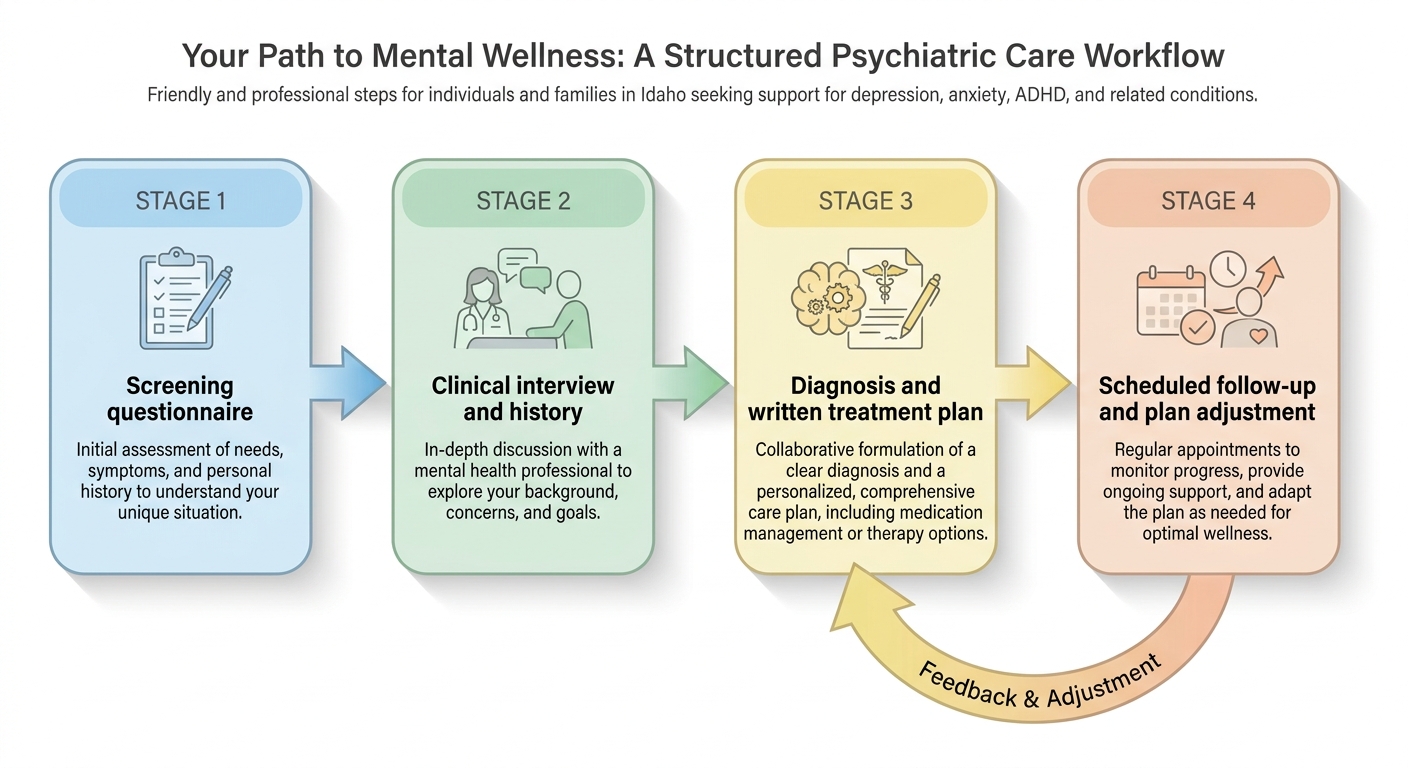
Anxiety care is a sequence, not a single appointment. Anxiety care is the coordinated process of screening, diagnosing, and treating an anxiety disorder over time, with scheduled follow-ups to adjust the plan.
Most first visits include four things:
- Screening. A brief questionnaire, commonly the GAD-7, which scores recent symptoms on a 0–21 scale. Higher scores generally signal heavier symptom load, and many clinicians treat a score around 10 as the point to look more closely.
- Clinical interview. Your history, sleep, substance use, medical conditions, and what daily life actually looks like right now.
- Diagnostic clarification. Anxiety is not one condition. The DSM-5-TR separates generalized anxiety disorder, panic disorder, and social anxiety disorder, among others — and the distinction changes the treatment plan.
- A written plan with a follow-up date. Care without a review date tends to drift.
The GAD-7 is a seven-item questionnaire about how often anxiety symptoms have bothered you over the past two weeks, with each item scored 0 to 3. Scores of roughly 5, 10, and 15 are the thresholds commonly cited for mild, moderate, and severe symptom levels. It is a screening tool, not a diagnosis — the number starts the conversation, and the clinical interview finishes it. The DSM-5-TR, published by the American Psychiatric Association, is the reference clinicians use to name the specific disorder behind that score.
Our anxiety treatment overview explains how these steps fit together across conditions.
Key takeaway: A good first appointment should end with a named diagnosis direction, a starting treatment, and a date to review how it is going.
Which Therapy Types Work Best for Anxiety?
Cognitive behavioral therapy has the deepest research base for anxiety disorders, and exposure-based work is widely considered first-line for panic and specific phobias. Other approaches earn their place when avoidance, rumination, or emotion regulation dominate the picture.

| Approach | Best suited for | Typical course | What a session feels like | Evidence standing |
|---|---|---|---|---|
| CBT | Generalized anxiety, social anxiety, panic | Often around 12–16 sessions | Structured; you identify thought patterns and test them with homework between visits | Strongest and most widely studied for anxiety disorders |
| Exposure / ERP | Panic, phobias, OCD-related anxiety | Varies; often a defined, graded sequence | You approach feared situations in planned steps, without the usual safety behaviors | Widely regarded as first-line for phobic and panic presentations |
| ACT | Chronic worry, anxiety tangled with life values | Often open-ended or time-limited by agreement | Less about arguing with thoughts, more about acting on what matters anyway | Established evidence base; often used when avoidance is the main obstacle |
| DBT skills | Intense emotional swings alongside anxiety | Often group-based skills modules | Practical drills: distress tolerance, emotion regulation, grounding | Originally developed for emotion dysregulation; skills are commonly applied more broadly |
| EMDR | Anxiety linked to trauma memories | Varies by case | Guided recall paired with bilateral stimulation such as eye movements | Recognized trauma treatment; used selectively rather than as a general anxiety first choice |
A few practical notes that directories rarely mention:
- Session count is a plan, not a promise. Progress is reviewed as you go, and courses often get extended or shortened.
- Homework matters. CBT and exposure both rely on practice between visits.
- Fit counts. If you dread the sessions themselves, say so early — the approach can be adjusted.
- Progress is usually measured, not guessed. Many therapists re-administer the GAD-7 every few weeks so improvement shows up as a changing score rather than an impression.
Exposure therapy is a structured approach in which you approach feared situations in planned, graded steps while dropping the safety behaviors that normally keep anxiety in place. It is the approach most often recommended when avoidance — not worry itself — is what is shrinking your life.
If you are weighing a therapy referral against seeing a prescriber, our deeper piece on how clinicians weigh medication against therapy lays out the reasoning behind that call.
Key takeaway: Pick the approach that matches your dominant symptom — worry, avoidance, panic, or trauma — rather than the acronym you have heard most often.
How Does Medication Management Fit In?
Medication is usually considered when symptoms interfere with work, sleep, or relationships, or when therapy alone has stalled. It is a track you can start, pause, or combine — not a last resort.
Medication management is ongoing prescribing plus structured follow-up to track response, side effects, and dosing over time. That follow-up is the part that makes it work.
What prescriber-led care typically covers:
- First-line options. SSRIs and SNRIs are the usual starting classes for anxiety disorders.
- A realistic timeline. These medications are not expected to work the day you start them. Prescribers commonly schedule a reassessment several weeks out — often around four to six — before judging the dose.
- Short-term adjuncts. Benzodiazepines are generally used sparingly and briefly because of dependence and tolerance concerns. Other non-habit-forming options may be discussed.
- Side-effect review. Early side effects and whether they are settling are standard agenda items at every check-in.
Some Idaho practices also offer pharmacogenetic testing — a cheek-swab test intended to give prescribers additional information about how you may metabolize certain medications. It informs decisions rather than replacing clinical judgment. Our integrative patient care model describes how that testing sits alongside advanced psychopharmacology, and you can see the full range of psychiatry services in Idaho we provide.
⚠️ Never stop an SSRI or SNRI abruptly on your own. Stopping suddenly can cause discontinuation symptoms. Any taper should be planned with your prescriber, even if you feel fine.
How Do You Choose Where to Start?
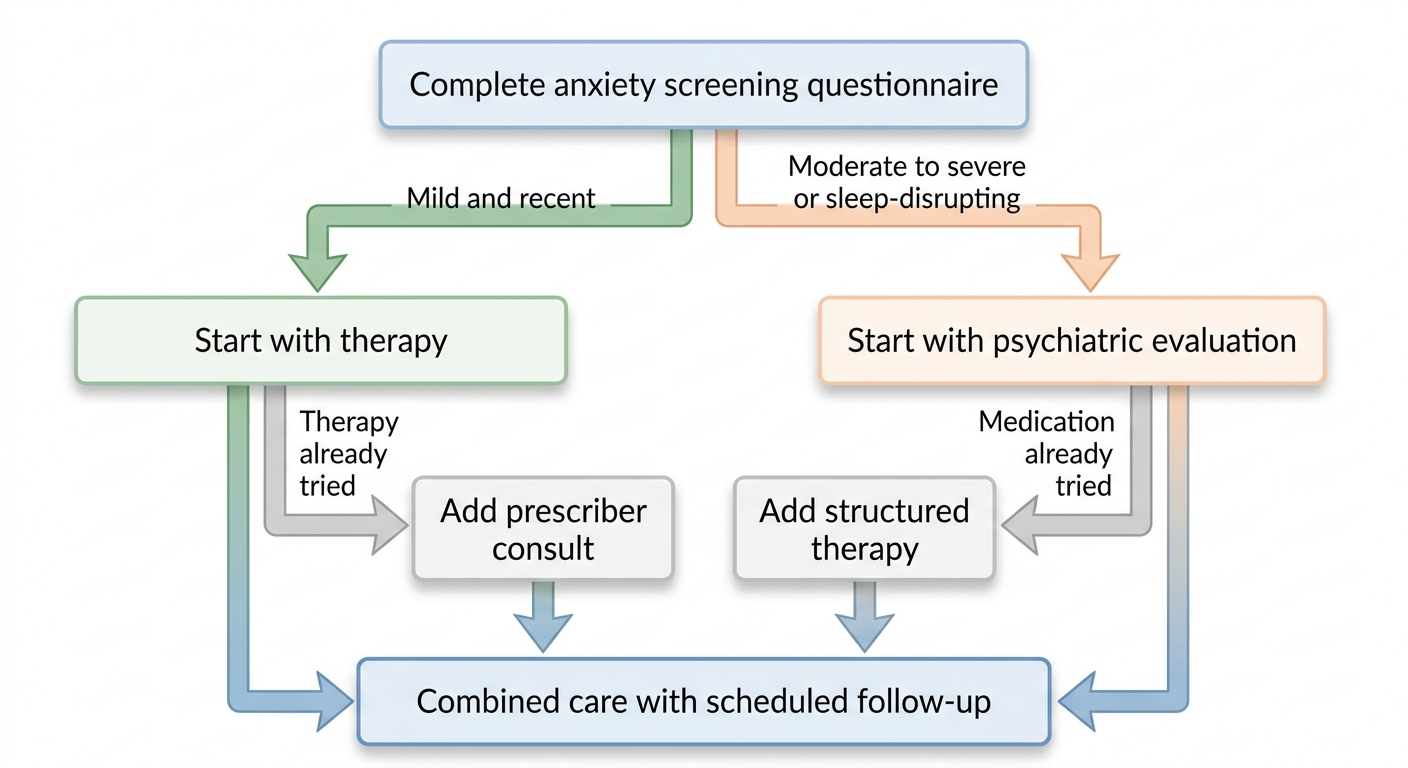
Start with severity, duration, and what you have already tried. Mild, recent symptoms often begin with therapy. Moderate-to-severe symptoms — especially those wrecking your sleep or your ability to work — frequently begin with a psychiatric evaluation so both tracks can be considered at once.
Walk it in order:
- Screening score. A brief GAD-7 gives you and the clinician a shared starting number.
- Duration. Weeks of stress after an identifiable event is a different situation from years of background worry.
- Treatment history. If you have completed a full course of CBT without much change, a prescriber consult is a reasonable next step. If you have taken medication without therapy, the reverse may apply.
- Functional impact. Panic attacks, avoided obligations, and broken sleep push toward a combined conversation.
- Access and insurance. The best plan is the one you can actually attend consistently.
If the evaluation route is unfamiliar, our walkthrough of what happens during a psychiatric evaluation covers the appointment step by step, including what you will be asked and how long it typically runs.
Key takeaway: There is no wrong door — but choosing deliberately, based on severity and history, usually beats choosing by whichever clinic answers the phone first.
What Causes Anxiety to Keep Coming Back?
Recurrence usually traces back to one of four things: avoidance creeping back in, stopping treatment early, untreated sleep problems, or an unaddressed co-occurring condition.
Avoidance is the quiet one. Every skipped meeting or declined invitation lowers anxiety in the moment and reinforces it over time. That is why exposure practice is often maintained after symptoms settle.
Co-occurring conditions matter just as much. Anxiety frequently travels with OCD, depression, and alcohol use disorder. Treating the anxiety alone while another condition goes unscreened tends to produce partial results.
A practical relapse-prevention checklist:
- Keep practicing exposure — even in small doses, after symptoms improve.
- Taper only with a clinician, never on your own timeline.
- Protect sleep before assuming the anxiety itself has worsened.
- Ask to be screened for depression, OCD, and substance use at least once.
- Schedule booster sessions rather than waiting for a full relapse to re-engage.
- Re-take the GAD-7 periodically so changes show up as data, not just a feeling.
For the underlying biology, temperament, and environmental factors behind recurrence, see our deep dive on what causes anxiety disorders.
Key takeaway: Returning symptoms are usually a signal to review the plan with your clinician — not evidence that treatment failed.
What Does Anxiety Treatment Cost in the Treasure Valley?
Cost depends far more on your insurance status than on which Eagle-area provider you pick. The same visit can carry three very different prices depending on how it is billed.
| Payment route | First visit | Follow-up visits | Therapy sessions |
|---|---|---|---|
| In-network insurance | Copay or coinsurance after deductible | Copay or coinsurance | Copay per session; some plans limit annual visits |
| Cash pay / self-pay | Published flat rate, typically higher than follow-ups | Lower flat rate, often spaced every few months | Flat per-session rate |
| Sliding scale | Income-based, where a practice offers it | Income-based | Income-based; availability varies by practice |
Several Eagle-area psychiatry and counseling practices publish self-pay rates in their directory listings, with a higher one-time consultation fee and lower follow-up pricing scheduled every few months. Those figures are set by each practice, change over time, and should be confirmed directly before you book.
Two things reliably shift the math:
- In-network status. Verify it by plan name, not just insurer name. Check the insurance partners we work with before your first call.
- Good-faith estimates. Under the federal No Surprises Act, uninsured and self-pay patients are entitled to a good-faith estimate of expected charges. Our billing rights and surprise-bill protections page explains how that works.
Key takeaway: Ask two questions on your first call — "Are you in-network with my specific plan?" and "What is the self-pay rate if you are not?" Those answers determine most of your cost.
What Is Access Like for Anxiety Care in Eagle, Idaho?
Eagle residents realistically have three access routes: clinics in town, Boise and Meridian options roughly 10–20 minutes away, and telehealth that removes the drive entirely.

Eagle is a small market, so in-town availability can be limited at any given moment. That is not a reason to wait — it is a reason to widen the search radius before you give up. You can see details for our Eagle, Idaho location, and nearby Boise and Meridian clinics draw from the same Treasure Valley patient base.
Telehealth is worth understanding clearly. Idaho-licensed clinicians can generally see patients located in Idaho by video, which means a provider based in Boise or Nampa may be just as available to you as one on State Street. For medication management follow-ups in particular, video visits are common.
Telehealth is a live video or phone appointment with a licensed clinician, conducted from wherever you are, and it is subject to the same privacy and documentation standards as an in-office visit.
| Access route | Travel time from Eagle | Works best for | Trade-off |
|---|---|---|---|
| In-town Eagle clinic | Minimal | First visits, in-person therapy, staying close to home | Smallest pool of providers, so waits can be longer |
| Boise or Meridian clinic | Roughly 10–20 minutes | Wider provider choice, specialty approaches like ERP or EMDR | A standing drive built into every appointment |
| Telehealth with an Idaho-licensed clinician | None | Medication follow-ups, ongoing therapy, tight work schedules | Needs private space and a steady internet connection |
Questions worth asking when you call:
- What is the current wait for a new-patient appointment?
- Do you offer both in-person and telehealth, and can I switch between them?
- Is the first visit with the prescriber or with an intake coordinator?
- Do you provide therapy in-house, or will I need a separate referral?
- Are evening or early-morning slots available?
Key takeaway: If the first clinic you call has a long wait, widen the radius or switch to telehealth rather than postponing care.
What Can You Do Between Appointments?
Most anxiety improvement happens between sessions, not during them. The practice is the treatment; the appointment is the coaching.
Between-visit basics worth trying:
- Paced breathing. A slow pattern with a longer exhale than inhale, practiced daily — not only during a spike.
- A worry window. Set aside a fixed 15 minutes to worry deliberately, then postpone worries that surface outside it.
- Graded exposure logging. Write down the situation, your anxiety rating before and after, and what you avoided. Patterns show up fast.
- Caffeine and sleep audit. Caffeine can mimic and amplify anxiety symptoms. Shifting it earlier in the day, and protecting a consistent sleep schedule, is a low-cost experiment.
- A coping card. Three written lines you can read when thinking clearly is hard.
None of this replaces treatment. Self-help tends to work best as a complement to a structured plan, and it is not a substitute for assessment when symptoms are worsening.

⚠️ Seek urgent care for chest pain, trouble breathing that does not ease, or any thoughts of harming yourself. In the U.S., you can call or text 988 to reach the Suicide & Crisis Lifeline, 24/7.
Key takeaway: Daily practice between visits is what turns a treatment plan into a change you can feel.
Frequently Asked Questions
What are the treatment options for anxiety disorders?
The main options are psychotherapy, medication, and the two combined. Psychotherapy commonly means CBT, exposure or ERP, and ACT. Medication commonly starts with SSRIs or SNRIs, with other agents considered case by case. Lifestyle supports — sleep, exercise, caffeine reduction — are typically added alongside rather than used on their own. The National Institute of Mental Health publishes free overviews of each category.
What does it mean to feel anxious about being anxious?
Anxiety sensitivity is fear of the physical sensations of anxiety themselves — a racing heart read as danger rather than as adrenaline. It is a documented maintaining factor in panic disorder, because the fear of the sensation triggers more of the sensation. Interoceptive exposure, which deliberately and safely brings on those sensations in session, is the technique that specifically targets it.
How do you deal with anxiety when you're alone?
Grounding and scheduled contact tend to help more than distraction. The 5-4-3-2-1 technique — naming five things you see, four you feel, three you hear, two you smell, one you taste — pulls attention back to the present. Keep a pre-written coping card within reach. If you are in crisis, call or text 988 at any hour.
Are videos and apps useful for learning about adult anxiety?
Yes as supplements, no as substitutes. Clinician-produced explainers and guided breathing videos can make a technique click faster than a written description. Free, credible material is published by the National Institute of Mental Health and through VA/DoD CBT resources. They do not diagnose, adjust medication, or notice when something else is going on — that still requires a clinician.
How long does anxiety treatment usually take?
It depends on the track. Structured therapy courses for anxiety are frequently planned around 12–16 sessions, with progress reviewed along the way. Medication is typically reassessed about four to six weeks after a start or dose change, because SSRIs and SNRIs are not expected to work immediately. Many people continue a reduced schedule — periodic check-ins or booster sessions — after the main course ends.
Does insurance cover anxiety treatment in Idaho?
Usually, yes, though the amount you pay depends on your specific plan rather than your insurer's name. Confirm in-network status by plan before booking, and check the insurance partners we work with. If you are uninsured or paying cash, the federal No Surprises Act entitles you to a good-faith estimate of expected charges before your visit.
Can I get anxiety treatment in Eagle without driving to an appointment?
Often, yes. Idaho-licensed clinicians can generally see patients located in Idaho by video, and medication management follow-ups are commonly handled that way. Some first visits and certain therapy approaches work better in person, so ask whether the practice allows you to switch between formats. Details for our Eagle, Idaho location list both options.
Summary: Key Takeaways on Anxiety Treatment in Eagle, Idaho
Anxiety treatment in Eagle, Idaho is a sequence you can plan for, not a mystery you have to decode from a directory listing.
| Question | Short answer |
|---|---|
| Where does care begin? | A screening questionnaire such as the GAD-7 plus a clinical interview |
| What are the main tracks? | Therapy, medication management, or both together |
| Which therapy has the strongest evidence? | CBT overall, with exposure/ERP first-line for panic and phobias |
| How fast does medication work? | Not immediately — reassessment is usually planned several weeks out |
| What drives the cost? | Insurance status far more than which clinic you choose |
| What if no one in Eagle is available? | Widen to Boise or Meridian, or use telehealth with an Idaho-licensed clinician |
- Measure, then decide. A GAD-7 score plus a symptom timeline makes the first conversation far more productive than a general description.
- Match the method to the symptom. Worry, avoidance, panic, and trauma-linked anxiety each point toward different approaches.
- Plan for follow-up. Every effective plan has a review date attached to it.
- Practice between visits. Exposure, paced breathing, and sleep protection are where most of the progress accumulates.
Key takeaway: The right anxiety treatment is the one matched to your severity and history — and one you can realistically attend week after week.
Next Steps: Turning a Plan Into an Appointment
The fastest route from "I should do something" to an actual appointment has two steps. First, complete an anxiety self-assessment (GAD-7) so you arrive with a score and a timeline rather than a vague description. Second, make one consultation call where insurance, availability, and starting point get sorted in a single conversation.
To recap what anxiety treatment in Eagle, Idaho realistically looks like:
- Screening and a clinical interview come first, and they shape everything after.
- Therapy, medication management, and combined care are parallel tracks chosen by severity and history.
- Cost is driven mostly by insurance status, and you are entitled to a good-faith estimate if you are self-pay.
- Telehealth meaningfully widens your options in a small market like Eagle.
When you are ready, schedule a consultation and we will walk through the options with you. Individual results vary, and the right plan is decided together in a clinical visit.
Information about third-party platforms reflects publicly available details at the time of writing and may have changed. Please verify directly with the provider. See our Terms of Use for more.