Psychiatric Care in Emmett, Idaho: What to Expect
Integrity Mental Health Editorial ·

Psychiatric Care in Emmett, Idaho: What to Expect
Finding a psychiatrist when you live in Emmett means weighing three realistic options: a provider in town, a clinic about a half-hour down Highway 16, or a telehealth visit from your kitchen table. This guide explains what psychiatric care actually includes, who is licensed to provide it, what it tends to cost in Idaho, and how to get a first appointment on the calendar without a long runaround.
Quick Answer
Psychiatric care is the medical treatment of mental health conditions by a licensed prescriber — usually a psychiatrist (MD or DO) or a psychiatric mental health nurse practitioner. It covers diagnostic evaluation, medication management, treatment planning, and ongoing follow-up visits. Emmett residents in Gem County generally reach that care one of three ways: a local counseling and psychiatric office, a Treasure Valley clinic roughly 30 minutes away, or telehealth from home.
TL;DR
- Psychiatric care is the medical half of mental health treatment — diagnosis, prescribing, and monitoring — and it works best alongside therapy. See what the four components include
- Only prescribers deliver psychiatric care; therapists and psychologists provide counseling and testing. Compare the provider roles side by side
- Emmett has limited local prescribing capacity, so most patients drive to the Treasure Valley or use video visits. Walk through the three Gem County access routes
- With insurance you typically pay a specialist copay; self-pay clinics quote intake and follow-up rates separately. Review how Idaho billing pathways differ
- Symptoms lasting more than two weeks that disrupt work, sleep, or parenting are a reasonable trigger to call. Check the symptom checklist and crisis numbers
In This Article
- What Does Psychiatric Care Actually Mean?
- Who Provides Psychiatric Care — and How Do the Roles Differ?
- How Do Emmett and Gem County Residents Access Psychiatric Care?
- When Should You Seek Psychiatric Care?
- What Conditions Does Psychiatric Care Treat?
- What Happens at a First Psychiatric Appointment?
- What Does Psychiatric Care Cost in Idaho?
- Does Telehealth Psychiatry Work as Well as In-Person?
- How Do You Choose a Psychiatric Provider Near Emmett?
What Does Psychiatric Care Actually Mean?
Psychiatric care is the medical side of mental health treatment. A prescriber evaluates your symptoms, arrives at a working diagnosis, and manages treatment that can include medication. Counseling sits alongside it, not inside it.
Most psychiatric services break into four parts:
- Diagnostic evaluation — a structured interview covering symptoms, medical history, family history, sleep, substance use, and daily functioning. Clinicians compare what they hear against diagnostic criteria published in the DSM-5-TR, the reference manual used across U.S. psychiatry.
- Medication management — selecting a medication when appropriate, starting at a conservative dose, and adjusting based on how you respond and what side effects appear.
- Treatment planning — setting goals you both agree on, deciding on a follow-up rhythm, and naming what "better" would look like for you specifically.
- Coordination — looping in your therapist, your primary care provider, and sometimes your pharmacy so nobody is working from half the picture.
Short screening questionnaires often support the process. The PHQ-9 measures depression symptoms, and the GAD-7 measures anxiety symptoms. Both are quick, scored checklists that help track change over time rather than replace a clinical judgment.
Medication management is the ongoing process of prescribing, monitoring, and adjusting psychiatric medication over a series of visits. It is not a one-time prescription handoff — the follow-up schedule is the point.
Key takeaway: Psychiatric care handles diagnosis and medication; therapy handles skills and processing. Many people benefit from both, and results vary from person to person.
Who Provides Psychiatric Care — and How Do the Roles Differ?
Several professions fall under "mental health care," but only prescribers deliver psychiatric care. Psychiatrists, psychiatric mental health nurse practitioners, and physician assistants can prescribe medication. Therapists and psychologists generally do not.
| Role | Credential | Can prescribe? | Typical visit focus | Often best for |
|---|---|---|---|---|
| Psychiatrist | MD or DO with a psychiatry residency | Yes | Diagnosis, medication, complex cases | Complicated or treatment-resistant presentations |
| Psychiatric NP | MSN/DNP, board-certified PMHNP-BC | Yes | Evaluation, medication management | Most routine medication care and follow-ups |
| Physician assistant | PA-C, practicing in psychiatry | Yes | Evaluation, medication management | Medication care within a supervising team |
| Therapist / counselor | LCSW, LPC, LMFT | No | Talk therapy, coping skills | Processing stress, trauma, relationships |
| Psychologist | PhD or PsyD | Generally no in Idaho | Therapy and psychological testing | Formal testing and structured therapy |
In practice, the credential on the door matters less than what you need done. If you want a medication evaluation, you need a prescriber. If you want weekly talk therapy, you need a therapist. If you are unsure which one to book first, our breakdown of psychiatrist vs psychologist walks through the decision in detail.
A few practical notes for Gem County families:
- Primary care can start the conversation. Many family physicians prescribe common antidepressants and will refer out when a case gets complicated.
- Team-based clinics are common. You may see a nurse practitioner for medication and a separate counselor for therapy within the same practice.
- Pediatric care is a separate question. Always ask directly whether a provider treats children or adolescents, since not every prescriber does.
Key takeaway: "Mental health provider" is an umbrella term. Ask one specific question when you call — can this person prescribe?
How Do Emmett and Gem County Residents Access Psychiatric Care?
Most Emmett residents reach psychiatric care through one of three routes: a local counseling and psychiatric office in or near town, a Treasure Valley clinic roughly a half-hour drive southwest, or a telehealth visit from home.
Route 1 — Local. Emmett has counseling and psychiatric providers listed in public directories. As of November 2026, one directory listing for Emmett Counseling and Psychiatric Services, LLC shows a Payette, Idaho address, so confirm the current location and services by phone before you plan a trip. For general medical needs, Valor Health describes itself on its website as Gem County's local health partner offering emergency, family medicine, urgent care, and specialty services in Emmett. Ask them directly what psychiatric prescribing they handle in-house versus refer out.
Route 2 — Treasure Valley. Eagle sits roughly 30 minutes from Emmett in normal driving conditions, with Meridian, Boise, and Nampa a little farther. That drive buys you a wider pool of prescribers and more subspecialty options. Our Emmett, Idaho services page outlines how Gem County patients connect with nearby offices.
Route 3 — Telehealth. A video visit removes the drive entirely, which matters when a 45-minute follow-up would otherwise cost you half a workday.
Like many rural Idaho counties, Gem County has fewer prescribing mental health providers than the metro areas to its south. That shortage is the main reason telehealth has become a default rather than a fallback for local patients.
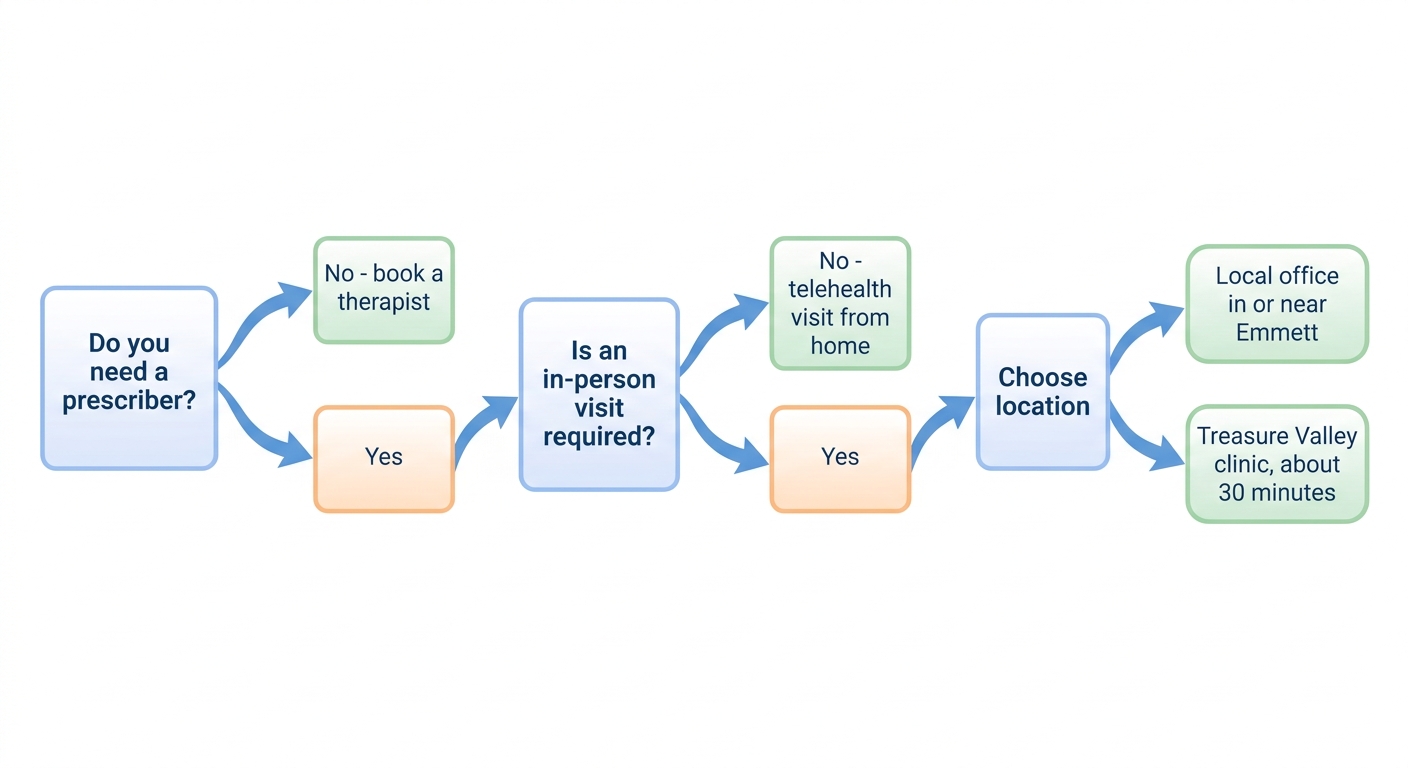
Key takeaway: The question is not whether care exists near Emmett — it is which route gets you seen soonest for the kind of visit you need.
When Should You Seek Psychiatric Care?
Call when symptoms have lasted more than about two weeks, when they are interfering with work, school, parenting, or sleep, or when therapy alone has not moved things. You do not need to be in crisis to qualify for an evaluation.
Signs that commonly prompt a psychiatric consultation:
- Low mood or loss of interest that persists most days
- Panic episodes, racing heart, or avoidance of ordinary situations
- Focus and follow-through problems affecting job or school performance
- Mood swings that feel out of proportion to events
- Alcohol or substance use quietly increasing
- Mood changes during pregnancy or after childbirth
- Sleep that is badly broken — too little or far too much
- Intrusive thoughts or repetitive rituals that eat up time
- Memory or personality changes in an aging parent
- Medication you are already taking that does not seem to be helping
A quick, private starting point: our free PHQ-9 and GAD-7 self-assessments give you a score you can bring to a first appointment. They are screening tools, not diagnoses, but they make the first conversation far more concrete.
⚠️ If someone is in immediate danger, do not wait for an appointment. Call or text 988 for the Suicide & Crisis Lifeline, call the Idaho Crisis & Suicide Hotline at 1-208-398-4357, or go to the nearest emergency department. Outpatient psychiatric care is not a substitute for emergency services.
What Conditions Does Psychiatric Care Treat?
Psychiatric care covers mood disorders, anxiety disorders, attention disorders, psychotic disorders, trauma-related conditions, substance use disorders, eating disorders, and cognitive changes. The five conditions most often grouped together in public health discussions are major depressive disorder, anxiety disorders, bipolar disorder, schizophrenia, and obsessive-compulsive disorder.
That grouping is a convenience, not a boundary. In a general outpatient practice, prescribers also commonly see:
- ADHD in adults, often identified years after it was missed in childhood
- PTSD and trauma-related symptoms, including among first responders and veterans
- Postpartum depression and anxiety, which can begin months after delivery
- Alcohol use disorder, frequently alongside depression or anxiety
- Eating disorders, which usually need coordinated medical, nutritional, and psychiatric input
- Dementia-related cognitive changes in older adults, where mood and memory symptoms overlap
Overlap is the norm, not the exception. Someone arriving for anxiety may also be sleeping four hours a night and drinking more than they intend. A good evaluation looks at the whole pattern rather than treating the first symptom named.

What Happens at a First Psychiatric Appointment?
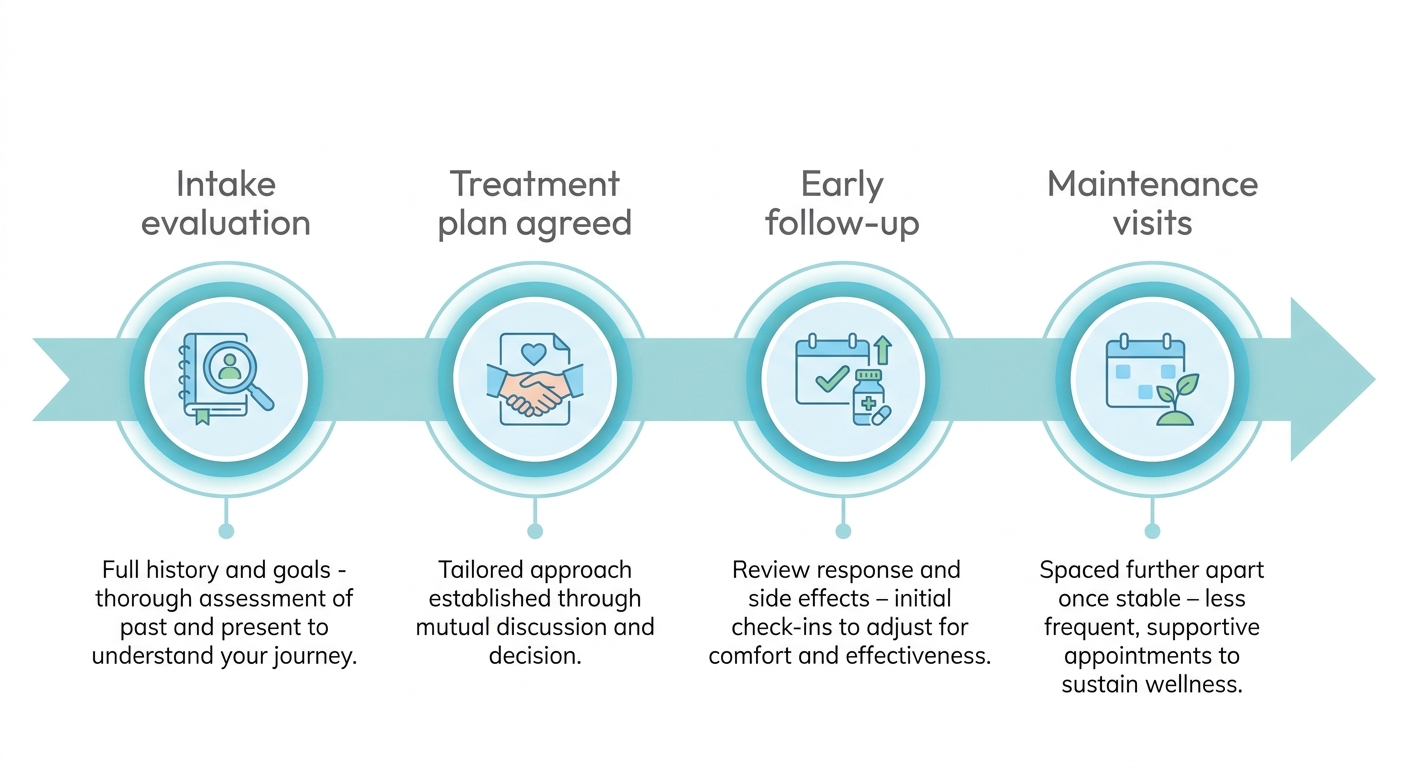
The first visit is an intake — longer than later appointments, often around an hour. You talk, the provider asks structured questions, and you leave with a working diagnosis and a plan.
Five steps you can expect:
- Paperwork and consent — history forms, insurance details, and privacy agreements, usually completed before the visit.
- Symptom history — what you are experiencing, when it started, and how it affects daily life.
- Background review — medical conditions, current medications and supplements, family psychiatric history, and substance use.
- Working diagnosis — the provider explains what the pattern most likely reflects and what else they are ruling out.
- Treatment plan — medication options if appropriate, therapy referrals, labs if needed, and a follow-up date.
Follow-ups typically come first at a short interval while a medication is being adjusted, then stretch out once things are stable. For a step-by-step look at the questions asked and how to prepare, read what happens during a psychiatric evaluation.
What Does Psychiatric Care Cost in Idaho?
With commercial insurance, most Idaho patients pay a specialist copay per visit, plus anything remaining on an unmet deductible. Without insurance, clinics quote a self-pay rate — intake visits are priced higher than follow-ups because they take longer.
| Pathway | How you are billed | What to ask before booking |
|---|---|---|
| Commercial insurance | Copay or coinsurance per visit, after deductible | "Are you in network with my plan?" and "Is behavioral health carved out to a separate administrator?" |
| Idaho Medicaid | Covered benefit for enrolled members at participating practices | "Do you currently accept new Medicaid patients?" |
| Self-pay | Flat clinic rate, usually different for intake vs follow-up | "What is the intake rate, the follow-up rate, and do you offer a payment plan?" |
| Telehealth | Commonly billed the same as an in-person visit of the same type | "Does my plan cover video visits at the same rate?" |
Three things worth knowing before you call:
- Check network status by provider, not just by clinic. Panels vary between individual prescribers at the same address. Our list of accepted insurance plans is a starting point, and verifying with your insurer is still the safe move.
- Ask for a good-faith estimate. Under the federal No Surprises Act, uninsured and self-pay patients can request a written estimate of expected charges before scheduling.
- Budget for the whole arc, not one visit. Medication management involves repeat appointments, so ask what the first three months typically look like.
Key takeaway: The copay is rarely the surprise — the deductible and the follow-up cadence are. Ask about both on the first phone call.
Does Telehealth Psychiatry Work as Well as In-Person?
For most medication management and routine follow-up visits, telehealth is a well-established option. Insurers and psychiatric practices across Idaho have widely adopted video visits for ongoing care, and whether it suits your situation is a clinical decision your provider makes with you.
What telehealth solves for Gem County patients is concrete:
- No 30-minute drive each way, and no winter road conditions factored into whether you keep the appointment
- No half-day off work for what may be a 20-minute medication check
- Easier continuity — short, frequent check-ins during a dose adjustment become realistic
What still favors an in-person visit: a first evaluation where the provider wants to observe more directly, any care involving a physical exam or in-office testing, and some cognitive assessments that are hard to administer over video.
⚠️ Federal rules for prescribing controlled medications — including stimulants used for ADHD — by telemedicine have been revised repeatedly in recent years. Ask any clinic directly how it currently handles these prescriptions before you assume a video visit will cover it.
Our integrative patient care model explains how in-person and virtual visits are structured across a course of treatment, so a plan does not have to be all one or the other.
How Do You Choose a Psychiatric Provider Near Emmett?
Screen on five things: prescriber credential, insurance acceptance, wait time to a first appointment, telehealth availability, and whether the practice coordinates with your therapist and primary care provider.
Seven questions worth asking on the call:
- "Is the provider a prescriber?" — psychiatrist, PMHNP, or PA.
- "What is your current wait for a new-patient intake?"
- "Do you keep a cancellation list?" — this is the single fastest way to move up.
- "Are you in network with my plan, and is behavioral health administered separately?"
- "Do you treat this age group?" — especially for children, teens, and older adults.
- "Do you offer telehealth for follow-ups?"
- "Will you coordinate with my therapist and primary care provider?"
Some practices also offer pharmacogenetic testing — a cheek-swab or blood test that reports how your genes may affect the way your body processes certain medications. It is used as one input among many, not as a prescription decider, and availability varies by clinic. If it interests you, ask whether the practice offers it and how results are used.
You can also meet the provider team before booking to see credentials and areas of focus in advance.
Frequently Asked Questions
What is the meaning of psychiatric care?
Psychiatric care is the medical evaluation, diagnosis, and treatment of mental health conditions by a licensed prescriber. It usually includes an intake evaluation, a working diagnosis, medication management when appropriate, and scheduled follow-up visits to monitor response and side effects. It often runs alongside therapy rather than replacing it.
What does it mean to be under psychiatric care?
Being under psychiatric care means you have an active treating prescriber, a documented treatment plan, and scheduled follow-up appointments. It does not imply hospitalization. Most people under psychiatric care are outpatients who come in periodically, live at home, and work or attend school as usual.
What are the five major psychiatric disorders?
The five most commonly grouped together are major depressive disorder, anxiety disorders, bipolar disorder, schizophrenia, and obsessive-compulsive disorder. These categories come from standard diagnostic groupings used in U.S. psychiatry. The grouping is not exhaustive — ADHD, PTSD, substance use disorders, and eating disorders are also treated in general psychiatric practice.
What are some examples of mental health issues?
Common examples include PTSD, ADHD, postpartum depression, alcohol use disorder, eating disorders, panic disorder, and cognitive changes associated with aging. Many people experience more than one at once — anxiety alongside depression is especially common. A full evaluation looks for overlap rather than stopping at the first symptom you describe.
Is there a psychiatrist in Emmett, Idaho?
Emmett has limited local psychiatric prescribing capacity, and listings change, so verify current services by phone. Online directories list therapists, counselors, and psychiatrists serving the area. Many Gem County residents see a prescriber in the Treasure Valley, roughly a half-hour drive, or use telehealth from home.
How long does it take to get a psychiatric appointment in Idaho?
New-patient waits in the Treasure Valley are usually measured in weeks rather than days, and they vary by clinic and season. Telehealth slots often open sooner than in-person ones. Asking to be placed on a cancellation list is the most reliable way to be seen earlier than the quoted date.
Do I need a referral to see a psychiatrist in Idaho?
It depends on your plan, not on the clinic. Many commercial plans let you book a behavioral health specialist directly, while some managed-care and HMO-style plans require a referral from your primary care provider first. Call the number on the back of your insurance card and ask whether behavioral health requires a referral or prior authorization — it takes a few minutes and prevents a denied claim later.
Can I see a psychiatrist and a therapist at the same time?
Yes, and for many people that combination is the plan. The prescriber manages diagnosis and medication while the therapist works on skills, coping, and processing. The two roles are complementary, so it helps to tell each provider who the other is and give written permission for them to share notes. Coordinated care means you are not repeating your story twice or getting conflicting advice.
What should I bring to my first psychiatric appointment?
Bring your insurance card and photo ID, a written list of every medication and supplement you take with doses, the names and contact details of your primary care provider and any therapist, and a short timeline of when symptoms started. If you completed a PHQ-9 or GAD-7 screening, bring the score. Writing down two or three questions beforehand also helps, since intake visits cover a lot of ground quickly.
How often will I need follow-up visits?
That depends on where you are in treatment. While a medication is being started or adjusted, visits are usually scheduled at shorter intervals so the prescriber can check response and side effects. Once things are stable, appointments typically spread out. Ask your provider what cadence they expect for your situation, since it affects both your schedule and your out-of-pocket budget.
Can a psychiatrist in the Treasure Valley see me by telehealth if I live in Emmett?
Generally yes, as long as the provider is licensed in Idaho and you are physically located in Idaho at the time of the visit. Many Gem County patients do an in-person intake and then switch to video for follow-ups. Confirm with the clinic how it handles first appointments, and ask separately about any controlled medications, since those rules are handled differently.
Summary
Psychiatric care in Emmett is accessible — it just takes one or two extra phone calls than it would in Boise. Decide first whether you need a prescriber or a therapist. Then pick the route that fits your week: a local office, a Treasure Valley clinic about 30 minutes away, or a telehealth visit that costs you no drive at all.
Before you book, confirm network status, ask about the current intake wait, and request a cancellation-list spot. If you are unsure whether to start with a psychiatrist or a counselor, say exactly that when you call — a good scheduler will route you correctly. And if symptoms are urgent, use 988 or your nearest emergency department rather than waiting for an appointment.
Information about third-party platforms reflects publicly available details at the time of writing and may have changed. Please verify directly with the provider. See our Terms of Use for more.