Depression Symptoms: What to Look For
Integrity Mental Health Editorial ·

If you've typed "what are symptoms of depression" into a search bar late at night, you're already doing something useful: paying attention. Depression rarely announces itself. It usually shows up as a slow drift — less energy, less interest, more friction on ordinary days — and most people notice it in their body or their routine long before they'd ever call it depression.
Quick Answer
Depression symptoms are a cluster of changes in mood, body, and behavior that last two weeks or longer. Clinicians use nine criteria from the DSM-5-TR (the diagnostic manual used in U.S. mental health care): persistent low mood, loss of interest or pleasure, and changes in sleep, appetite, energy, movement, concentration, self-worth, or thoughts of death. Major depressive disorder is considered when five or more are present most of the day, nearly every day, and at least one of them is low mood or loss of interest.
TL;DR
- Depression requires either persistent low mood or loss of interest — you can be depressed without feeling sad. See the full nine-symptom checklist
- The clinical threshold is two weeks of near-daily symptoms, but different patterns have different timelines. Compare the duration thresholds
- Physical complaints — fatigue, headaches, stomach trouble, aching muscles — are often the first thing people notice. Read why the body signals first
- Teens, men, new parents, and older adults often show depression in ways that get mistaken for something else. See how presentation shifts by age and gender
- A free, two-minute PHQ-9 screen gives you something concrete to bring to a first appointment. Walk through what happens next
In This Article
Here's the path we'll take, from recognizing symptoms to knowing when it's time to call someone:
- What Are the 9 Core Symptoms of Depression?
- What Does Depression Feel Like Day to Day?
- What Are the Physical Symptoms People Miss?
- How Do Depression Symptoms Differ by Age and Gender?
- How Long Do Symptoms Have to Last to Count?
- When Should You Talk to a Provider?
- What Happens After You Recognize the Symptoms?
What Are the 9 Core Symptoms of Depression?
Clinicians work from nine symptoms listed in the DSM-5-TR. Five or more, present most of the day and nearly every day for at least two weeks, point toward major depressive disorder — and at least one of those five has to be depressed mood or loss of interest.
The PHQ-9, a nine-item screening questionnaire validated in primary care by Kroenke, Spitzer, and Williams (2001), maps almost one-to-one onto those criteria. That's why the same nine themes show up in almost every depression screen you'll encounter.
| DSM-5-TR symptom | What it can look like | Matching screening question |
|---|---|---|
| Depressed mood | Flat, hopeless, or empty — not always tearful | Feeling down, depressed, or hopeless |
| Loss of interest (anhedonia) | Your Saturday hobby feels like a chore | Little interest or pleasure in doing things |
| Sleep change | Waking at 3 a.m., or sleeping 11 hours and still tired | Trouble falling or staying asleep, or sleeping too much |
| Appetite or weight change | Skipping meals, or grazing constantly | Poor appetite or overeating |
| Fatigue | A shower feels like a project | Feeling tired or having little energy |
| Worthlessness or guilt | "Everyone would be better off without me around" | Feeling bad about yourself, or that you're a failure |
| Concentration trouble | Rereading the same email four times | Trouble concentrating on things |
| Psychomotor change | Moving and speaking slowly, or restless pacing | Moving so slowly others notice — or being fidgety |
| Thoughts of death or self-harm | Passive wishes not to wake up, or active planning | Thoughts that you'd be better off dead |
Anhedonia is the loss of pleasure or interest in activities you used to enjoy. It's one of the two gateway symptoms, and it's the one people most often misread as laziness or burnout.
Psychomotor retardation refers to a visible slowing of movement, speech, and thinking that other people usually notice before you do.
Scoring yourself takes less time than reading this section. The depression self-assessment (PHQ-9) uses these exact nine items, scored 0 to 3 each. It's a screen, not a diagnosis — but it turns a vague feeling into something you can show a provider.
Key takeaway: Five or more of the nine symptoms, for two weeks, with low mood or lost interest among them — that's the clinical pattern.
What Does Depression Feel Like Day to Day?
Most people describe depression less as sadness and more as flatness. Things that used to carry you — music, plans with friends, a good meal — stop landing. The volume gets turned down on everything at once.
The day-to-day version often sounds like this:
- The 3 p.m. wall — energy drops out and doesn't come back, no matter how you slept.
- Small tasks become expensive — dishes stack up, laundry sits folded in the basket for a week.
- Texts go unanswered — not because you don't care, but because replying feels like lifting something heavy.
- The "I'm fine" reflex — you answer automatically, then feel further away from everyone.
- Irritability — snapping at people you love, then sitting in guilt about it.
Depression is a common mental health condition encountered in clinical practice, and it affects people across every income level, job, and family situation., and it affects people across every income level, job, and family situation. Plenty of people functioning well on the outside — showing up to work, getting kids to school — are running on empty underneath.
Key takeaway: Not crying doesn't mean you're not depressed. Numbness and irritability are just as diagnostic as sadness.
What Are the Physical Symptoms People Miss?
Depression often shows up in the body first. Fatigue, unexplained aches, headaches, digestive upset, and changes in appetite or weight are extremely common — and they're the reason many people see a primary care provider for back pain or insomnia months before anyone asks about mood.
Somatic symptoms are physical complaints — pain, fatigue, digestive trouble — that stem from a mood disorder rather than a separate medical cause.
The most commonly overlooked physical signs include:
- Persistent fatigue that rest doesn't fix
- New or worsening pain — back, neck, joints, headaches — with no clear injury
- GI symptoms like nausea, cramping, or appetite swings
- Sleep that's broken rather than short — early waking is a classic pattern
- Slowed movement or speech, or restlessness you can't settle
- Reduced libido and loss of physical interest generally
⚠️ Rule out the mimics first. Thyroid disease, anemia, sleep apnea, vitamin D deficiency, certain medications, and chronic pain can all produce symptoms that look like depression. A good workup includes labs and a medical history — here's how a psychiatric evaluation rules this out before anyone settles on a diagnosis.
This matters practically. If you've had six months of unexplained fatigue and your labs keep coming back normal, mood is worth screening — not as a consolation prize, but as a real diagnostic possibility.
How Do Depression Symptoms Differ by Age and Gender?
The diagnosis is the same, but the presentation shifts a lot. When people ask what are symptoms of depression at different ages, the honest answer is that the nine criteria stay constant while the surface behavior changes — which is exactly why depression gets missed in teens, men, and older adults.
| Group | Common presentation | Often mistaken for | Watch for |
|---|---|---|---|
| Teens | Irritability, withdrawal, screen retreat, dropping grades | "Normal teenage attitude" | Quitting a sport or friend group, sleep flip, self-criticism |
| Men | Anger, risk-taking, overwork, increased alcohol use | Stress or a bad stretch at work | "I'm just tired," short fuse, physical complaints |
| New parents | Guilt, intrusive thoughts, crying, feeling disconnected from the baby | "Baby blues" that should pass | Symptoms past two weeks postpartum, trouble sleeping when baby sleeps |
| Older adults | Apathy, memory complaints, somatic focus, isolation | Early dementia or "just aging" | Loss of interest without sadness, neglected self-care, new confusion |
A few notes worth sitting with:
- Teens often look angry rather than sad. Irritability is an accepted presentation of depressed mood in young people under the DSM-5-TR.
- Men are more likely to describe stress, anger, or physical symptoms than low mood — the words change, the condition doesn't.
- New parents experiencing symptoms beyond the first couple of weeks may be dealing with postpartum depression, which is treatable and far more common than most families expect.
- Older adults may present with apathy and cognitive complaints that overlap with symptoms that overlap with dementia. Careful evaluation matters, because depression in older adults is treatable and can look strikingly similar to early cognitive decline.
Key takeaway: If the behavior changed and stayed changed, look at mood — regardless of whether the person ever uses the word "depressed."
How Long Do Symptoms Have to Last to Count?
Two weeks of near-daily symptoms is the clinical threshold for major depressive disorder. But duration is also what separates several different conditions from each other, which is why providers ask so many questions about timing.
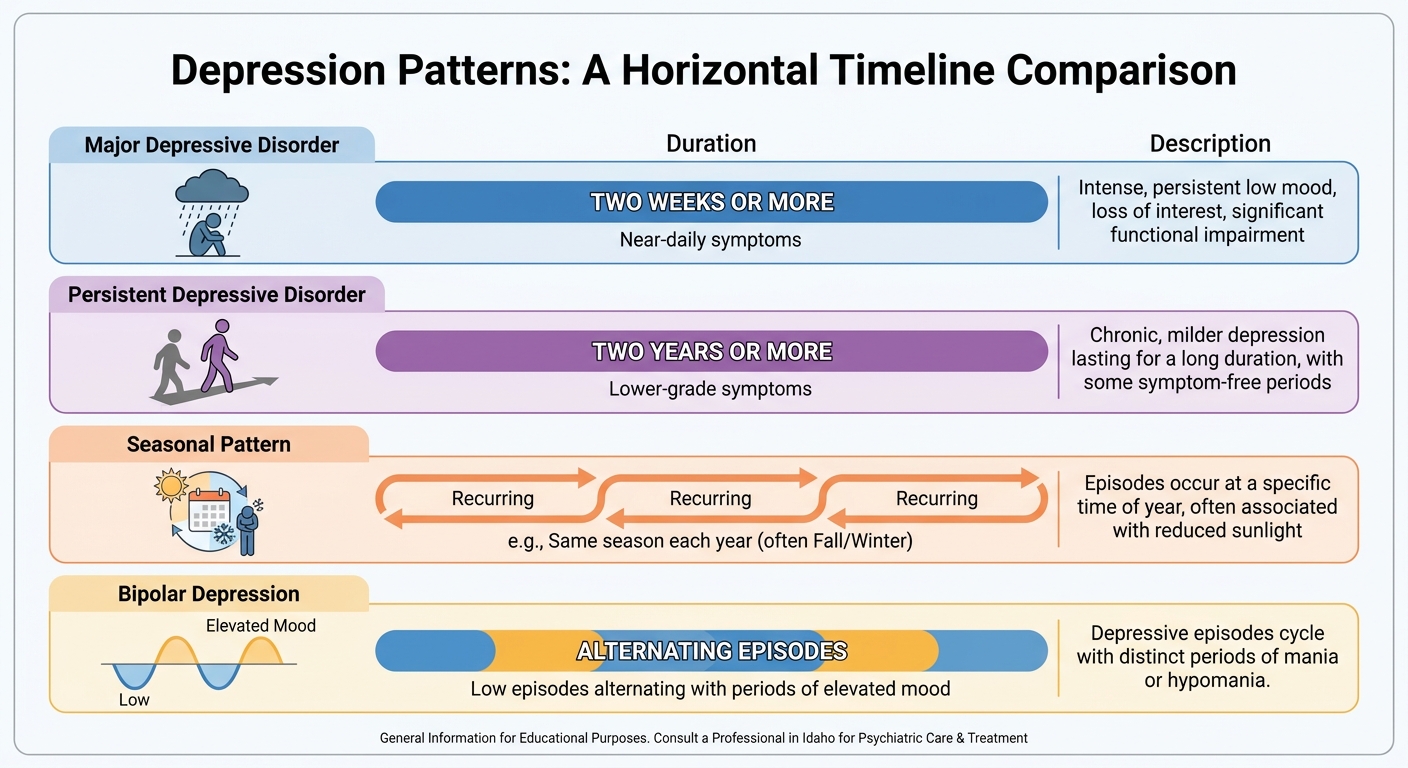
- Major depressive disorder (MDD) — five or more symptoms, most of the day, nearly every day, for two weeks or longer.
- Persistent depressive disorder (dysthymia) — lower-grade depressed mood lasting two years or more in adults. Often described as "I've just always been like this."
- Seasonal pattern depression — episodes that recur at the same time each year, typically in fall and winter. Worth considering in Idaho, where short daylight hours from Nampa to Coeur d'Alene run for months.
- Bipolar depression — depressive episodes that alternate with periods of elevated, expansive, or unusually energized mood. This distinction changes treatment significantly, so providers screen for bipolar disorder before starting antidepressant medication.
The two-week rule exists to separate a rough patch from a clinical episode. Grief, a brutal work quarter, or a breakup can produce several of the same symptoms — the difference is usually that those lift as circumstances change, while a depressive episode holds steady regardless.
Key takeaway: You don't have to wait out the full two weeks before asking for help. The threshold is a diagnostic standard, not a permission slip.
When Should You Talk to a Provider?
Reach out when symptoms have lasted about two weeks, when they're interfering with work, school, parenting, or relationships — or immediately, at any point, if you're having thoughts of death or self-harm.

Reach out this week if any of these are true:
- Symptoms have been near-daily for two weeks or more
- You've stopped doing things you used to look forward to
- Sleep or appetite has changed and stayed changed
- Work, school, or caregiving is slipping
- People close to you have said something
- You're drinking more, or using substances to get through the day
- You feel like a burden to the people around you
⚠️ If you're thinking about harming yourself, don't wait. Call or text 988 to reach the Suicide & Crisis Lifeline, available 24/7. If someone is in immediate danger, call 911 or go to the nearest emergency room. Emergency care is an appropriate choice for an acute mental health crisis.
For non-urgent concerns, a psychiatric consultation is a conversation, not a commitment to medication. You can learn what's available through psychiatry services across Idaho and Utah, and read more about depression care in Idaho and Utah before you book anything.
What Happens After You Recognize the Symptoms?
The next step is a structured screening followed by an evaluation — not an immediate prescription. Knowing the sequence removes most of the anxiety people feel about that first call.
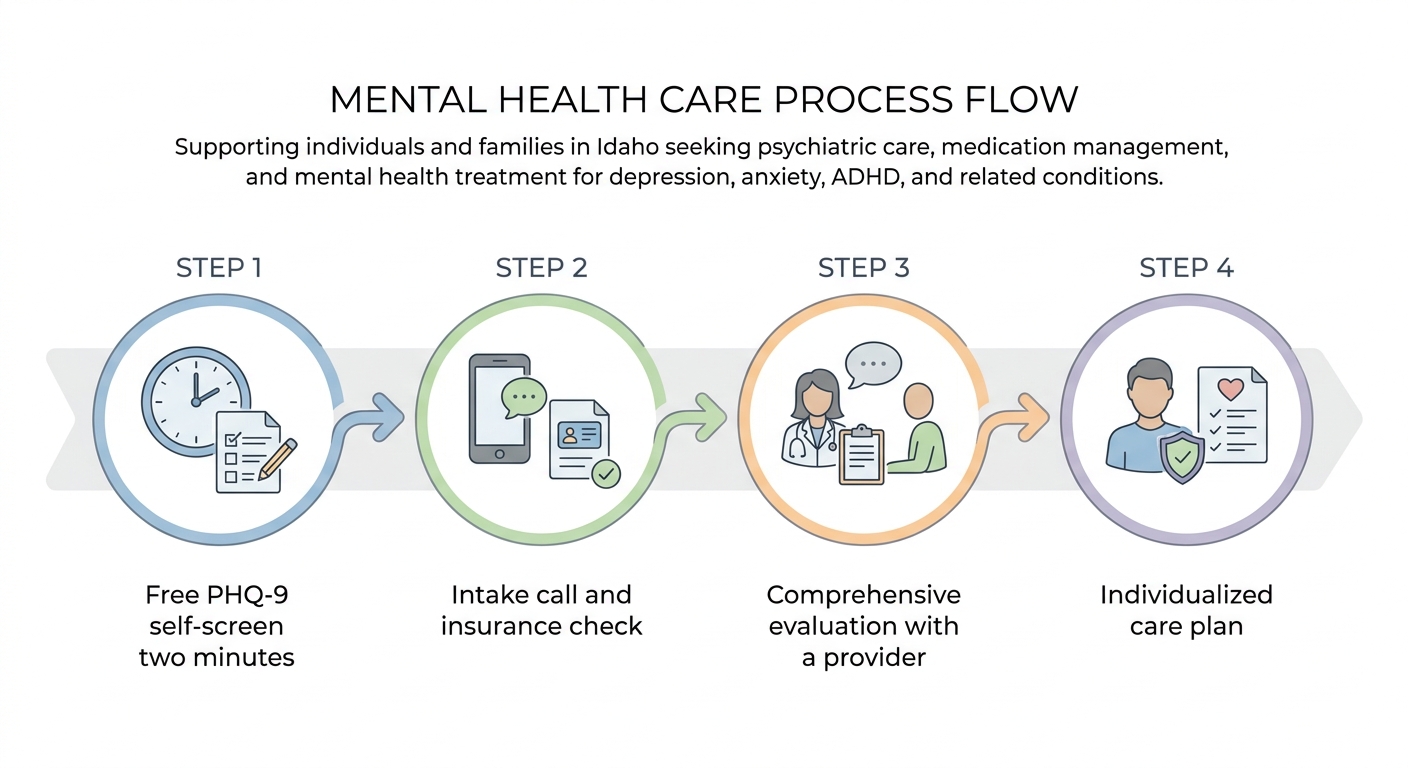
- Self-screen. The PHQ-9 takes two minutes and gives you a score and a symptom list to reference.
- Intake call. Scheduling, insurance verification, and a short description of what's going on.
- Evaluation. A longer first appointment covering symptom history, medical history, family history, substance use, sleep, and current stressors.
- A plan. Built with you, reviewed over time, and adjusted as things change.
A plan might include therapy, medication, or both. Some practices also use pharmacogenetic testing — a cheek swab that looks at how your genetics may affect the way your body processes certain medications — alongside lifestyle supports like sleep, movement, and light exposure. You can read how those pieces fit together in the patient care model, and see a fuller breakdown of depression treatment options if you want to know what's on the table before you go.
What you won't get at a first visit is a guarantee. Treatment response varies between individuals, and what works is decided through an ongoing clinical conversation rather than a single appointment.
Frequently Asked Questions
What is the difference between sadness and depression?
Sadness is a response to something specific, and it lifts. Depression is persistent — it lasts two weeks or longer and affects sleep, appetite, energy, concentration, and self-worth regardless of what's happening around you. If good news doesn't move the needle, that's a meaningful signal.
Can you have depression without feeling sad?
Yes. The DSM-5-TR requires either depressed mood or loss of interest — not both. Plenty of people describe numbness, irritability, or flat physical exhaustion as their dominant experience and never once use the word "sad." Anhedonia alone, paired with four other symptoms, meets criteria.
How accurate is the PHQ-9 depression screening?
The PHQ-9 is a nine-item questionnaire validated against structured clinical interviews by Kroenke, Spitzer, and Williams (2001), and it's widely used in primary care and psychiatry. Clinicians commonly treat a score of 10 or higher as a prompt for a fuller evaluation. It is a screening tool, not a diagnosis — a licensed provider confirms the picture.
Do depression symptoms go away on their own?
Some episodes do remit without treatment. Some clinicians note that untreated episodes may persist longer or recur, though this varies by individual and circumstance. Evidence-based treatment aims to shorten episodes and reduce the chance of recurrence, though individual results vary and suitability is determined in a clinical consultation.
Summary: What Are Symptoms of Depression, and What Now?
The short version of what are symptoms of depression: nine criteria, five or more present, two weeks or longer, with low mood or loss of interest among them. Those symptoms span emotional changes, physical complaints, and behavior — and they look different in a teenager, a father of three, a new parent, and a retiree.
If several of these have been true for you for two weeks, the most useful next move is small: score the nine items honestly, write down when things changed, and bring both to a provider. Recognition is the hard part, and you've already started it.
This article is for general education and is not medical advice. If you're experiencing a mental health crisis, call or text 988 or go to your nearest emergency room.