Depression Treatment Options That Actually Work
Integrity Mental Health Editorial ·

Depression Treatment Options That Actually Work
Depression is treatable, but finding the right treatment is rarely a straight line. This guide walks through the main depression therapy and medication options, what reputable clinical sources say about each, and how providers decide what to try first. It also covers practical steps for starting depression care in Idaho — including what to do before your first appointment.
Quick Answer
Depression is usually treated with psychotherapy, antidepressant medication, or both together. The National Institute of Mental Health states that depression treatment typically involves psychotherapy, medication, or both, and that other options are considered when those do not reduce symptoms sufficiently (NIMH, as of November 2026). When standard depression therapy and medication trials fall short, providers may discuss advanced options such as TMS. Treatment choice depends on symptom severity, history, and your own preferences — and results vary between individuals.
TL;DR
- There is no single cause of depression. Biology, life stress, medical conditions, and circumstance interact, which is why two people with the same diagnosis often need different plans. See what contributes to depression
- Several talk therapies have published guideline support for adults. The American Psychological Association's adult depression guideline lists behavioral therapy, cognitive therapy, CBT, interpersonal psychotherapy, and mindfulness-based cognitive therapy. Compare the main therapy types
- Medication is judged over weeks, not days. Prescribers typically set a scheduled reassessment rather than expecting an immediate verdict. Read how antidepressants are managed
- The real question is sequencing, not medication versus therapy. Severity, prior episodes, and access all shape where you start. Walk through the decision factors
- In-person depression care is available across the Treasure Valley. Boise, Eagle, Meridian, Nampa, and Emmett, plus telepsychiatry. See the step-by-step path to a first visit
In This Article
- What Causes Depression?
- Which Types of Depression Therapy Work Best?
- How Does Antidepressant Medication Work?
- Depression Medication vs Therapy: Which Should You Start With?
- What Is TMS Therapy for Depression?
- What Does Comprehensive Depression Care Look Like in 2026?
- How Do You Find Depression Care Near You in Idaho?
- How Can You Support Someone Living With Depression?
- Frequently Asked Questions
What Causes Depression?
There is no single cause. Depression develops from interacting biological, psychological, and social factors, which is why the old "chemical imbalance" one-liner no longer reflects how clinicians explain it. Two people can arrive at the same diagnosis by very different routes.
Major depressive disorder is a mood condition defined by a sustained period — at least two weeks under current diagnostic criteria — of depressed mood or loss of interest, along with associated changes in sleep, appetite, energy, concentration, or self-worth. That differs from a hard week, and it differs again from persistent low-grade depression that lasts for years. If you're trying to sort out which pattern fits, our overview of depression symptoms and types breaks the categories down.
What factors contribute to depression?
Clinicians generally look across several categories rather than hunting for one culprit:
- Family history and biology — Depression tends to run in families, and differences in how brain circuits regulate mood and stress are an active area of research.
- Chronic stress and trauma — Prolonged stress, loss, abuse, or instability can change how the body's stress-response system behaves over time.
- Medical conditions — Thyroid disorders, anemia, sleep apnea, chronic pain, and vitamin deficiencies can produce or worsen depressive symptoms, which is why a medical workup matters.
- Medications and substances — Some prescriptions, and alcohol in particular, can contribute to low mood.
- Life circumstance — Isolation, financial strain, caregiving load, and job loss all carry weight, and in rural parts of Idaho, distance from care adds another layer.
Are there different kinds of depression?
Yes. Postpartum depression follows childbirth and has its own treatment considerations. Seasonal patterns show up in some people during low-light months — relevant in a state with long, dark winters. Depression can also occur as part of bipolar disorder, which changes the treatment approach entirely.
Inflammation and immune signaling are being studied as contributors in some people, but this remains a research area rather than a routine clinical test. Be skeptical of any provider or product promising a single biological explanation for your depression.
Key takeaway: Depression almost always has multiple contributing causes, so a good evaluation looks at your medical history, your life circumstances, and your family history — not just your symptom list.
Which Types of Depression Therapy Work Best?
Several structured talk therapies have established guideline support for adults. The American Psychological Association's depression treatment guideline for adults lists behavioral therapy, cognitive therapy, cognitive-behavioral therapy, interpersonal psychotherapy, and mindfulness-based cognitive therapy among the treatments it covers (APA, as of November 2026). Which one suits you depends on your symptoms, your history, and what you're willing to practice between sessions.
Cognitive behavioral therapy (CBT) is a structured, time-limited talk therapy that targets the thought patterns and behaviors keeping low mood in place. Sessions are usually weekly, with homework between them.
What do the main therapy types involve?
- CBT — Identifies and tests unhelpful thoughts, then pairs that with behavior change. Best suited for people who want a structured, skills-based approach.
- Behavioral activation — Rebuilds contact with rewarding activity, working on the principle that action often comes before motivation. Best suited for withdrawal, inactivity, and "I can't make myself do anything."
- Interpersonal psychotherapy (IPT) — Focuses on relationships, role changes, grief, and conflict. Best suited for depression tied to a loss, a transition, or a strained relationship.
- Mindfulness-based cognitive therapy (MBCT) — Combines mindfulness practice with cognitive skills. Often discussed in the context of people with repeated episodes.
- Dialectical behavior therapy (DBT) — Teaches distress tolerance and emotion regulation skills. Used when depression co-occurs with intense emotional swings or self-harm risk.
| Therapy type | How it works | Typical format | Best suited for |
|---|---|---|---|
| CBT | Restructures thoughts and behaviors driving low mood | Weekly, time-limited, with homework | Structured learners; negative thought loops |
| Behavioral activation | Schedules small, specific rewarding activities | Weekly, highly practical | Withdrawal, inertia, loss of routine |
| IPT | Addresses relationships, grief, and role transitions | Weekly, time-limited | Depression linked to loss or conflict |
| MBCT | Mindfulness plus cognitive skills | Often group-based course format | Recurrent episodes; rumination |
| DBT | Builds emotion-regulation and distress-tolerance skills | Individual plus skills group | Emotion dysregulation, self-harm risk |
How do you know if therapy is working?
You track it. Good practices re-measure symptoms at intervals instead of relying on memory, and they revisit the plan if scores aren't moving. Before your first appointment, it helps to take the PHQ-9 depression self-assessment so you and your provider have a baseline to compare against.
Therapy is not one-size-fits-all, and a poor fit with a therapist is a real reason to switch rather than quit. Individual responses vary.
How Does Antidepressant Medication Work?
Antidepressants adjust how brain chemical messengers — mainly serotonin, norepinephrine, and dopamine — are signaled and recycled, with downstream effects on how brain circuits adapt. Cleveland Clinic describes depression treatment as usually involving talk therapy, medication, or a combination of both, with other options available (Cleveland Clinic, as of November 2026). Mayo Clinic similarly states that medications and psychotherapy are effective for most people with depression, and that a primary care doctor or psychiatrist can prescribe medications (Mayo Clinic, as of November 2026).
What are the main classes of antidepressants?
- SSRIs (selective serotonin reuptake inhibitors) — Often a first choice; examples include sertraline and escitalopram.
- SNRIs (serotonin-norepinephrine reuptake inhibitors) — Such as venlafaxine and duloxetine; sometimes considered when pain coexists with depression.
- Bupropion — Works on different pathways than SSRIs and has a different side-effect profile.
- Mirtazapine — Sometimes considered when sleep and appetite are heavily disrupted.
- Augmentation strategies — Adding a second agent to an existing antidepressant, used when a single medication hasn't produced an adequate response.
Selection isn't random. Your prescriber weighs your symptom pattern, other medical conditions, prior responses, drug interactions, and side effects you'd find hardest to live with. Some clinics also use genetic information to inform choices — our advanced psychopharmacology and pharmacogenetic testing page explains how that fits into a plan. Testing informs decisions; it doesn't make them.
How long before you know if a medication is right?
Medication isn't judged on day three. Prescribers typically schedule a reassessment several weeks after starting, because an adequate trial means staying at an appropriate dose long enough to evaluate it fairly. Stopping early — before that scheduled check-in — is one of the most common reasons people conclude "antidepressants don't work for me."
Side effects often show up before any benefit does, which is a genuinely rough sequence. Nausea, sleep changes, headache, and sexual side effects are among the commonly discussed ones. Report them rather than silently quitting; dose, timing, or medication can usually be adjusted.
⚠️ Do not stop an antidepressant abruptly. Sudden discontinuation can cause withdrawal-like symptoms, and tapering should be planned with your prescriber. Antidepressants also carry an FDA boxed warning about increased risk of suicidal thoughts and behaviors in children, adolescents, and young adults — which is why close monitoring early in treatment matters. If you have thoughts of harming yourself, call or text 988.
Key takeaway: An antidepressant trial needs an adequate dose and an adequate duration before anyone can judge it — so put the follow-up appointment on your calendar when you fill the first prescription.
Depression Medication vs Therapy: Which Should You Start With?
For milder depression, therapy alone and medication alone are both reasonable starting points, and many people choose based on preference and access. For more severe or recurrent depression, combining the two is commonly recommended. NIMH describes treatment as typically involving psychotherapy, medication, or both (NIMH, as of November 2026) — note that "both" sits alongside the single-modality options, not after them.
So the useful question isn't which one. It's what order, and when do we add the other one.
| Approach | What it asks of you | Ongoing burden | Typical best fit |
|---|---|---|---|
| Therapy alone | Weekly appointments plus between-session practice | Time-intensive; depends on appointment availability | Mild to moderate symptoms; preference against medication |
| Medication alone | Daily dosing plus periodic follow-up visits | Lower time cost; side effects to monitor | Limited therapy access; symptoms blocking engagement |
| Combination | Both at once, coordinated | Highest time and cost burden | Moderate to severe or recurrent depression |
| Advanced options | Specialist evaluation and a structured course | Varies by treatment | Inadequate response after adequate prior trials |
What factors should shape your decision?
- Severity — When symptoms make it hard to attend or participate in sessions, medication may be discussed first.
- History — Repeated episodes change the conversation toward longer-term planning.
- Sleep and appetite disruption — Heavy physical symptoms often shift the plan.
- Access — A therapy waitlist is a real constraint, not a moral failing.
- Pregnancy or breastfeeding — Requires a specific risk-benefit discussion with your prescriber.
- Your preference — Treatment you'll actually stick with beats treatment you resent.
Who does what also matters. Psychiatric providers diagnose and manage medication; therapists and counselors provide talk therapy. Clinics offering both under one roof reduce the coordination work you'd otherwise do yourself — see our psychiatry services overview for how those roles divide.
Here is how that decision usually flows in practice:
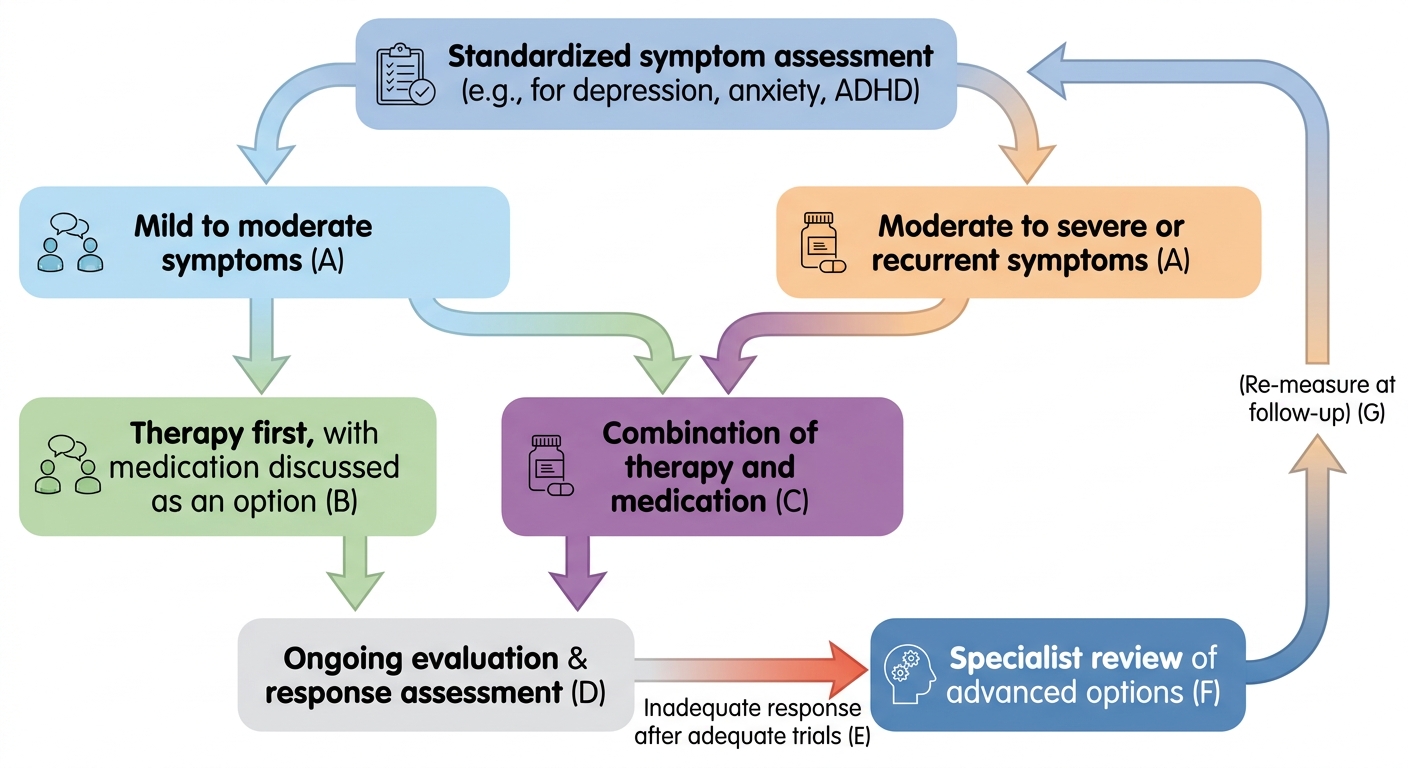
Key takeaway: Starting with one approach doesn't lock you out of the other — most plans are revisited at the first follow-up and adjusted from there.
What Is TMS Therapy for Depression?
Transcranial magnetic stimulation (TMS) is a non-invasive brain stimulation treatment that uses focused magnetic pulses to stimulate a region of the prefrontal cortex involved in mood regulation. It is delivered in an outpatient setting, while you are awake, without anesthesia or sedation. TMS devices are cleared by the U.S. Food and Drug Administration for use in adults with depression who have not responded adequately to prior antidepressant treatment.
Who is considered a candidate for TMS?
Candidacy is determined in a clinical consultation, not online. Providers generally review:
- Whether you've had adequate trials of antidepressant medication without a satisfactory response
- Your current diagnosis, including whether bipolar disorder has been ruled in or out
- Seizure history and any implanted metal near the head, which can be safety exclusions
- What your insurance requires for authorization
A standard course involves near-daily weekday sessions spread over several weeks, followed by a tapering schedule. Protocols differ by device and provider, and accelerated protocols that compress sessions into a shorter window exist at some centers. Your provider will explain the specific schedule before you commit.
What does a session feel like?
You sit in a chair while a coil is positioned against your scalp. Most people describe a tapping sensation and a clicking sound. Commonly reported side effects include scalp discomfort and headache; seizure is a rare but recognized risk, which is why screening matters.
| Treatment | Invasiveness | Sedation or anesthesia | Typical course | Usual candidacy |
|---|---|---|---|---|
| TMS | Non-invasive, outpatient | None | Repeated weekday sessions over several weeks | Adults after inadequate response to prior medication trials |
| Esketamine (Spravato) | Nasal spray, administered in a certified setting | No anesthesia; monitored observation period required after dosing | Scheduled in-clinic visits, tapering over time | Treatment-resistant depression, used alongside an oral antidepressant |
| ECT | Procedure in a medical setting | General anesthesia required | Series of treatments, typically several per week | Severe or urgent cases, or after other treatments haven't worked |
Esketamine is a prescription nasal spray that must be administered in a certified healthcare setting with a monitoring period afterward. Electroconvulsive therapy (ECT) is performed under general anesthesia in a hospital or surgical setting. All three are specialist treatments, and suitability — along with any discussion of likely outcomes — belongs in a consultation with a qualified provider. Individual results vary.
⚠️ Avoid clinics that advertise response rates or promise specific outcomes for brain stimulation treatments. Ask instead about screening criteria, session schedule, total cost, and what happens if you don't respond.
If you want to know whether any of this applies to your situation, you can request a consultation and ask directly.
What Does Comprehensive Depression Care Look Like in 2026?
Comprehensive depression care is a plan, not a prescription handed over at a single visit. It combines an accurate diagnosis, a medical workup, a treatment plan you understand, and scheduled follow-up that actually changes the plan when scores don't move.
Measurement-based care uses repeated standardized scores — such as the PHQ-9 — at each visit to decide whether to continue, adjust, or escalate treatment. It replaces "how have you been feeling?" with a number you can track over time.
What should good depression care include?
- Ruling out medical mimics — Thyroid function, anemia, and sleep disorders can imitate or worsen depression.
- Screening for bipolar disorder before starting an antidepressant — This matters, because the treatment approach differs; our page on screening for bipolar disorder explains why providers ask about past high-energy periods.
- Checking for co-occurring conditions — Anxiety, ADHD, and alcohol use disorder frequently travel with depression and change the plan.
- A documented treatment plan — What you're trying, at what dose or frequency, and when it will be reassessed.
- Baseline and repeat scoring — Start by having patients take the PHQ-9 depression self-assessment and repeat it over time.
- A follow-up appointment already scheduled — Not "call if it gets worse."
- Relapse-prevention planning — Including how long to continue treatment after symptoms improve.
Why does coordinated care matter?
Because fragmented care creates gaps. When your prescriber and therapist never speak, you become the messenger between them — while depressed. Collaborative models that keep both in the same system reduce that burden.
Access is the other half of the picture. Telepsychiatry has made it practical for people in rural Idaho counties to see a psychiatric provider without a two-hour drive each way, and it can make weekly consistency realistic rather than aspirational.
Key takeaway: The difference between adequate and comprehensive depression care is usually follow-up — a plan that gets measured and adjusted, rather than set once and forgotten.
How Do You Find Depression Care Near You in Idaho?
Start with insurance, then decide what kind of provider you need. A psychiatric provider handles diagnosis and medication management. A therapist or counselor provides talk therapy. Many people need both, and clinics that offer both internally spare you the coordination work.
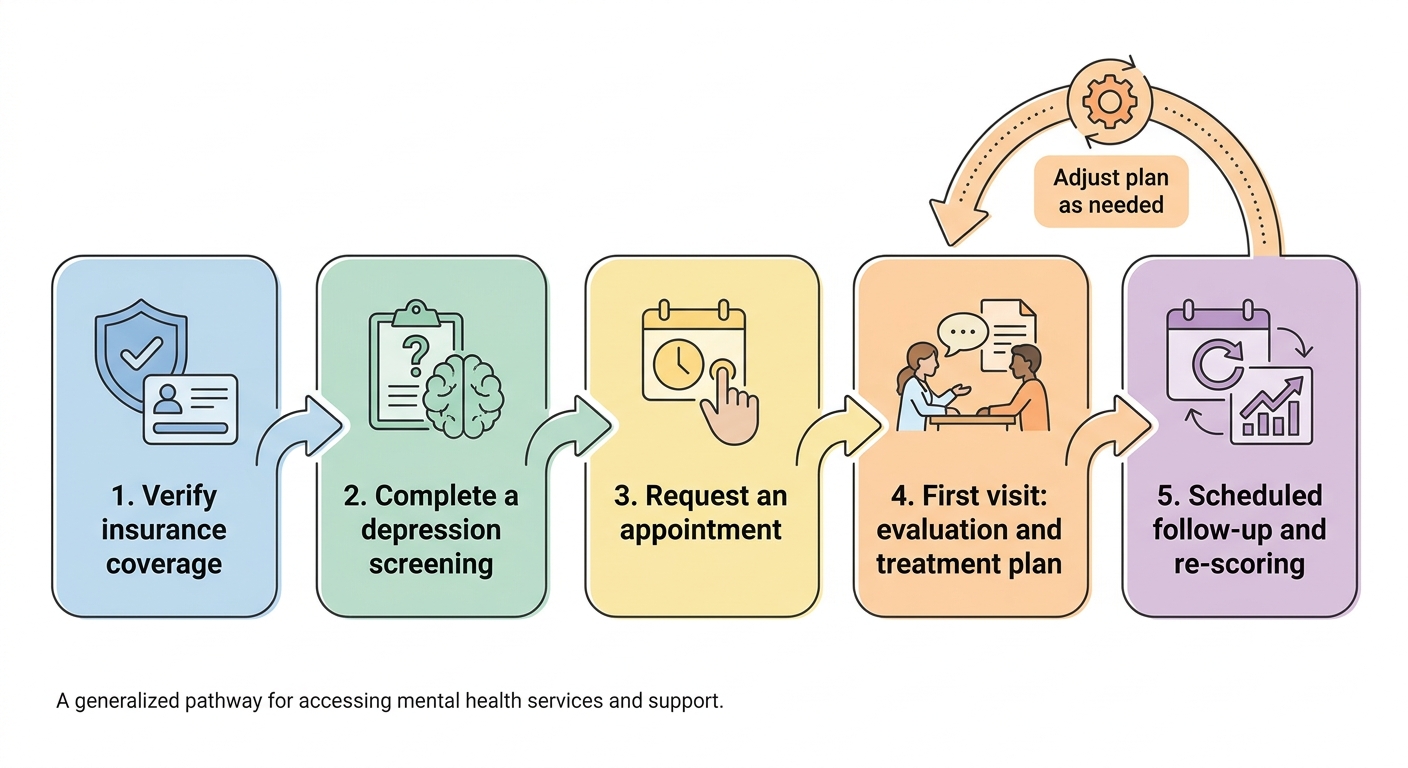
The path from "I should probably do something about this" to a treatment plan looks like this:
What are the practical steps?
- Check coverage first. Confirm your plan is in network before you book — review our accepted insurance partners to see where you stand.
- Complete a screening. A PHQ-9 score gives your first visit a concrete starting point.
- Request an appointment. Note whether you want in-person or telehealth.
- Prepare for the first visit. Bring your medication list, past treatment history, and any family mental health history. Our companion guide on what happens during a psychiatric evaluation walks through the appointment itself.
- Keep the follow-up. The second visit is where the plan gets adjusted — it is not optional.
Where can you get in-person depression care in the Treasure Valley?
In-person appointments are available in Boise, Eagle, Meridian, Nampa, and Emmett, with telepsychiatry available for patients elsewhere in Idaho. You can see details for Boise mental health services or the Meridian location depending on which is closer.
If you're searching for depression care near you and aren't ready to contact a clinic yet, two neutral national resources exist: the 988 Suicide & Crisis Lifeline, available by call or text 24/7, and the treatment locator maintained by the Substance Abuse and Mental Health Services Administration (SAMHSA, as of November 2026).
How Can You Support Someone Living With Depression?
Be specific, low-pressure, and consistent. "I'm driving to Meridian Thursday at 2 — want me to take you to your appointment?" lands better than "let me know if you need anything," because depression makes initiating anything harder.
What helps, and what doesn't?
- Helps: Offering a concrete ride, meal, or errand. Sitting with them without needing conversation. Asking directly how treatment is going. Helping with insurance calls and scheduling, which are genuinely draining tasks.
- Doesn't help: "Just think positive." Comparing their situation to someone worse off. Framing exercise or diet as a replacement for treatment. Taking withdrawal personally.
Watch for warning signs: giving away possessions, talking about being a burden, a sudden calm after a long stretch of distress, withdrawing from everyone at once, or any direct or indirect mention of not wanting to be here. Ask about it plainly. Asking does not plant the idea, and a direct question is often a relief for the person being asked.
If someone is in immediate danger, call 911. If you are worried but it isn't an emergency, call or text 988 — the Suicide & Crisis Lifeline supports friends and family members, not just the person in crisis.
Key takeaway: Specific, repeated, practical help does more than encouragement — and asking directly about suicidal thoughts is a safe thing to do.
Frequently Asked Questions
How long does depression treatment take?
It depends on the approach and the person. Structured therapies such as CBT and IPT are usually described as time-limited courses of weekly sessions, while antidepressant trials are typically reassessed several weeks after starting rather than judged immediately. NIMH describes treatment as typically involving psychotherapy, medication, or both, with other options considered when those don't reduce symptoms sufficiently (NIMH, as of November 2026). Expect the plan to be reviewed and adjusted at follow-up visits rather than finished in one appointment.
What if the first depression treatment doesn't work?
That is common enough that clinicians plan for it. The usual next steps are to confirm the diagnosis, check whether the trial was long enough and at an adequate dose, look for untreated medical or co-occurring conditions, and then adjust — switch medications, add therapy, or discuss augmentation. If you've had adequate trials without a satisfactory response, that is the point where advanced options such as TMS are typically discussed in a consultation.
Will I have to take antidepressants forever?
Not necessarily. Duration is an individual decision made with your prescriber, and it depends on factors such as how many episodes you've had and how well symptoms have resolved. What matters most is that the question gets discussed deliberately — including a relapse-prevention plan — rather than being settled by quietly stopping. Never stop an antidepressant abruptly; tapering should be planned with your provider.
Does insurance cover depression therapy and medication management?
Coverage varies by plan, and specifics such as copays, visit limits, and prior authorization differ between insurers. The practical move is to confirm network status before you book rather than after your first visit. You can review our accepted insurance partners to see where your plan stands, and bring any questions about authorization — especially for advanced treatments — to the scheduling conversation.
Can I get depression care by telehealth in Idaho?
Yes. Telepsychiatry is available for patients across Idaho, which matters in rural counties where the nearest in-person clinic may be a long drive. Many people use telehealth for medication management follow-ups and in-person visits when they prefer them. In-person appointments are available in Boise, Eagle, Meridian, Nampa, and Emmett.
Is depression therapy or medication better for mild depression?
For milder depression, therapy alone and medication alone are both reasonable starting points, and preference and access often decide it. For moderate to severe or recurrent depression, combining the two is commonly recommended. The more useful framing is sequencing — where you start, and when you add the second piece — rather than treating it as a permanent either/or choice.
What should I bring to my first depression appointment?
Bring a current medication list (including supplements), a summary of past treatments and how they went, any relevant family mental health history, and your insurance card. A completed PHQ-9 score is also genuinely useful, because it gives your provider a baseline number to compare against at follow-up. Our guide on what happens during a psychiatric evaluation covers the visit itself in more detail.
Key Takeaways
Depression treatment works best when it's treated as a process rather than a single decision. A few things worth carrying forward:
- There is no single cause, so a good evaluation covers medical history, life circumstances, and family history.
- Multiple depression therapy options have guideline support — CBT, behavioral activation, IPT, MBCT, and DBT each suit different situations.
- Antidepressants need an adequate dose and duration before anyone can judge them, and side effects should be reported rather than solved by quitting.
- Medication vs therapy is really a sequencing question, and most plans are revisited at the first follow-up.
- Advanced options such as TMS, esketamine, and ECT are specialist treatments considered after inadequate response to earlier trials.
- Comprehensive depression care means measurement and follow-up, not a prescription handed over once.
If you're ready to start, the sequence is simple: check your accepted insurance partners, take the PHQ-9 depression self-assessment, and then request a consultation. If you're in crisis, call or text 988 now.
This article is for general information and is not a substitute for individualized medical advice. Treatment decisions and outcomes vary between individuals and should be made with a qualified provider.