How ADHD Evaluations Work, Step by Step
Integrity Mental Health Editorial ·

Getting evaluated for ADHD can feel mysterious — people often picture a brain scan, a timed computer test, or a single yes-or-no verdict. In reality, ADHD testing is a structured conversation backed by standardized rating scales and a careful review of your history. Here's exactly what the process involves, how long it takes, what it costs, and how to start one in Idaho.
Quick Answer
An ADHD evaluation is a structured clinical assessment in which a licensed provider reviews your symptom history, collects standardized rating scales, gathers information from people who know you, and rules out conditions that mimic ADHD before applying diagnostic criteria from the DSM-5-TR (American Psychiatric Association, 2022). It commonly takes one to three hours of clinician time, sometimes split across two visits. No blood test or brain scan diagnoses ADHD on its own.
TL;DR
- There is no single ADHD test. Diagnosis is clinical, built from interview, rating scales, and outside input. See which ADHD tests are actually used
- The criteria are specific: symptom counts differ for children and adults, and several symptoms must trace back to before age 12. Read the DSM-5-TR criteria breakdown
- Adults can be diagnosed without childhood paperwork. A parent or sibling interview often fills the gap. Walk through the adult assessment step by step
- Cost depends on the path you choose — a covered office visit bills very differently than hourly neuropsychological testing. Compare the billing paths and codes
- Telehealth evaluations are legitimate when the clinician is licensed where you are physically located. Compare online and in-person options
In This Article
- What Is an ADHD Evaluation, Exactly?
- What Types of ADHD Tests Are Actually Used?
- How Do Clinicians Actually Diagnose ADHD?
- What Does an Adult ADHD Assessment Look Like, Start to Finish?
- What Questions Will They Ask During an ADHD Evaluation?
- How Long Does an ADHD Evaluation Take?
- What Does ADHD Testing Cost?
- Is an Online ADHD Evaluation as Good as an In-Person One?
- How Do You Get Evaluated for ADHD in Idaho?
- What Happens After the Diagnosis?
- Frequently Asked Questions
What Is an ADHD Evaluation, Exactly?
An ADHD evaluation is a multi-source clinical assessment, not a quiz. A licensed provider — a psychiatrist, psychiatric nurse practitioner, or psychologist — gathers information from several directions and compares the whole picture against published diagnostic criteria.
It rests on three pillars:
- Clinical interview — a detailed conversation about your symptoms, childhood, daily functioning, medical history, and mental health history.
- Standardized rating scales — validated questionnaires such as the ASRS-v1.1 (the World Health Organization's Adult ADHD Self-Report Scale), the Conners 4, or the Vanderbilt Assessment Scale commonly used with school-age children.
- Collateral information — input from someone who sees you regularly.
A collateral informant is a person who knows you well — a parent, partner, sibling, or teacher — and can describe patterns you may not notice in yourself. Their input matters because ADHD symptoms show up differently from the inside than they look from the outside.
This whole process usually sits inside a broader psychiatric intake. If you want the wider view of that appointment, read what happens during a psychiatric evaluation.
Key takeaway: A credible ADHD assessment draws on at least three sources — your account, a standardized scale, and someone else's observation.
What Types of ADHD Tests Are Actually Used?
Four broad categories of ADHD testing exist, and most people only need the first two. Rating scales and clinical interviews carry the diagnostic weight; computerized tasks and full neuropsychological batteries are add-ons used when the picture is complicated.
| Test type | Example instrument | Typically used for | What it shows |
|---|---|---|---|
| Self-report rating scale | ASRS-v1.1 (WHO) | Adults | Flags symptom likelihood; screening only, not a diagnosis |
| Observer / collateral scale | Vanderbilt, Conners 4 | Children and teens, with parent and teacher input | How symptoms appear across home and school settings |
| Executive function inventory | BRIEF-2 | Children, teens, adults | Patterns in planning, working memory, and emotional control |
| Continuous performance test | TOVA, QbTest | Optional add-on | Computer-measured attention and impulsivity; supporting data |
| Full neuropsychological battery | Multiple combined tests | Complex cases, suspected learning disorder | Broader cognitive and learning profile |
A continuous performance test is a computer task that measures how consistently you respond to repeated stimuli over time. Clinicians generally treat the results as supporting information alongside the interview, not as a standalone verdict.
⚠️ Be cautious with "brain scan" marketing. QEEG, SPECT imaging, and similar scans are sometimes advertised as ADHD tests. Diagnosis under the DSM-5-TR is based on clinical history and observed functioning, not imaging findings. If a provider offers a scan as the deciding test, ask what clinical criteria they are applying.
Before any formal testing, it helps to organize your own symptoms. Our free self-assessments are a useful starting point for putting language to what you're experiencing.
How Do Clinicians Actually Diagnose ADHD?
Clinicians diagnose ADHD by matching your history against the criteria published in the DSM-5-TR (American Psychiatric Association, 2022). The manual lists nine inattentive symptoms and nine hyperactive-impulsive symptoms.
The criteria work like this:
- Symptom count — six or more symptoms in a category for children up to age 16; five or more for people age 17 and older.
- Early onset — several symptoms present before age 12.
- Multiple settings — symptoms appear in two or more environments, such as home, school, work, or relationships.
- Clear impairment — the symptoms interfere with functioning, not just cause mild annoyance.
- Not better explained — another condition doesn't account for the pattern.
Those criteria produce three recognized presentations.
Predominantly inattentive presentation: Enough inattentive symptoms are met, but not the hyperactive-impulsive threshold. This is the presentation most often missed in adults and in quiet students.
Predominantly hyperactive-impulsive presentation: The hyperactive-impulsive threshold is met without enough inattentive symptoms.
Combined presentation refers to meeting the required symptom thresholds in both the inattentive and the hyperactive-impulsive categories at the same time.
The "two settings" rule is the one people trip over. Struggling only at a job you hate isn't the same as a lifelong pattern that follows you across jobs, school, home, and friendships.
Key takeaway: A diagnosis rests on a durable, cross-setting pattern that started in childhood — not on how distracted you felt this month.
What Gets Ruled Out Before an ADHD Diagnosis?
Several conditions produce attention problems that look nearly identical to ADHD, and a good evaluation checks for them before landing on a diagnosis. Common look-alikes include anxiety, depression, trauma-related conditions, sleep disorders such as untreated sleep apnea, thyroid dysfunction, anemia, substance use, and specific learning disorders.
This step is called differential diagnosis, and it protects you. Treating sleep-driven inattention as ADHD, for example, leaves the actual cause in place.
Your provider may order basic labs. Those labs are not ADHD tests — they exist to rule other explanations in or out.
⚠️ ADHD also frequently occurs alongside other conditions rather than instead of them. Finding anxiety doesn't automatically rule out ADHD, and a thorough assessment accounts for both.
What Does an Adult ADHD Assessment Look Like, Start to Finish?
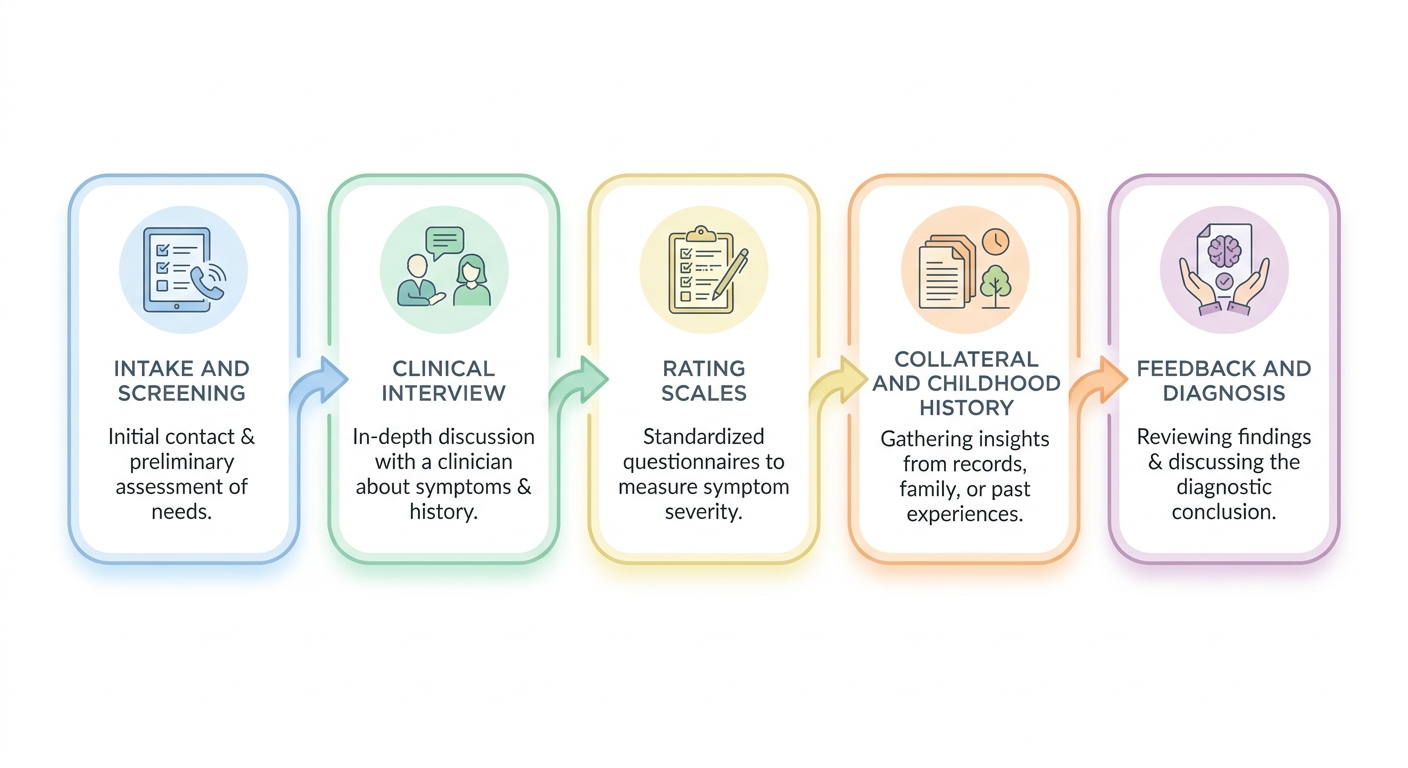
An adult ADHD assessment generally moves through five stages, often spread across one or two appointments.
- Intake and screening — a short call or online form covering your main concerns, insurance, and scheduling. Usually brief.
- Clinical interview — the longest stage. Expect roughly an hour of detailed questions about symptoms, development, medical history, mood, sleep, and substance use.
- Rating scales — self-report questionnaires completed before or during the visit, often in about 20 minutes.
- Collateral and childhood history — report cards, old evaluations, or a conversation with a parent, sibling, or partner.
- Feedback and diagnosis — the provider explains what the criteria do and don't support, and outlines next steps.
What if you can't find childhood records?
Missing report cards do not disqualify you. The DSM-5-TR requires that symptoms were present before age 12 — not that someone documented them at the time.
Useful substitutes include:
- A conversation with a parent, older sibling, or longtime family friend
- Old school progress reports or standardized test comments, if any survive
- Early work performance reviews noting deadlines, organization, or focus
- Military service records or training evaluations
- Your own specific memories tied to grades, teachers, or recurring feedback
Write those recollections down before the appointment. Specific examples carry more weight than general impressions.
In Idaho and Utah, evaluations are performed by licensed prescribers and counselors as part of our psychiatry services, which means a diagnosis and a treatment conversation can happen within the same practice.
What Questions Will They Ask During an ADHD Evaluation?
Expect questions across six life domains. Drafting answers in advance makes the interview faster and more accurate — memory under pressure is unreliable, and you'll likely be asked for examples.
Childhood and school
- Were you ever told you talked too much or couldn't sit still in class?
- Did teachers describe you as bright but careless, or "not working to potential"?
Work and money
- How often do you have trouble wrapping up the final details of a project? (ASRS-v1.1 item 1)
- Do bills, renewals, or paperwork pile up past their deadlines?
Relationships
- Do people close to you say you interrupt, tune out, or forget what they told you?
Organization and time
- How do you handle tasks that require sequencing and planning?
- Do you lose track of time, keys, phones, or wallets regularly?
Emotional regulation
- Does criticism or perceived rejection hit harder or last longer than it seems like it should?
- How quickly do frustration and irritability come and go?
Sleep and substances
- What does a typical night of sleep look like?
- How much caffeine, nicotine, alcohol, or cannabis is in a normal week?

How Long Does an ADHD Evaluation Take?
Most straightforward evaluations involve one to three hours of clinician time, often split across two visits, with results delivered the same day or within a couple of weeks. Full neuropsychological testing takes considerably longer.
| Path | Clinician time | Visits | Results |
|---|---|---|---|
| Child or teen | Interview plus parent and teacher scales | Usually 2 | Often after scales are returned |
| Adult, straightforward | ~1–2 hours | 1–2 | Frequently same-day |
| Adult with co-occurring conditions | ~2–3 hours | 2+ | Typically after follow-up |
| Full neuropsychological testing | Multiple hours of testing | 2–3 | Written report, usually weeks later |
Timelines vary by practice and by how complicated your history is. In practice, the longest delay is often scheduling rather than the evaluation itself, which is why it's worth asking about new-patient availability when you first call a Boise clinic location or any other office near you.
What Does ADHD Testing Cost?
Cost depends almost entirely on which path you take. A clinical evaluation billed as an office visit works very differently from hourly psychological testing.
| Path | How it's typically billed | Codes you may see | What to ask upfront |
|---|---|---|---|
| Insurance-covered clinical evaluation | Specialist office visit — copay plus any deductible | 90791 (diagnostic interview) | Is the provider in network? Is a referral required? |
| Self-pay clinical evaluation | Flat fee per visit | 90791 | What's the total for the evaluation and any follow-up? |
| Neuropsychological testing | Hourly, across several hours | 96130, 96136 | How many hours are estimated, and at what rate? |
Hourly testing rates are published by some clinics. For example, a Dallas-based assessment practice lists ADHD testing at $300 per hour on its assessments services page, as of November 2026. Rates differ by region and provider, so treat any single figure as one data point rather than a benchmark.
Two practical steps before you book:
- Verify coverage directly. Call the number on your insurance card and ask about behavioral health benefits, in-network status, and whether testing codes require prior authorization. You can also check the insurance partners we work with.
- Request a good-faith estimate if you're self-paying. Federal law gives uninsured and self-pay patients the right to an itemized estimate before scheduled care. Review your No Surprises Act protections so you know what to ask for.
⚠️ Prices and coverage rules change. Confirm costs with both your provider and your plan before your appointment rather than relying on any published range.
Is an Online ADHD Evaluation as Good as an In-Person One?
A telehealth evaluation performed by a licensed clinician, using the same interview structure and the same validated rating scales, is a clinically recognized way to assess ADHD. It isn't the right fit for everyone, though — especially when learning disorders or complex medical questions are in play.
| Online / telehealth | In-person clinic | Full neuropsych testing | |
|---|---|---|---|
| Typical cost | Office-visit level | Office-visit level | Highest; billed hourly |
| Scheduling | Often the fastest | Varies by location | Usually the longest wait |
| Best suited to | Adults with a clear, straightforward history | Children, teens, anyone wanting in-room observation | Suspected learning disorder or complex cognitive questions |
| In-room observation | Limited to what the camera shows | Full | Full |
| Cognitive testing | Not performed in person | Limited | Extensive |
Two things matter regardless of format. First, state licensure: your clinician must be licensed where you are physically located at the time of the appointment — Idaho or Utah, in our case. Second, prescribing rules: ADHD stimulant medications are federally controlled substances, and the rules governing when they can be prescribed via telehealth have shifted in recent years. Ask any provider directly how they handle prescribing before you book.
Key takeaway: Format matters less than rigor. Ask what instruments are used, whether collateral input is collected, and what gets ruled out.
How Do You Get Evaluated for ADHD in Idaho?
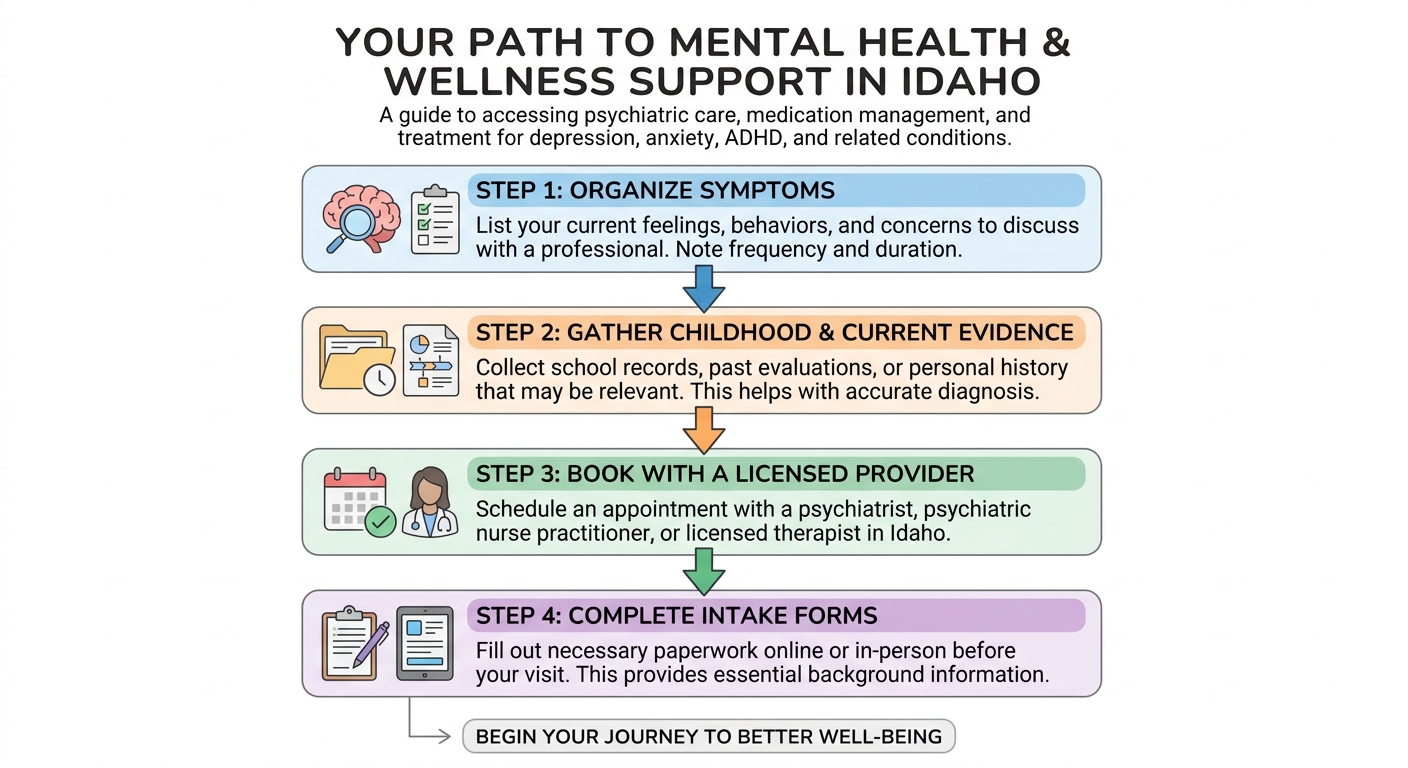
Four steps take you from "I wonder" to a scheduled appointment.
- Organize your symptoms. Start with our free self-assessments to put structure around what you've noticed. A screener is not a diagnosis, but it gives your provider a head start.
- Gather evidence. Collect childhood recollections, old records if you have them, and a short list of concrete examples from work, school, and home.
- Book with a licensed psychiatric provider near you. We see patients across Boise, Meridian, Eagle, Nampa, Emmett, Coeur d'Alene, and Rexburg, with telehealth available across Idaho and Utah.
- Complete intake forms early. Finishing paperwork before the visit leaves more of your appointment for the actual conversation.
When searching for an ADHD evaluation near you, ask three screening questions on the phone: Are you accepting new patients? Do you evaluate adults, children, or both? Do you take my insurance?
Key takeaway: The fastest route to an evaluation is a provider licensed in your state who is currently accepting new patients — availability, not credentials, is usually the bottleneck.
What Happens After the Diagnosis?
A diagnosis is the beginning of a treatment plan, not the end of the process. Care for ADHD generally combines three components, adjusted to the person.
- Skills and behavioral strategies — externalized systems for time, task initiation, and organization.
- Therapy — approaches that address the habits and emotional patterns built up around years of untreated symptoms, including any co-occurring anxiety or depression.
- Medication management — stimulant and non-stimulant options, discussed with a prescriber, with ongoing monitoring of response and side effects. Results vary between individuals, and suitability is decided in a clinical consultation.
Students and employees may also pursue formal accommodations — a 504 plan in a school setting, or ADA workplace accommodations such as modified deadlines or a quieter workspace.
Some practices also use pharmacogenetic testing, which examines how your genetics may affect the way you metabolize certain medications, as one input into prescribing decisions. You can read how that fits into our patient care model.
Frequently Asked Questions
Can an online quiz diagnose ADHD?
No. Screeners such as the ASRS-v1.1 estimate the likelihood that symptoms are consistent with ADHD, but only a licensed clinician can confirm a diagnosis using DSM-5-TR criteria and a differential workup. Use a quiz to decide whether to book an appointment, not to decide what you have. Our free self-assessments are built for exactly that purpose.
Can adults be diagnosed with ADHD if it was missed in childhood?
Yes. The DSM-5-TR requires that several symptoms were present before age 12, but it does not require a childhood diagnosis or documentation from that era. Retrospective history, specific memories, and collateral reports from a parent or sibling are accepted sources. Many adults are first identified after a child in the family is evaluated.
Do I need a referral for an ADHD evaluation?
Often not. Many PPO plans allow you to self-refer to a behavioral health specialist, while some HMO and Medicaid plans require a primary-care referral or prior authorization first. Call the number on your insurance card and ask specifically about behavioral health referral requirements, then confirm with the insurance partners we work with.
Does ADHD show up on a brain scan or blood test?
No. ADHD is diagnosed clinically, based on history and functioning across settings — not on imaging or lab values. Blood work is sometimes ordered to rule out other explanations for inattention and fatigue, such as thyroid dysfunction or anemia. Be skeptical of any service marketing a scan as the deciding diagnostic test.
How accurate is an ADHD diagnosis?
Accuracy depends on thoroughness. Evaluations that combine a structured clinical interview, validated rating scales, collateral input, and a deliberate differential diagnosis are generally considered more reliable than a single brief visit. If an assessment skips collateral information or never discusses look-alike conditions, it's reasonable to ask why.
Summary
ADHD testing is less mysterious than it sounds: a structured interview, validated rating scales, outside perspective, and a careful check for conditions that mimic inattention, all measured against DSM-5-TR criteria. Most evaluations take one to three hours of clinician time across one or two visits. Cost hinges on whether you pursue a clinical evaluation or full neuropsychological testing, so verify coverage and request a good-faith estimate before you book.
If the pattern has followed you across school, work, and home for as long as you can remember, that's worth bringing to a licensed provider — and requesting an evaluation is a short conversation away.
Information about third-party platforms reflects publicly available details at the time of writing and may have changed. Please verify directly with the provider. See our Terms of Use for more.